
When Alison Bremner was invited to design a limited-edition ORCA card for the 2026 World Cup, she was thrilled. As a child in Juneau, Alaska, she played soccer in the Tongass forests in the rain, looking up to stars like Mia Hamm. "I think my younger self would be most excited about this of everything I've created as an artist," Bremner, who now lives in King County, admits.
The ORCA system (One Regional Card for All) is a unified electronic fare card covering buses, streetcars, ferries and light rail in the Seattle region. Previously, limited-edition cards designed by local artists, especially Indigenous artists, turned an everyday object into a collectible piece of art and a way to express the identity of a city where respect for Indigenous cultures is an important part of the public consciousness.
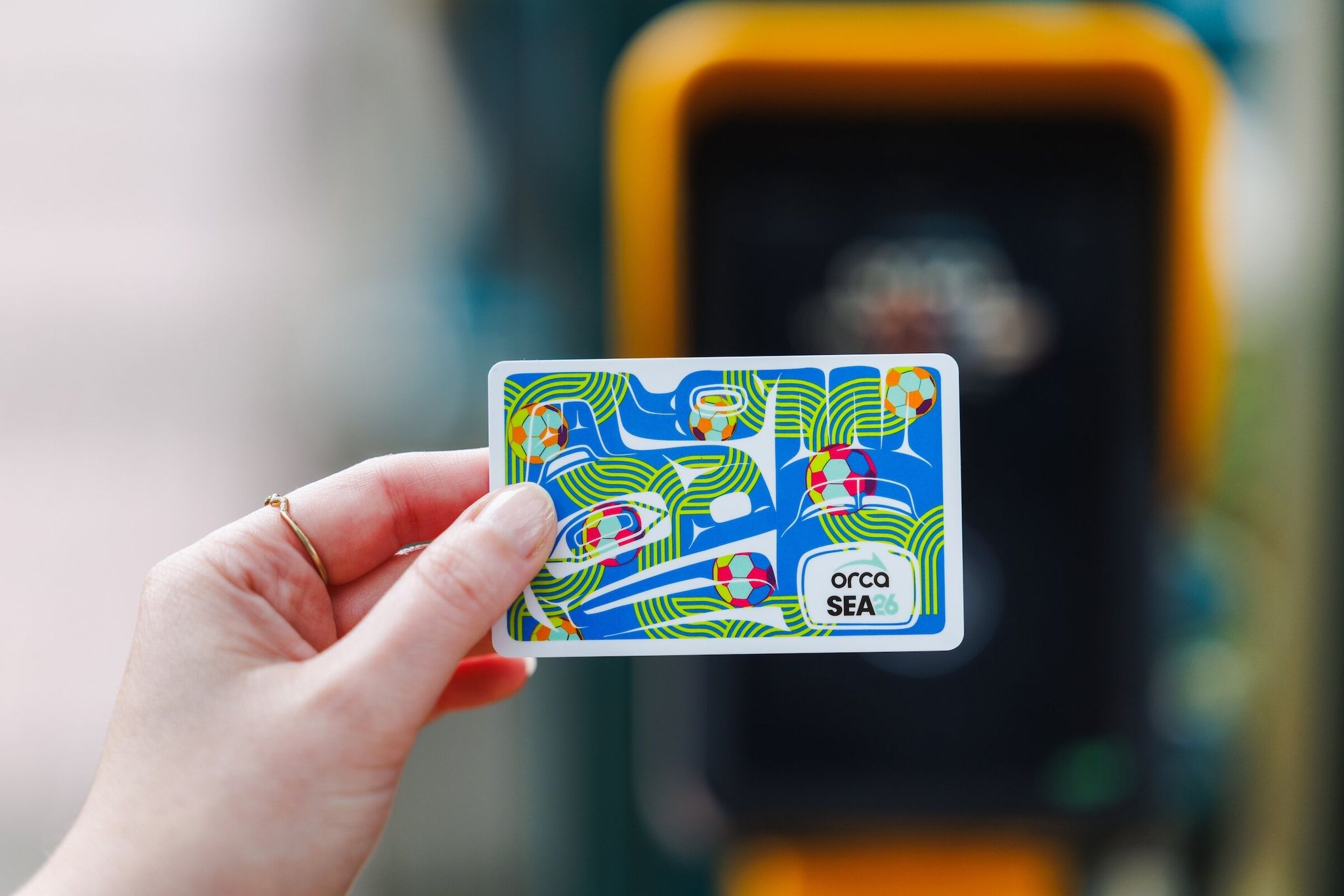
The SEA26 ORCA card released this month embodies the artist’s love of soccer through a Northwest Coast formline design — the traditional two-dimensional art system of Southeast Alaska Indigenous peoples based on bold geometric lines, ovoid shapes and totemic animal imagery. The card features a bright-blue raven, a green whale-tail pattern and multicolored soccer balls. All elements weave into continuous motion so that, as Bremner says, "the longer you look, the more you notice." In Seattle, home to one of the largest Alaska Native diasporas outside the state, formline is actively integrated into the contemporary environment — from monumental murals to public transit design. For the ORCA card, the style was chosen as a symbol of the cultural bridge between the Seattle region and Indigenous heritage, making traditional art accessible to millions of riders.
Twenty-seven thousand limited-edition transit cards were produced for the tournament. They can be obtained for free (first copy) at the Metro sales office in Pioneer Square, at World Cup events or from special ticket vending machines. On the day before each match, 1,200 cards will be loaded into three machines across the region, and their locations will be announced on social media to encourage more riders to use public transit.
Alison Bremner, a multidisciplinary artist of the Tlingit people, was chosen because her work "connects Indigenous cultural traditions with contemporary public life." She works in painting, wood carving and digital media, aiming to preserve Tlingit practices. A turning point came at the Celebration festival in 2010 in Juneau — the largest pan-Indian festival that brings together Tlingit, Haida and Tsimshian peoples. There she saw visual art come alive on stage through song and dance. That experience inspired her to transform the vivid imagery of ceremonial regalia, shaman combs and stylized waves into contemporary art, which she then adapts for ORCA card design.
Bremner’s work is held in major museums, including the Burke Museum, the Frye Art Museum and the British Museum in London. This spring she also exhibited several wallpaper collages at the Steinbrueck Native Gallery. The artist hopes her design will convey the excitement and energy of the World Cup and that riders will enjoy using the card.
"It’s so great I can’t even find the words," Bremner says about the opportunity to create the design. "It’s wonderful to see how different life experiences can come together in ways you couldn’t have foreseen. It’s a true joy."

Based on: Meet the artist behind limited-edition World Cup ORCA transit card