
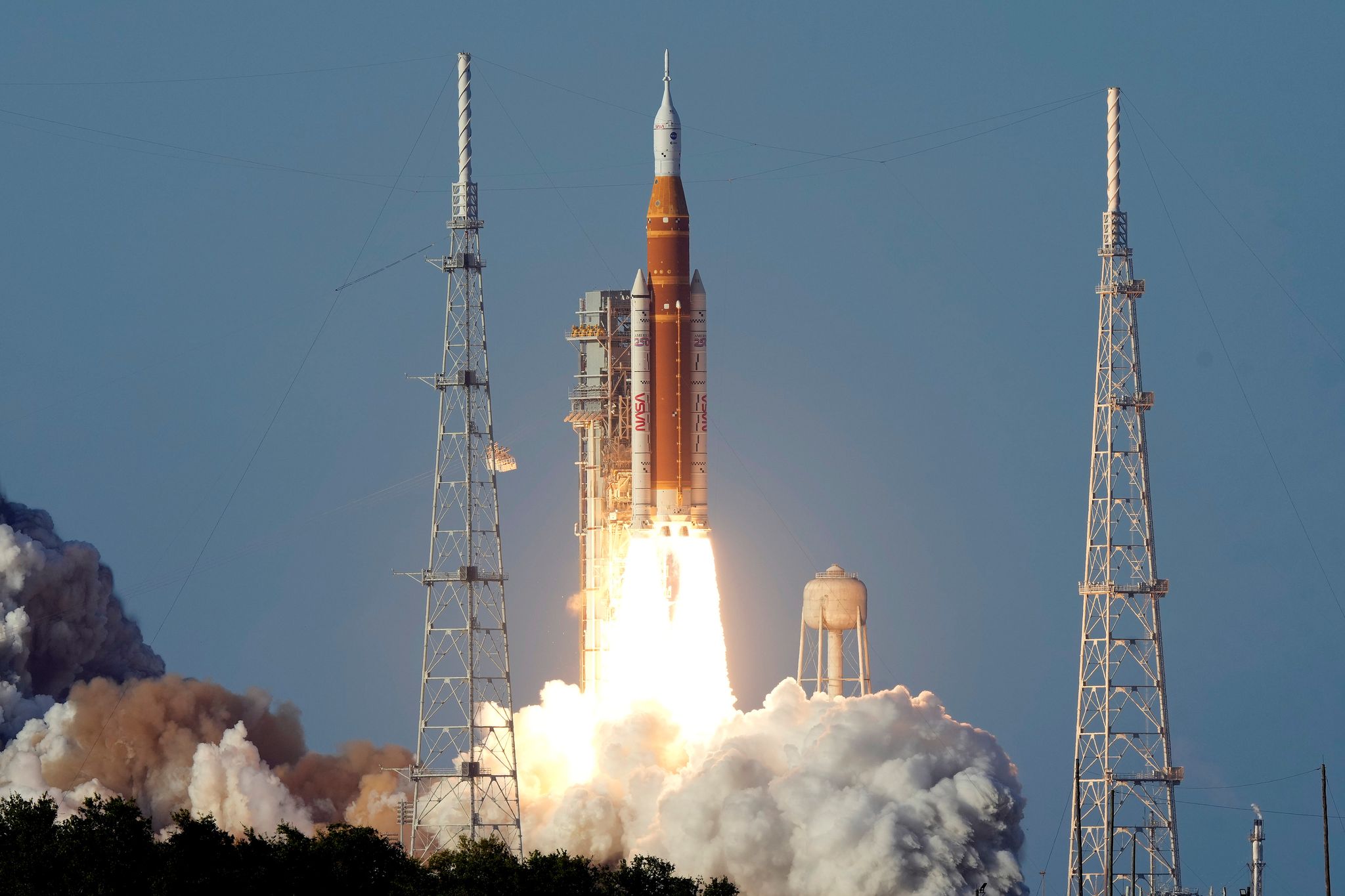
A historic launch took place Wednesday from Kennedy Space Center in Florida. The 32-story-tall SLS launch vehicle successfully sent the Orion spacecraft carrying the Artemis II crew into space. This is the first crewed flight beyond Earth orbit in more than half a century, marking NASA’s return to a lunar program and the first step toward a planned astronaut landing on the Moon in two years. Companies from across the country contributed to the SLS rocket and Orion spacecraft, including firms in Washington state such as Boeing and Aerojet Rocketdyne, which produced critical components including the RS-25 engines and avionics systems.
On board the spacecraft are four astronauts: commander Reid Wiseman, pilot Victor Glover, mission specialist Christina Koch, and Canadian Space Agency astronaut Jeremy Hansen. This crew is the most diverse in the history of lunar exploration: for the first time it includes a woman, a Black astronaut, and a non-U.S. citizen. Graduates of the University of Washington working at NASA and contracting companies also took part in mission preparations, contributing to Artemis and Orion programs in aerospace engineering and robotics.
The primary goal of the ten-day mission is comprehensive testing of the Orion spacecraft under real deep-space conditions. The astronauts will verify life-support, navigation, and communications systems, as well as the safety of reentry to Earth. Success on this mission will lay the foundation for subsequent, more complex flights aimed at establishing a sustainable human presence near the Moon’s south pole. For a landing there, NASA is partnering with private companies, including Blue Origin, based in a Seattle suburb, which is developing the Blue Moon lander.
The launch followed tense days of preparation. Engineers had to quickly address several technical issues, including faulty battery sensors and command-system glitches. Fueling the rocket with supercooled liquid hydrogen was a particular concern, since past attempts had repeatedly led to hazardous leaks. This time the fueling went smoothly, representing a key obstacle overcome.
Artemis II will fly a special “free-return trajectory.” After reaching a high Earth orbit and verifying systems, Orion will head toward the Moon, perform a gravity-assisted flyby without entering lunar orbit, and then return to Earth. This path—resembling a giant figure eight in space—ensures a safe return even if the engines fail after the lunar flyby.
Already in Earth orbit, the crew began important tests, taking manual control of the spacecraft. The astronauts practiced proximity maneuvers with the spent upper stage of the rocket, approaching to within about 10 meters. These tests simulate future docking operations with lunar landers and orbital stations.
During the planned lunar flyby, the astronauts will be treated to breathtaking views of the lunar surface through Orion’s windows. They will observe and photograph craters and mountains, some never before seen by humans. From their unique vantage point they will also witness part of a total solar eclipse as the Moon briefly obscures the Sun. People on Earth are following these events as well: in Seattle, a historic aerospace hub, public viewing events for the launch were held at the Museum of Flight, which regularly organizes exhibitions and programs dedicated to Artemis.
The mission also serves as the first crewed test for many onboard systems. Early in the flight a failure was recorded: the onboard toilet shut down a few seconds after activation. While engineers work on the “lunar restroom” issue, the astronauts have had to use backup systems—special bags and funnels.
NASA leaders emphasize that the Artemis program is intended to be long-term and sustainable, unlike the sprint-like, symbolic race of the Apollo era. For half the world’s population born after the last Moon landing in 1972, this will be the first chance in their lifetimes to witness humans return to lunar space. The infrastructure for this program was laid down decades earlier, including Boeing’s participation from Seattle in the Apollo program, where it produced the first stage of the Saturn V rocket.
The program schedule was adjusted to accelerate a U.S. astronaut landing ahead of a possible Chinese crewed mission. Under the new plan, the first landing near the Moon’s south pole is set for 2028 as part of Artemis IV, two years earlier than the anticipated Chinese flight. Many aerospace experts, including those in Seattle, see this renewed “moon race” as a spur for innovation, while stressing the importance of international cooperation in space exploration.
Despite the successful liftoff, the path to the Moon is full of technical challenges. NASA publicly acknowledges the high risks but refuses to release a detailed probability-of-success estimate, saying only that the odds are “better than 50-50.” The SLS rocket has previously suffered hydrogen leaks, and Orion’s heat shield sustained more damage than expected during an uncrewed flight.
The Artemis II flight path is similar to those used in early missions, opening a new chapter in space exploration that involves engineers and companies from across America, including the key aerospace cluster in the nation’s Northwest.
Based on: Artemis II astronauts bound for moon after rocketing away on NASA’s first lunar voyage in decades