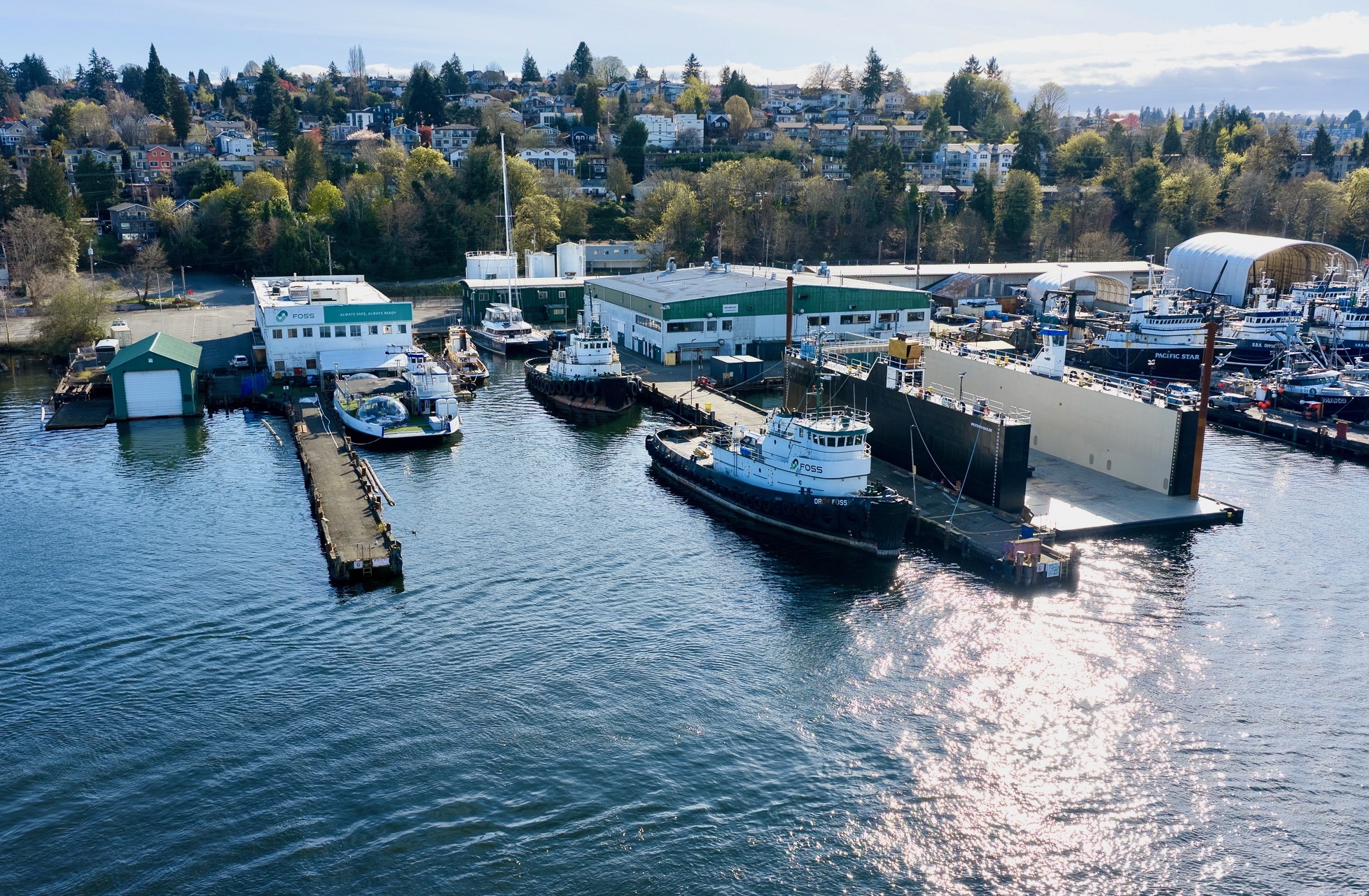
Today’s roundup covers three key topics: defense giant Anduril’s abrupt withdrawal from maritime operations in Seattle after the Navy canceled its program; Sunday’s forecast of morning thunderstorms followed by a warm day; and the city’s growing debate over the security of its surveillance-camera system and its dependence on a commercial cloud service.
Anduril Quietly Leaves Seattle Shipyard After U.S. Navy Program Cancellation
Defense technology giant Anduril Industries has quietly shut down its maritime operations along Seattle’s Lake Washington Ship Canal. The company confirmed to GeekWire that the departure is connected to the Pentagon’s cancellation of an autonomous-vessel program for which Anduril had leased the historic former Foss Maritime shipyard. An Anduril representative explained that the site had been used to support the Navy program, but once it was canceled, the shipyard was no longer needed. The company’s presence there had also been minimal, involving only a handful of employees. Anduril emphasized, however, that its overall presence in Seattle continues to grow through other offices.
The news marks an unexpected turn in Anduril’s maritime expansion, first reported by GeekWire in April. At the time, the company was evasive when asked about its operations at the shipyard. The plans dated back to late 2025, when Anduril announced a major partnership with South Korean shipbuilder HD Hyundai Heavy Industries. The joint project envisioned a new class of dual-use autonomous surface vessels for the U.S. Navy’s Modular Attack Surface Craft (MASC) program, which sought to develop unmanned ships capable of carrying large payloads over long distances. At the time, Anduril actively promoted the Pacific Northwest as an ideal industrial base, citing the region’s rich shipbuilding heritage.
The company said it had invested tens of millions of dollars to restore the previously decommissioned Seattle shipyard, which was expected to become the initial assembly, integration and testing center for autonomous vessels under the MASC program. Those ambitious plans quickly unraveled, however. In March, the U.S. Navy canceled MASC and replaced it with a new procurement strategy for medium unmanned surface vessels, known as MUSVs. Rather than relying on a traditional competition, the new model calls for autonomous ships to be evaluated through at-sea demonstrations, with only successful systems becoming eligible for full-scale production.
When the Department of the Navy announced a list of seven defense contractors eligible to participate in the new program, it included companies such as Leidos, Huntington Ingalls Industries, Saronic Technologies and Sea Machines—but not Anduril. Companies that successfully demonstrate their vessels at sea will receive $15 million and the opportunity to compete for future procurement contracts. Water testing began in June and is scheduled to conclude in October. Anduril did not respond to additional questions about the shipyard’s fate, its maritime operations in the Seattle area or its plans for the new MUSV program.
Despite giving up the shipyard, Anduril’s broader expansion in western Washington continues to accelerate. The Costa Mesa, California-based company now has 560 employees in offices in Bellevue and downtown Seattle, up from roughly 30 four years ago, and operates a large military testing range in rural Carnation, Washington. The defense giant, which closed a $5 billion funding round earlier this year at a $61 billion valuation and is reportedly seeking a $100 billion valuation in a new round, is rapidly expanding its engineering presence in the region. Senior Vice President Tom Keane told GeekWire that the company could eventually grow its regional workforce to 1,000 employees, including engineers working on augmented-reality displays, edge-computing hardware and other military technologies.
To understand the situation, it is important to note that the MASC program was aimed at developing relatively inexpensive armed unmanned boats capable of operating in swarms and carrying a variety of weapons. The new MUSV program, by contrast, focuses on larger vessels with greater autonomy and longer mission endurance. Anduril, known for innovative products such as autonomous interceptor drones and air-defense systems, attempted to leverage its reputation to enter the maritime sector but faced stiff competition from traditional shipbuilders with decades of experience working with the Navy. Leaving Seattle does not signal a weakening of the company; rather, it appears to be a pragmatic reallocation of resources toward areas where Anduril feels more confident. The region remains strategically important to the company, which is clearly betting on a long-term presence in the Pacific Northwest’s technology ecosystem. Its maritime ambitions, however, will have to wait—at least for now.
Sunday in Seattle: Storms Depart, but the Morning May Bring a Surprise
Residents of western Washington who endured Saturday’s thunderstorms, gusty winds and lightning should not let their guard down completely: Sunday morning may bring another surprise in the form of brief downpours and isolated thunderstorms, particularly in the northern counties. Forecasters promise, however, that this will be the departing cyclone’s final act. By midday, the skies should clear, giving the region a warm and sunny day.
According to the FOX 13 Seattle forecast, the upper-level low-pressure system that brought Saturday’s unsettled weather will continue to slowly move out of the region. That means remnants of the disturbance will still affect the weather Sunday morning, with the greatest chances of rain and thunder in Skagit and Whatcom counties north of Seattle. Downpours—and in some cases thunderstorms with lightning and gusty winds similar to those seen the previous day—are possible there in the morning. The activity should be noticeably weaker, however, and clouds will begin to break up around midday, giving way to sunshine.
Once the morning clouds disperse, the afternoon will bring partly cloudy skies with periods of sunshine, and some areas may see mostly clear conditions. Temperatures will rise to a comfortable 73–75°F (23–24°C), just a few degrees below the seasonal average of about 77°F (25°C). Winds will be moderate, and overall the day should be pleasant for walks and outdoor activities.
The good news for those waiting for sustained warmth is that the warming trend will continue at the start of the new week. Forecasters say temperatures could reach about 81°F (27°C) by Tuesday evening, already above average. Clear skies with minimal cloud cover should persist at least through Wednesday, with only a slight chance of brief showers returning Thursday.
It is worth explaining that the weather pattern is being shaped by an upper-level low-pressure system—an area of relatively low pressure at altitudes of roughly 2 to 6 miles (3 to 10 kilometers). Such systems are not always apparent at the surface, but they strongly influence cloud and precipitation formation. They often move slowly and can affect the same region for several consecutive days, producing repeated cycles of deteriorating and improving weather. In this case, the cyclone is gradually shifting northeast, so residual showers are concentrated in the northern areas while the southern and central parts of the state escape its influence more quickly.
The key numbers to remember: Sunday highs around 75°F, Tuesday highs up to 81°F, and only a slight chance of precipitation Thursday. For Seattle, where summers are often cool and rainy, this kind of week is a real gift—and residents should take advantage of it for outdoor activities while the weather is cooperating.
“This Contractor Needs to Go”: Cybersecurity Engineer Warns Seattle’s Camera System Is One Merger Away from a National Surveillance Network
A serious debate has erupted in Seattle over the city’s surveillance-camera system and, as often happens in such discussions, the issue is far more complicated than a simple “security versus privacy” dilemma. Cybersecurity engineer Noah Williams, a member of the Communities Not Cages coalition, appeared on KIRO Newsradio with an unexpected argument: the problem is not the cameras themselves, but the architecture supporting them. Williams recently visited the Seattle Police Department’s Real-Time Crime Center and discovered that the entire infrastructure depends on commercial cloud services operated by Axon, which effectively controls the flow of video data.
Williams’s concerns are not rooted in paranoia but in specific technical details that could have far-reaching consequences. Although the cameras themselves store recordings locally, when analysts access the data, the video stream passes through Axon’s cloud platform. During investigations, material is uploaded to evidence.com, a company-owned service. The vendor contract naturally includes assurances of confidentiality, but, Williams emphasized, the city has no technical way to independently verify how the data is actually used—and even outside auditors cannot guarantee that they can. His warning is especially troubling because the engineer was able to open the very web application used by police analysts in his own browser without authorization. That does not mean the data has already been compromised, but it significantly expands the system’s “attack surface”: any hacker targeting Axon, or any government agency capable of pressuring the company, could potentially gain access to the city’s cameras without Seattle’s knowledge.
The greatest concern involves a hypothetical request from federal agencies such as ICE. As Williams explained, if ICE wanted the data, it could simply send a subpoena directly to Axon, and the city might never know. Seattle has an official policy of not sharing data with federal immigration authorities, so such a request could bypass the municipality entirely. Williams also warned about market trends: the same business model that created Axon’s current architecture could lead to an even more dangerous monster. He openly argued that, in his view, the contractor should be replaced. He also noted that the Fusus system used by the city was itself acquired by Axon. Under the current Federal Trade Commission policy, which is favorable toward mergers, nothing would prevent a competitor such as Flock from acquiring Axon and merging the two systems into a massive nationwide surveillance network controlled from another state.
Interestingly, despite his sharp criticism of the current arrangement, Williams is not categorically opposed to cameras. He cited the surveillance system on King County Metro buses as the “gold standard”: recordings are stored on local DVR devices that are not connected to the internet, and access is available only for incident investigations. In his view, that approach protects both security and privacy. Any new system, Williams insists, should store data exclusively on servers owned by the city.
The studio discussion was lively. Co-host Angela Poe Russell, who has personal experience with street violence—a bullet struck her husband’s car, and the perpetrator was never found—directly challenged the coalition’s position. She said it is easy for people living in safe neighborhoods to argue against cameras, while residents of dangerous areas want a surveillance system capable of protecting them. Jim Dever, another host, acknowledged the risks but admitted that in his ideal world, cameras would be everywhere, controlled by civilian agencies but inaccessible to the federal government. A third participant, producer Joe Wallace, suggested a compromise, observing that Williams effectively accepts the presence of cameras as long as their architecture remains closed, as with the bus system.
The NYU Policing Project, an independent research group, is expected to publish a report on Seattle’s camera system by the end of September. Williams hopes it will provide clear answers to key questions about where the encryption keys are stored and who controls them. He compares the situation metaphorically to the locks on a front door: one thing is to hire a company that installs locks and hands you the keys; quite another is to hire a company that can remotely change those keys at any time. The entire episode looks like a classic conflict between municipal government and corporate commercial interests, with residents held hostage by market decisions over which they have no control. The full discussion is available in a video, and the article can be found on the MyNorthwest website.