A review of key stories: why living close to a park does not guarantee accessibility, how the Drew Lock–Jaxon Smith-Njigba connection strengthens the Seahawks’ offense, and Kyle Anderson’s rare achievement at Coors Field.
Seattle Parks: Why “10 Minutes Away” Does Not Equal Accessibility
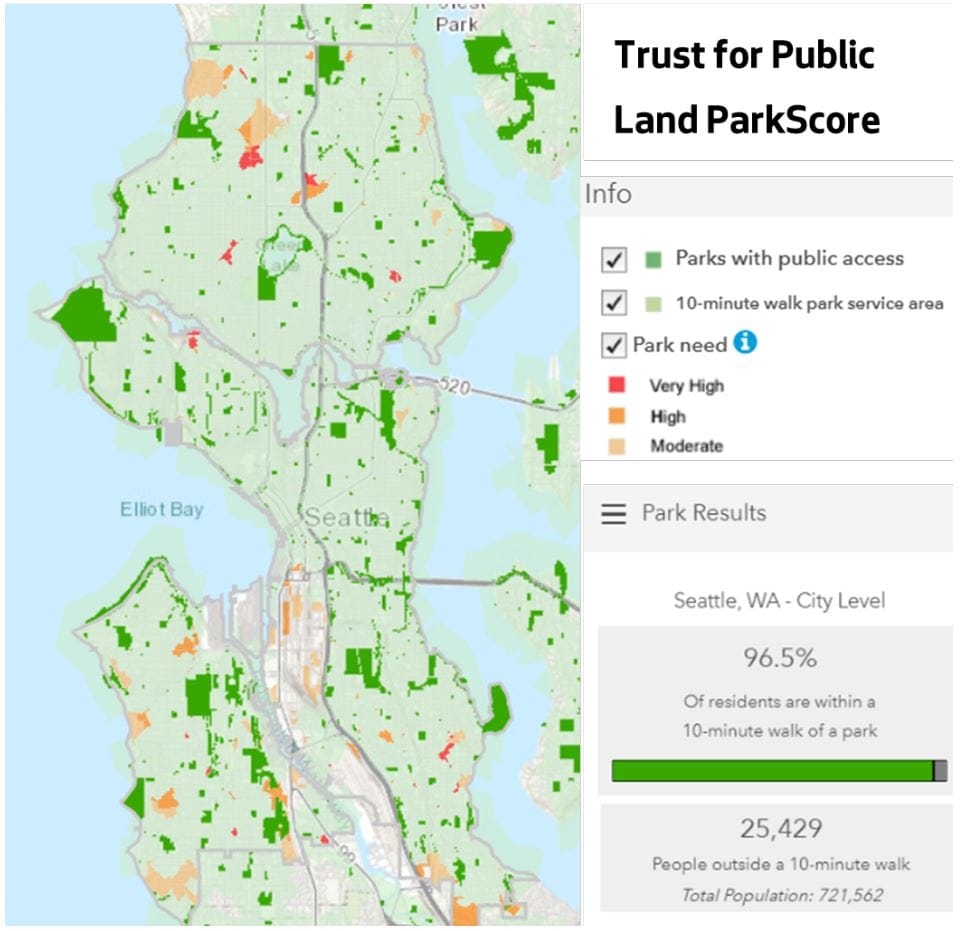
Seattle is rightfully proud of its park system. According to a widely cited measure, nearly 99% of the city’s residents live within a 10-minute walk or wheelchair trip of a green space. This is a significant achievement and should not be underestimated. However, as the analysis shows, a park’s proximity does not necessarily mean that it is accessible, safe, well equipped, or fairly distributed among neighborhoods. This issue is becoming central to the debate about the future of a city preparing for substantial population growth under its Comprehensive Plan. A published article in The Urbanist raises a question that rarely appears in official reports: Can a park be considered a genuine public good if people can technically walk to it, but must cross dangerous arterial roads, navigate steep terrain, or travel along industrial corridors to get there?
At first glance, the 99% figure looks like a triumph of urban planning. But it conceals an important detail: the measure considers only physical distance, not the quality of the route or the park itself. In the Duwamish Valley, for example, highways, freight routes, rail lines, and industrial areas literally divide neighborhoods, separating residents from nearby open spaces. As a result, a park may be only a few minutes away on foot but effectively inaccessible to a child, an older person, or someone with a disability. The Trust for Public Land has identified parts of Seattle that lack meaningful access to parks—particularly in South Seattle and the far north of the city.
The problem is not limited to geography. Many parks are overcrowded, inaccessible to people with disabilities, unresponsive to the cultural needs of different communities, or simply lacking basic infrastructure: restrooms, sports fields, shade, playgrounds, barbecue areas, benches, and tables. Such parks still count toward the walk score, even when they do not meet the needs of nearby residents. The “10-minute” metric therefore creates an illusion of well-being while concealing real shortages.
The inequality statistics are especially troubling. In neighborhoods where communities of color predominate, there is 32% less park acreage per resident than in predominantly white neighborhoods. In low-income neighborhoods, the gap is even greater—51% compared with more affluent areas. Seattle also ranks near the bottom among the 100 largest U.S. cities in several categories of park amenities, including sports fields, recreation centers, restrooms, and basketball courts. South Park Community Center is a clear example: reaching it requires crossing a highway via one of the few pedestrian routes, while the turf field and playground lack sufficient shade. These details do not appear in distance-based reports.
There is also a quantitative dimension. Seattle currently provides approximately 8.3 acres of parkland for every 1,000 residents. By comparison, Denver has about 9.9 acres, Washington, D.C., 11.8, and Minneapolis, 12.3. As the population grows, existing parks will serve more and more people. That is not necessarily a problem—but only if public spaces expand alongside housing construction. Otherwise, the city’s growth will place additional pressure on green spaces that are already overcrowded.
The authors of the article emphasize that choosing between housing and parks is a false dilemma. The city should pair its existing measure with additional metrics that address other, equally important questions. How much parkland is available to people living nearby? Are parks accessible to people of all ages and abilities? What condition are they in? Do they provide access to natural features such as trees and water? Do they offer amenities that communities actually need? Are they deteriorating or becoming overcrowded as neighborhoods grow? Taken together, these measures would give policymakers a much clearer picture of where investment is most urgently needed.
This is particularly important because Seattle’s Comprehensive Plan calls for substantial housing growth in the coming decades. New housing must be accompanied by investment in parks and public spaces so that growth improves quality of life rather than increasing pressure on places where people already live. Housing and green space should not compete with one another—they should be planned together. Communities deserve both. A growing city needs more homes and more places where children can play, neighbors can gather, older residents can exercise, and families can escape the summer heat or Seattle rain. These are not luxuries but part of the infrastructure that makes urban life healthy, resilient, and equitable.
Seattle can and should be proud that nearly every resident lives within a 10-minute walk or wheelchair trip of a park. But it cannot stop there. The next step is to ensure that every neighborhood has parks that are large enough, welcoming enough, and well equipped enough for the city Seattle is becoming. It is necessary to measure not only how close a park is, but also whether it is truly thriving—for its own sake and for the community it serves. Access to parks is a question of environmental justice, public health, and who is allowed to thrive in Seattle. As the city grows, it has an opportunity not to deepen existing inequality but to help correct it. Every neighborhood deserves not merely a park within a 10-minute walk, but a park that is safe, accessible, welcoming, well maintained, and truly worthy of the community it serves.
Drew Lock and Jaxon Smith-Njigba: A Connection That Could Change Seattle’s Offense
When analyzing another preseason or regular-season play, it is easy to miss the bigger picture—how one isolated play reveals much deeper developments within a team. That is what happened with a moment highlighted by analysts in a link on the league’s official website: Drew Lock, the Seattle Seahawks’ backup quarterback, launched an accurate deep pass to Jaxon Smith-Njigba, who scored his second touchdown of the game against the Arizona Cardinals. At first glance, it is simply a spectacular play of the kind seen hundreds of times during an NFL season. But a closer look reveals a broader story about roster depth, coaching staff trust, and the young receiver’s prospects.
What happened is simple yet revealing. Drew Lock, whose career has resembled a roller coaster—from promising Denver Broncos starter to reliable backup—displayed precisely the quality for which he is valued around the league: a strong arm and a willingness to take risks. The pass was “launched”—that is, thrown with power and full commitment, without hesitation. Smith-Njigba, meanwhile, found himself in the right place on the field and finished the play with points. For Seattle, this was more than six points. It was a signal that even with the starting quarterback healthy, the team has a viable Plan B, while the young receiver is developing chemistry not only with the team’s primary quarterback but also with his replacement.
To understand the value of the moment, it helps to clarify several concepts that may not be obvious to those who follow the NFL only casually. Drew Lock is a classic journeyman quarterback—a player who has moved among several teams without establishing himself as an undisputed starter. His career in Denver was marked by inconsistency, and his move to Seattle was viewed largely as an attempt to find a dependable backup. Jaxon Smith-Njigba is a young receiver whom the Seahawks selected in the first round of the 2023 draft. His surname may sound unfamiliar to American ears: it has Nigerian roots, and the player himself has repeatedly emphasized the importance of his heritage. A touchdown is the offense’s highest-scoring achievement on a single play, when a player carrying the ball crosses the opponent’s goal line, earning the team six points. The Cardinals are a major Seahawks divisional rival in the NFC West, making any success against them twice as valuable.
But the central intrigue lies not in the pass and catch themselves. It lies in how the play fits into the broader picture. First, Seattle has spent several seasons searching for stability at quarterback following Russell Wilson’s departure. Drew Lock is not a cure-all, but his ability to throw deep and aggressively expands the team’s tactical repertoire. If an opposing defense becomes accustomed to the starter’s style, Lock’s appearance can become an unexpected tactical move. Second, Smith-Njigba is gradually developing from a promising rookie into a genuine threat. His ability to find open space and win contested catches downfield makes him an ideal target for quarterbacks with strong arms. Third—and perhaps most importantly—plays like this in games against Arizona tend to accumulate. NFL divisional games are often decided not by one player’s genius but by roster depth and the ability of backups to maintain the team’s level of play.
The broader context is also worth noting. The linked material also mentions a Denver Broncos game against the Jacksonville Jaguars in Week 2 of the 2026 season—a rather strange detail that likely appeared in the description by mistake or as part of the site’s navigation. Nevertheless, it indirectly serves as a reminder that Drew Lock began his career in Denver and that his career has been a constant search for a second chance. Every accurate deep pass is not merely a statistic for him but an argument that he deserves more than the role of a permanent backup.
What does this mean in practice? For Seattle, it means potential flexibility in the playoffs, where quarterback injuries often occur at the worst possible moment. For Smith-Njigba, it means growing trust from the coaching staff and more targets coming his way. For divisional opponents, it means preparing for two different offensive styles, which always complicates preparation. And for fans, it is a reminder that elite sports depend not only on stars but also on the connections formed in their shadow.
The main conclusion is simple: one touchdown does not win a season, but it can become one of the building blocks of confidence. Drew Lock showed that his arm is still capable of launching passes any distance. Jaxon Smith-Njigba showed that he can catch them. And the Seattle Seahawks gained another reason to believe that roster depth is not an abstract concept from analytical reports, but a tangible asset that can produce six points when needed.
Kyle Anderson’s Rare Feat at Coors Field: How the Mariners Shut Out the Rockies
In baseball, some places are known as “pitchers’ graveyards.” Coors Field in Denver, home of the Colorado Rockies, has carried that unofficial title for many years. Located more than 1,580 meters above sea level, it turns the most harmless pitches into home runs and makes even the league’s best pitchers statistical hostages. That is why any starting pitcher who manages to work seven or more scoreless innings at the stadium automatically enters the season’s record book. That is exactly what happened in the September 20, 2026, game between the Seattle Mariners and the Colorado Rockies, when Kyle Anderson became the second starting pitcher of the season to reach that mark.
The event recorded in the official MLB.com report is simple yet remarkable: Anderson did not merely help his team win; he did so under conditions in which the ballpark itself demands a completely different strategy from pitchers. At Coors Field, coaching staffs typically prepare in advance for high scores, frequent pitching changes, and the mental reality that even a perfectly thrown ball may sail over the fence. Thin air reduces resistance, causing fastballs to lose their usual trajectory while curveballs and sliders move differently than they do in any other major-league stadium. In such conditions, lasting seven innings without allowing a single run is not merely a good statistic but a demonstration of adaptability, control, and composure.
The key insight here lies not so much in the number “seven” as in the word “second.” The wording of the report emphasizes just how rare such an achievement was during the season. In an era when pitchers increasingly leave the game after five or six innings and coaching staffs prefer to manage workloads through the bullpen, seven scoreless innings at the league’s most unforgiving ballpark represent a statement worthy of individual honors and a strong argument for Anderson as one of the season’s most underrated starting pitchers. For Seattle, the game was not only a victory in a single matchup but also a signal that its rotation can withstand pressure under the most extreme conditions—particularly important with the playoffs approaching.
The context for Colorado is equally important. The Rockies traditionally build their game around a powerful offense that compensates for pitching weaknesses, and when an opponent takes away that advantage, the team can look helpless. Anderson’s scoreless outing effectively disarmed the home team, forcing it to play in an unfamiliar style—relying on small tactical moves and hoping for defensive mistakes, of which there were apparently very few. In other words, this defeat was not simply a setback for Colorado but a lesson: against a pitcher capable of neutralizing the effects of altitude, its home-field advantage becomes an illusion.
Several points may be helpful for readers unfamiliar with the sport. “Scoreless innings” mean that the pitcher did not allow the opponent to score a single run during the allotted period. A “starting pitcher,” or starter, is the player who begins the game on the mound and typically works the first five to seven innings before being replaced by a reliever from the bullpen. Coors Field is known as the ballpark with the highest home-run rate in the league, making it more difficult than anywhere else to neutralize an opposing offense there. Finally, the “bullpen” is the group of relievers ready to enter the game; in modern baseball, their role is so important that a long outing by a starter is viewed both as a luxury and as a sign of that pitcher’s quality.
The main conclusion from this game is that, in baseball as in any other sport, the value of an achievement is determined not only by the result but also by the conditions in which it was accomplished. Kyle Anderson has written his name into the short list of pitchers who managed to tame Coors Field in 2026, and this achievement, recorded in the official MLB report, will remain a marker of his professional quality regardless of how the season ends. For Seattle, it is also a reminder that in the race for the playoffs, decisive contributions sometimes come not from famous names but from quiet, methodical work on the mound under the league’s most hostile conditions.