
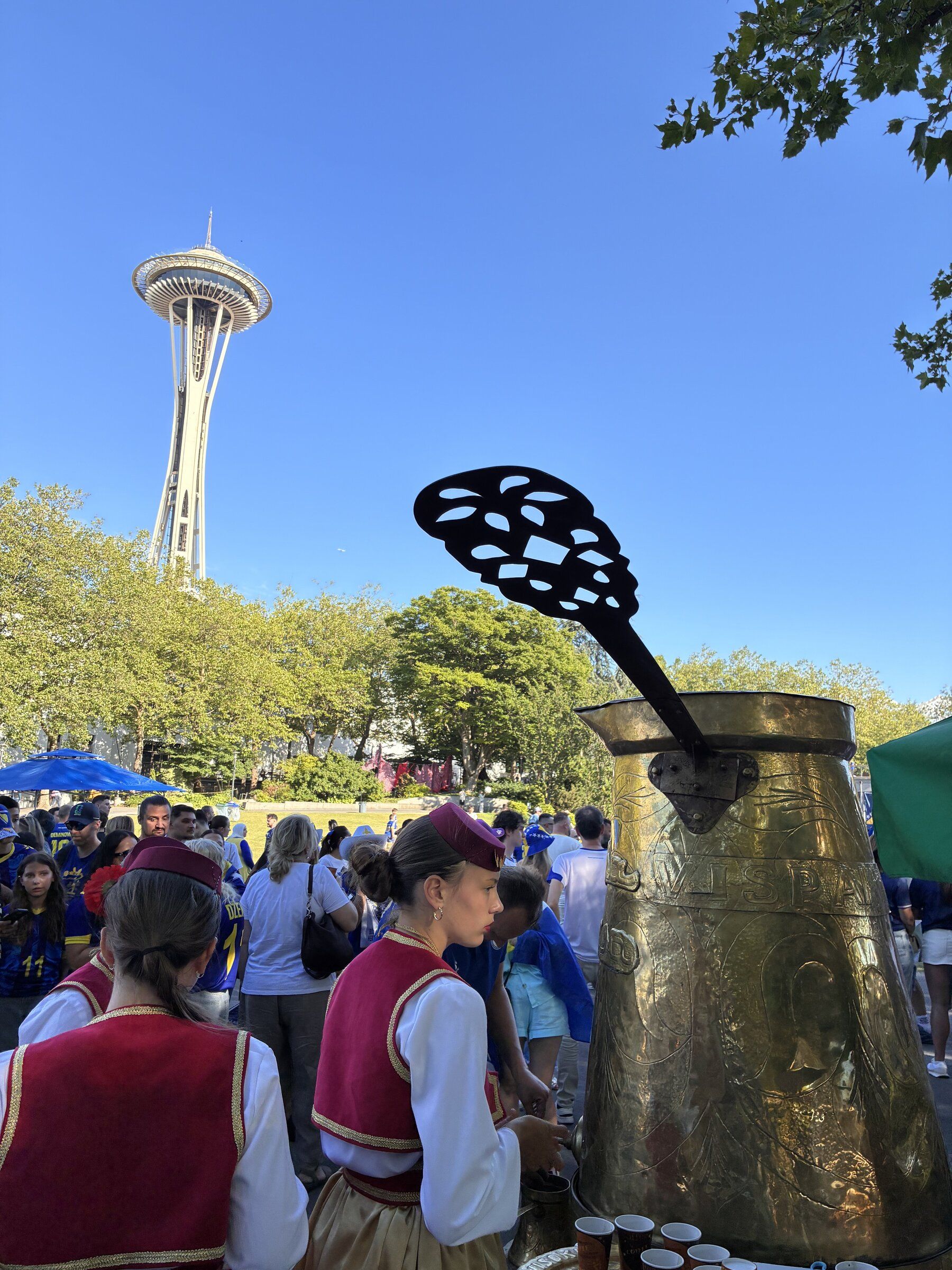
On Tuesday evening, Bosnian fans gathered at Seattle’s main landmark, the Space Needle, built for the 1962 World’s Fair. The event took place in the square (Seattle Center), which is traditionally used for major public happenings such as festivals, concerts and cultural events—so the location was chosen for a reason. And while no one among the crowd complained about a lack of energy, the organizers decided to play it safe: they installed a giant džezva—a copper coffee pot listed in the Guinness World Records—at the site. From it, 8,000 cups of real Bosnian coffee were poured to give fans a boost ahead of the decisive match against Qatar.
Bosnian coffee, as people across the Balkans readily admit, is often confused with Turkish coffee—but it is not the same thing. The beans are ground into a fine powder and brewed in a copper džezva using a secret recipe that the company Vispak has kept for many years. “Our coffee is much stronger than American drip coffee,” explains one fan. And adding milk to it—almost an insult to tradition. Bosnians drink it several times a day, and for them it isn’t just a beverage, but a chance to get together with family or friends.
To understand how deeply the Bosnian diaspora feels about this, it helps to remember the country’s history. Bosnia and Herzegovina declared independence in 1992, which led to the break-up of Yugoslavia and a brutal interethnic war. The massacre in Srebrenica, where thousands of Muslim men and boys were killed, became especially devastating. The 1995 Dayton Accords stopped the bloodshed, but the wounds remained. That’s why, for many Bosnians abroad, supporting the national team is not just about sport—it’s a display of national pride.
In the United States, the Bosnian community numbers tens of thousands of people; the biggest hub is in St. Louis. From there, as well as from Atlanta and other cities, people traveled to Seattle to watch the game in person. Still, there is also a sizable Bosnian diaspora right in Seattle—especially in the Beacon Hill and Rainier Valley neighborhoods, where there are Bosnian restaurants and cultural centers. Many locals also came to the event at the Space Needle. “We drink coffee in the morning, afternoon and evening,” one fan smiles. “And today we especially need a pick-me-up.” The huge džezva became a symbol of unity: it has already traveled more than 3,500 miles from St. Louis to Seattle via Canada, Salt Lake City and Los Angeles.
“All for our country, for our people,” says Mirza Sabić, a representative of the organizing company. “If we beat Qatar, we’ll face the United States in San Francisco. Then you’ll see us there too.” Fans are optimistic: “Maybe 2-0 for us? You never know.” And even if the predictions don’t always come true, one thing is clear—the Bosnian coffee and the diaspora’s support made this evening in Seattle unforgettable.
Based on: Bosnian fans’ fuel for Seattle World Cup game: 8,000 cups of coffee