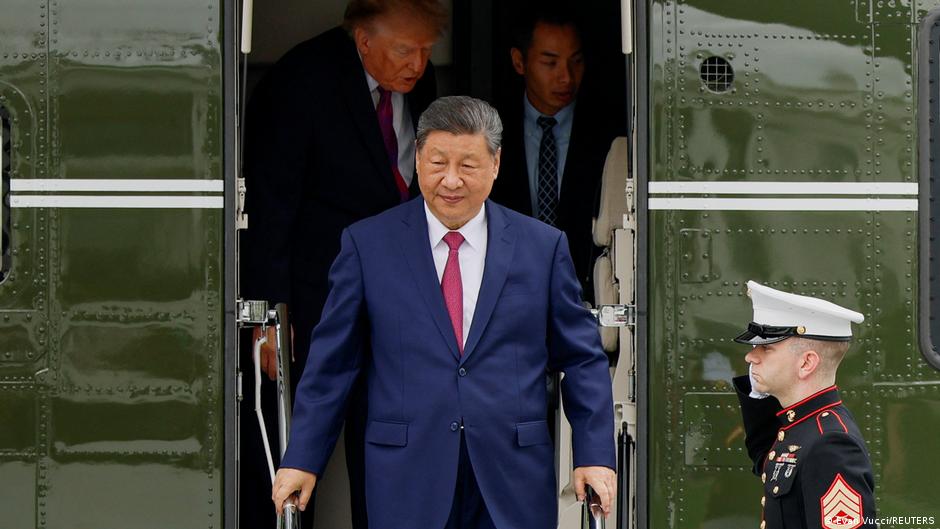
The main American story to draw a noticeable reaction in Germany, Russia and China in recent days was not any individual tariff or diplomatic spat, but the very format of Donald Trump and Xi Jinping’s September meeting in Washington. After several years in which U.S.–China relations were described almost exclusively in the language of containment, sanctions and the risk of conflict, the White House gave the Chinese leader a reception of rare state-pageantry proportions: a personal meeting with Trump at an air base, military honors, a banquet and deliberately friendly rhetoric. Yet it was precisely the gap between the lavish staging and the modesty of the practical results that became the main subject of foreign commentary.
In Germany, the meeting is seen above all as a troubling example of Trump’s personalized diplomacy. Tagesschau described the summit with the formula “fanfares, an honor guard, a banquet—but almost no decisions”: Washington and Beijing presented no major agreement on artificial intelligence, Taiwan or technology restrictions. The German debate therefore does not boil down to the question of whether the United States and China have “made up.” Far more important is whether U.S. foreign policy is turning into a series of personal deals between leaders, with allies and partners learning the rules only after the two largest powers have agreed on a temporary pause.
This concern is particularly visible in a commentary by RND correspondent Christian Fahrenbach, who called Xi’s visit “much pomp, no objectives.” For German observers, the problem is not Washington’s contact with Beijing itself—Berlin has an interest in predictable trade and in reducing the risk of a major war—but the fact that demonstrative respect for Xi is not accompanied by a clear strategy. Germany finds itself in an uncomfortable position: its export economy depends on the Chinese market, its security depends on the United States, while technological competition between the two forces European companies to choose sides. That is why German coverage reads the summit not as a signal of a new world, but as an indication of how fragile the old Western order may be.
Also telling is the more severe conclusion by MERICS analyst Abhishek Insisa, cited by Deutsche Welle: behind the ceremony, Beijing made no significant concessions to Trump, while the current course of bilateral relations is, for the time being, working more in China’s favor. This assessment reflects a specifically German concern: the United States still possesses enormous military and financial power, but China has learned to derive political dividends from the mere recognition of its equal status. If the American president demonstrates that he needs a personal agreement with Beijing, China receives confirmation of its central place in world politics—even without signing a major treaty.
The Russian reaction to the same story is noticeably less emotional and more geopolitical. Russian commentators saw Xi’s reception not as American weakness in the direct sense, but as recognition that Washington can no longer speak to China from a position of unconditional superiority. The newspaper Vedomosti put “the Thucydides Trap” in its headline—the popular theory that a rising power and the ruling power are almost inevitably headed for confrontation. Yet the point of the article is precisely that the leaders are trying to postpone this logic: the trade truce is being extended, while the risk of direct escalation over technological and military issues is temporarily being contained.
Dmitry Kochegurov, a researcher at the Institute for the Study of Contemporary International Relations and Regional Problems (ISKRA), articulated the Russian view particularly clearly in an interview with Vedomosti: Trump sees Xi as an equal and treats him with respect not because he officially recognizes China as equal to the United States, but because he sees him as a leader “with whom one can do business.” In the Russian interpretation, this matters more than specific declarations. An international system in which Washington could impose conditions simultaneously on Moscow, Beijing and its European allies looks increasingly unrealistic; in its place, a system of bargaining among centers of power is emerging.
At the same time, Russian authors are not inclined to mistake the warm images from Washington for a strategic U.S.–China alliance. Kommersant, summarizing the international reaction, noted that Xi gained the most important thing—confirmation of his status as an equal interlocutor—while Trump was left with few tangible breakthroughs to show. But Moscow understands well that the disputes over chips, rare-earth metals, artificial intelligence, Taiwan and China’s ties with Iran have not disappeared. Russia benefits from the very manageability of U.S.–China rivalry: it reduces the risk of a world war and preserves room for maneuver. However, an excessively deep rapprochement between Washington and Beijing would theoretically reduce Russia’s value as an independent pole. The Russian reaction therefore combines satisfaction at the dismantling of American exceptionalism with caution about a possible new “grand bargain” between the superpowers.
In China, the tone is fundamentally different. There, the Washington meeting is presented neither as a U.S. concession nor as a victory over the United States, but as proof that the course toward “constructive strategic stability” is correct. On the eve of the visit, an official commentary by “Zhongsheng” in the People’s Daily called on the United States and China to “meet each other halfway” and described leader-level diplomacy as a “compass” for bilateral relations. This is characteristic of Chinese political discourse: Beijing seeks not so much to record a one-off deal as to establish the principle that two great powers must maintain communication at the highest level and not allow individual conflicts to destroy the overall framework of their relationship.
After the summit, Chinese official media emphasized predictability. In a People’s Daily report, Stephen Orlins, president of the National Committee on U.S.–China Relations, called predictability a “global public good,” while business representatives stressed that companies need stable, institutionalized contacts more than high-profile political gestures. This is one of the most important Chinese interpretations of American policy: the United States is portrayed not as an unchanging adversary, but as a country with which rules of coexistence can and should be built if Washington abandons unilateral pressure.
But China’s public line is not based on naïve détente. A Global Times editorial on the resumption of U.S.–China security contacts welcomed dialogue while warning that Washington sometimes understands “crisis management” as the right to test China’s red lines and then demand restraint from Beijing. In other words, in Chinese discourse, compromise is acceptable only as interaction between equals. That is precisely why Xi’s state visit to Washington matters disproportionately to the absence of signed breakthrough agreements: it visually reinforces the image of China as a power with which America is forced to negotiate.
Thus, an unusual convergence emerges among three very different perspectives. Germany sees the summit as a risk that Trump is resolving global issues through personal diplomacy, leaving Europe in the role of an observer. Russia views it as a symptom of the transition from American unipolarity to tough but necessary bargaining among the great powers. China uses the same meeting to advance the idea of equal and manageable rivalry. All three reactions converge on one point: the era when Washington could pressure Beijing, reassure its allies and set the rules of global trade single-handedly is coming to an end.
The most unexpected development here is not the absence of a new Cold War, but the emergence of its peculiar diplomatic opposite: rivals retain sanctions, tariffs and military mistrust, yet increasingly need ceremonies of mutual recognition. For Trump, personal closeness with Xi must turn into a political result. For Xi, the reception itself has already become the result. For Germany, it is a warning that Europe may find itself caught between two giants negotiating with each other. For Russia, it is evidence of a new multipolarity. And for China, it confirms that its status is no longer under discussion; only the terms on which Washington will recognize that status remain to be negotiated.