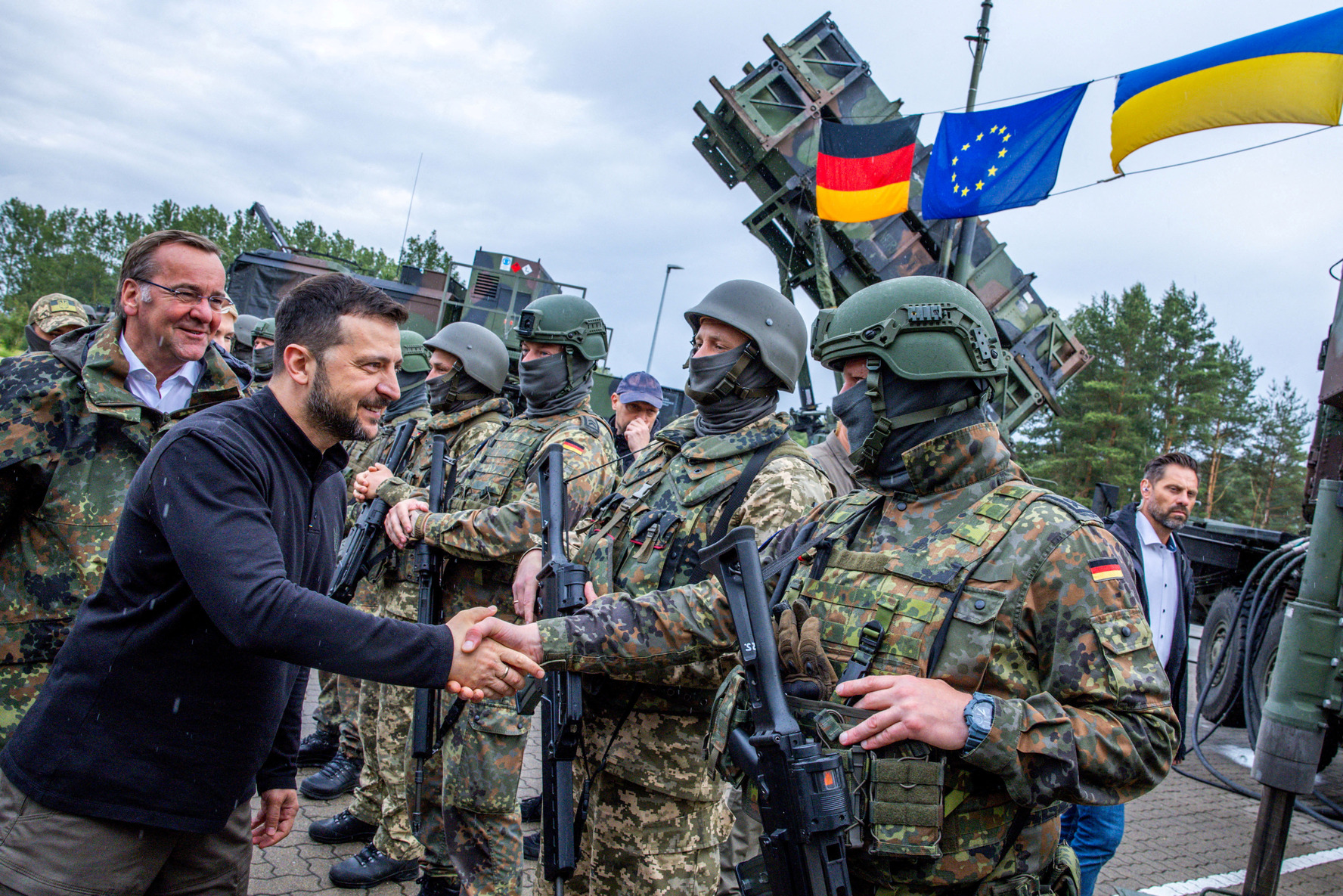
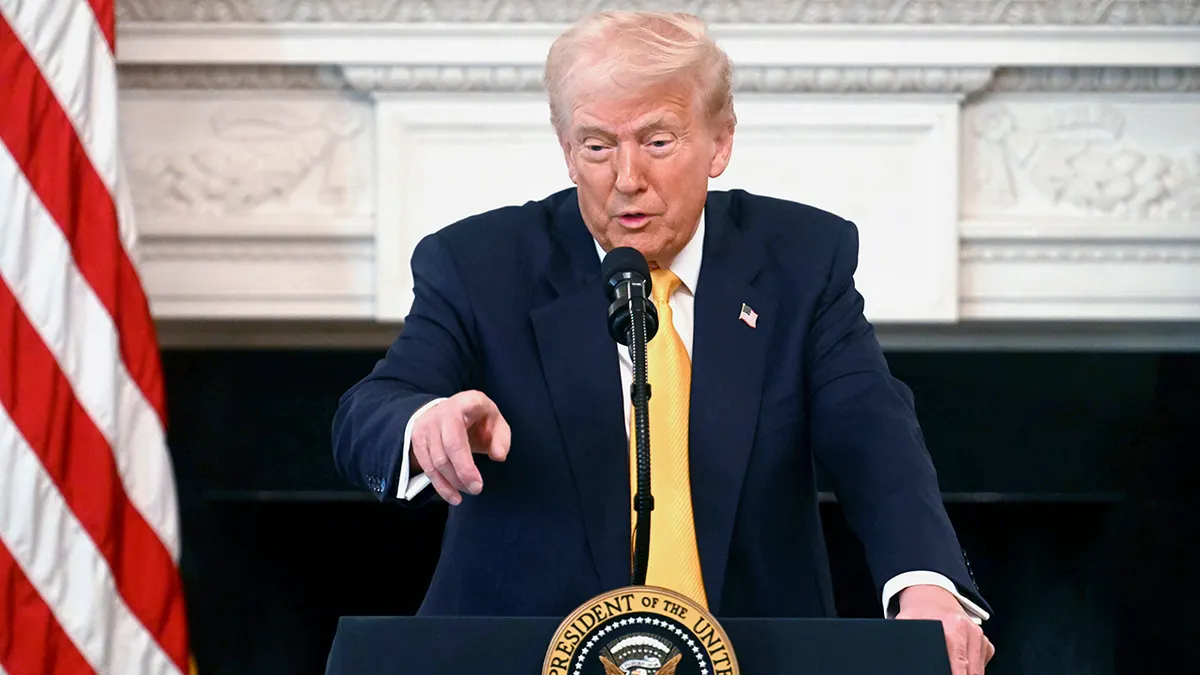
Today the discussion of the United States in Ankara, Kyiv and Berlin surprisingly converges around three themes: war and peace in Ukraine, the nature of Donald Trump’s new administration and its slogan “America First,” and Europe’s growing technological and political dependence on Washington. But in each country these motifs sound different: for Turkey the U.S. is a partner and a risky architect of a peace process; for Ukraine it is both a lifeline and a source of severe pressure; for Germany it is a necessary but increasingly problematic center of gravity from which it wants greater autonomy without breaking the alliance.
The first major motif is a U.S.-led peaceful settlement of the war in Ukraine. Turkish analysts in Russian- and Turkish-language outlets emphasize that it was the interaction between Ankara and Washington that in 2025 prevented the negotiation track from dying completely. An Anadolu Agency review says that in 2025 “thanks to initiatives by Turkey and the U.S. it was possible to prevent a complete breakdown of negotiation channels,” and that the Istanbul rounds produced concrete results on humanitarian issues such as prisoner and dead-body exchanges. The same publication stresses that the main, principled questions — territory, the status of particular zones, including around the Zaporizhzhia NPP — were deferred to 2026, and it is precisely here that the “American peace plan” becomes a subject of debate and expectation in the Turkish press. Turkish commentators see in this plan both an opportunity for Ankara to strengthen the role of “indispensable mediator” and a risk of becoming hostage to Washington’s rigid, deadline-driven style that may ignore Turkey’s long-term regional interests. Thus, in an analytical piece by the Harberg Center on the Turkey–U.S. summit it is noted that a “declarative agreement” emerged between Ankara and Washington on key formulations, but a “practical deadlock” remains over who and how will guarantee security after a possible ceasefire, as well as on U.S. policy contours in Syria and the Black Sea.
On the Ukrainian side, the center of gravity of discussions about the U.S. has shifted from the war itself to U.S. domestic politics and its direct impact on the front. Commentators openly write that 2026 will be the year when “Ukraine becomes part of the American elections.” In a column by Vadim Denysenko on Dumka.Media, the U.S. is described as a battlefield between proponents of harsh sanctions on Russia and those who want to “close the Ukrainian question by November 2026” in order to show voters a kind of “quick peace.” The author notes that Trump’s new sanctions on Russia became a “trigger” that cements the Ukrainian issue on the campaign agenda, and points out how quickly after their introduction Republican Senator Lindsey Graham met with Ukrainian Ambassador Olha Stefanishyna — a signal that Kyiv is trying to integrate itself into a new “anti-Russian legislative architecture” tied to the Republican establishment.
Other Ukrainian observers view the same processes far more darkly. In an opinion column on Focus.ua, political analyst Vladyslav Smirnov warns that 2026 “will be very difficult for Ukraine,” and the key problem is Donald Trump himself, under whose rule Ukraine has effectively ended up. Smirnov describes the style of the current White House as a “logic of pressure,” in which deadlines turn complex moral questions into “simple decisions that must be made today,” and conditional support is used as leverage. Such a portrait of American policy generates a fundamental sense of vulnerability in Kyiv: support remains vital — a recent example being the U.S. defense budget for 2026, which explicitly allocates $500 million in aid to Ukraine, as Ukrainian media reported citing Bloomberg materials — but it is increasingly perceived as an instrument of Washington’s domestic political play, not as a stable strategy.
This duality — dependence and distrust — also appears in more moderate column pieces. Political commentator Oleksandr Radchuk in Slovo i Dilo, in an article titled “After the era of ‘America First’: how Ukraine–U.S. relations will change in 2026,” links the future of bilateral relations not only to the personality of the president but to American policy’s general instinct of self-centeredness. He reminds readers that this week Washington will host the fifth “Ukraine Week,” timed to the 250th anniversary of U.S. independence, featuring the National Prayer Breakfast and an international summit on religious freedom, bringing together senior American officials and lawmakers. For Radchuk this is both a sign of the institutionalization of the Ukrainian issue in Washington and evidence that Kyiv must constantly “sustain American elites’ and society’s interest” in its agenda, otherwise priorities can quickly shift to domestic issues — protests against strict migration policy or interparty struggles.
In the second major theme — the general image of the U.S. and the new administration — the tone in the three countries diverges even more. In Ukrainian pieces Trump is almost always depicted through the lens of a values gap. Smirnov speaks of “a U.S. president unburdened by moral values and a commitment to justice” for whom “humiliating a partner” is a working tool. This is not merely criticism of a particular leader: behind it lies the fear that for Washington Ukraine is a variable to be bargained away if it helps win a domestic political contest.
In Turkey, attitudes toward Donald Trump are more pragmatic. Turkish analysts emphasize that the return to the White House of a politician Ankara has already dealt with opens a window for “reprogramming” the bilateral agenda: from an F-16 deal to a new configuration in Syria and the Black Sea. The Harberg Center piece notes that Erdoğan “has long sought” a full summit with Trump, and the first meeting since 2019 is seen as a chance to renew a personal channel of communication, which is so important for Turkish diplomacy. At the same time the author warns: rhetorical agreement — for example on the need for a “quick peace” in Ukraine — conceals deep divergences in understanding what the security architecture after such a peace should look like and how ready the U.S. is to take into account Turkey’s “red lines” on the Kurdish issue and the Syrian border. Here the American slogan “America First” is not criticized as immoral but treated as a given to be negotiated with.
In Germany the focus has shifted from the personality of the president to Europe’s structural dependence on the U.S. — above all technological and defense-related. Chancellor Friedrich Merz’s government declaration in the Bundestag, widely cited in the German press, was particularly indicative. In a Bild piece titled “Europa braucht den Schock von außen!” Merz says that Germany “has relied too long on others” for key technologies and that the government is preparing measures to reduce dependencies “into which we have entered too frivolously over recent years and decades.” The question is starkly utilitarian: what will happen if the American administration, under international pressure, decides to restrict Europe’s access to critical technologies — from cloud services to AI platforms? Merz urges using this risk as “a shock that moves Europe forward,” speaking of the need for “technological sovereignty.” At the same time he harshly criticizes President Trump for disparaging remarks about NATO’s mission in Afghanistan and stresses the irreplaceability of the transatlantic alliance for Germany’s security.
Out of these German debates grows the third major motif — the attempt to reconcile strategic autonomy with preserving a NATO-centered architecture. On one hand, Berlin is worried about Washington’s unpredictability: if the White House is ready to publicly devalue long-standing NATO missions and question the automaticity of collective defense, can the U.S. be relied upon as the guarantor of last resort? On the other hand, none of the serious players in Germany is proposing a radical break. The discussion is rather about diversifying risks: developing European defense initiatives and pursuing technological sovereignty as insurance against another “shock” from Washington.
The Turkish perspective on these German concerns is indirectly reflected in regional comments about the Turkey–U.S.–EU triangle. Several analytical reviews emphasize that Turkey’s domestic political confrontation reveals a new divergence between the U.S. and the European Union: Washington, according to a State Department representative, limits itself to calling on Ankara to “respect human rights” but fundamentally does not want to comment on the ally’s internal decisions, whereas European capitals react much more harshly to violations of democratic standards. For Turkish observers this is further confirmation of the thesis that the U.S. in the “America First” era evaluates partners through the prism of strategic usefulness — whether it is the Black Sea corridor, Ukrainian settlement, or containing Russia — while questions of democracy and human rights move to the background. The comparison with the EU plays an important role here: Ankara tries to balance between Western centers of power, using differences in their approaches.
Against this backdrop it is particularly telling how local debates overturn the familiar U.S. narrative about its global role. Where American media are inclined to see Washington as the “leader of the free world” or, conversely, simply another “great power,” Turkish, Ukrainian and German commentators much more often describe it as a player whose interests must be constantly “reprogrammed” to suit one’s needs. For Ankara this means extracting the maximum from the mediating role in Ukraine while minimizing the risks of being drawn into an anti-Russian confrontation according to NATO templates. For Kyiv it means constant work with Congress, religious and civic platforms in the U.S. to remain “part of the American conversation” and not become a bargaining chip in a deal with Moscow. For Berlin it is the painful realization that technological and military dependence on the U.S. must be reduced not out of anti-Americanism but out of elementary prudence in case another administration comes to the White House that views NATO and European partners through the logic of deals.
The same question is heard in all three countries: how durable are American commitments and how to minimize the cost to oneself if Washington decides to radically change course? The answers differ. Turkey bets on personalized relations and flexibility, Ukraine on institutionalizing support in the form of laws, budget lines and symbolic events like “Ukraine Week” in Washington, Germany on a long, complicated path to building European autonomy while preserving the alliance. But the common nerve is the same: the U.S. is no longer perceived as a fixed constant of the world system. And that is why in Ankara, Kyiv and Berlin today they read not only American laws and budgets so closely, but also internal cultural and political shifts, understanding that their own future is still largely written in Washington — but no longer in the way it used to be.