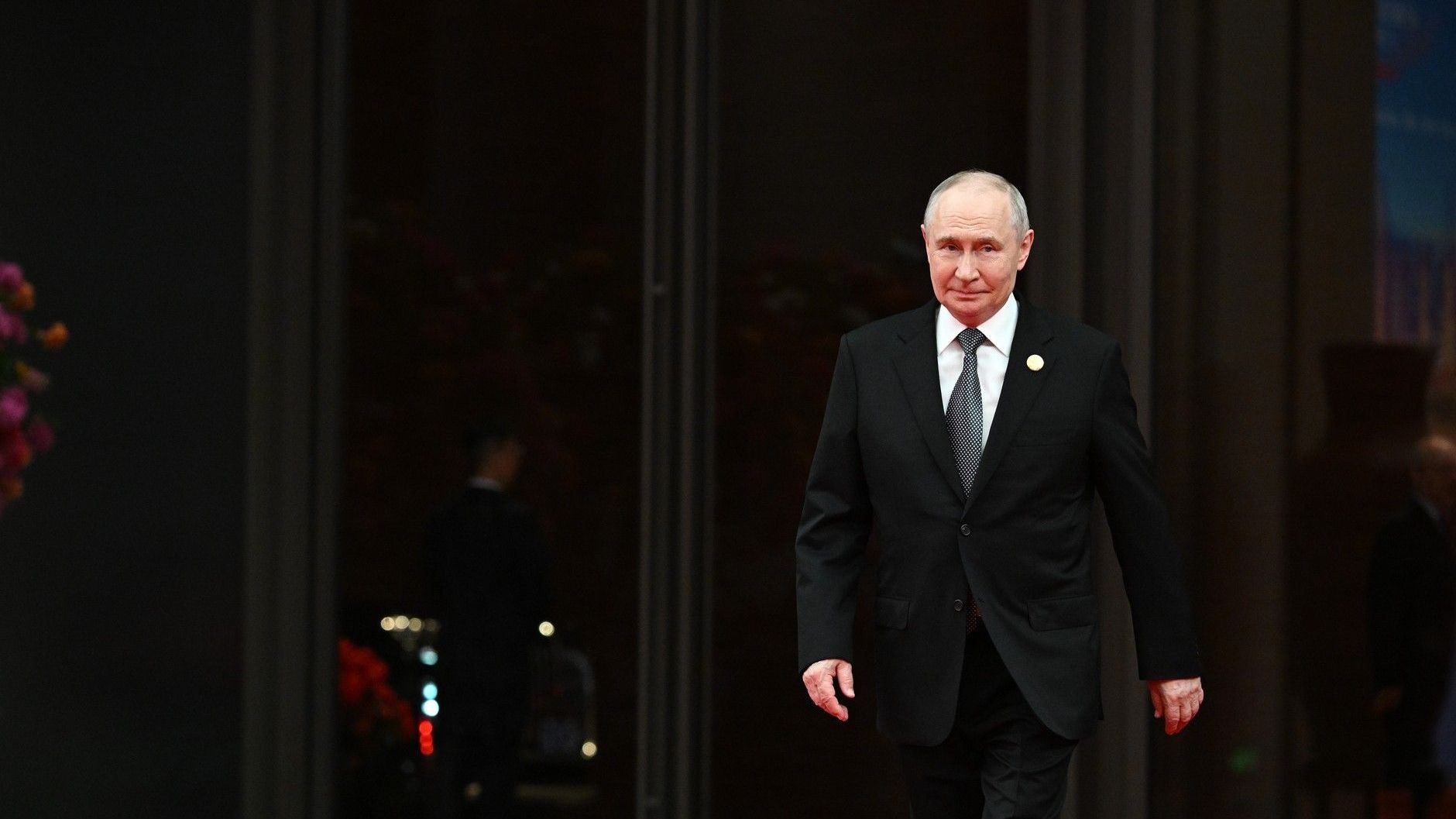
After the U.S. midterm elections, Donald Trump’s unusually warm tone toward Vladimir Putin and Xi Jinping raised questions about the future of American strategy. Some see personal contacts with the leaders of Russia and China as a way to strengthen U.S. security; others doubt the prospects for rapprochement with Moscow, given its support for Iran and the ongoing war in Ukraine. Against this backdrop, U.S. security guarantees for Kyiv are under discussion, while cordiality at a trilateral summit exists alongside enduring great-power rivalry. This article is based on reporting by La Presse (France) and Rosbalt (Russia).
Pope Leo XIV Urges U.S. to Embrace Dialogue and Reconciliation After Election
After the U.S. midterm elections, Pope Leo XIV urged American society to abandon hostile rhetoric and seek ways to foster dialogue, reconciliation, and mutual understanding. According to the French-language edition of La Presse, the head of the Catholic Church expressed hope for “more dialogue, bridge-building, reconciliation,” as well as “less polemic, less war, fewer divisions.”
The pontiff stressed that his words should not be taken as interference in party politics or as an assessment of specific political forces. “I am not making political comments; I am promoting the social teaching of the Church,” Pope Leo XIV said. His message centered on the need to keep listening to one another, even amid deep social and political polarization.
The report from Rome offers no assessment of Donald Trump’s policies, Russia, China, or the election results themselves. Rather than discussing winners and losers, the pope offers a moral framework for thinking about political confrontation: easing tensions, rejecting divisive rhetoric, and being willing to mediate.
For the French audience to whom La Presse’s report is addressed, this appeal resonates with the country’s traditional emphasis on diplomacy, multilateral engagement, and conflict prevention. Although France remains a secular state, the pope’s statements on war, international tensions, and divisions in Western societies continue to attract considerable public and international attention.
The pontiff’s use of the phrase “building bridges” is particularly significant. In European public discourse, it is traditionally associated with reconciliation, de-escalation, and the search for common ground between opposing camps. The report, however, includes no reactions from French politicians, experts, or church representatives, and does not examine the potential consequences of the U.S. elections for France’s economy, defense, or domestic politics.
Thus, Pope Leo XIV’s speech was not a political comment on the U.S. elections but a universal appeal to a society divided by bitter disputes: listen instead of confront, seek common ground instead of deepening divisions, and build bridges instead of waging a war of words.
Putin Says Knowledge and Resilience Are Key to Russia’s Victory
Russian President Vladimir Putin said the outcome of modern conflicts depends not only on the capabilities of weapons, but also on the intellectual level of society, the quality of specialist training, and the ability to respond quickly to new threats. According to Rosbalt, the head of state and military specialists consider “mathematical knowledge” an increasingly important factor.
This view reflects the idea of war as a contest not only between armies, resources, and industrial capacity, but also between scientific schools, engineering solutions, management systems, and the speed of technological adaptation. In today’s environment, specialists working with unmanned systems, programming, communications, navigation, data processing, artificial intelligence, and other high-tech fields play a key role.
Putin stressed that the advantage goes to “those who think better and respond more quickly to new events and challenges.” In Russia’s public discourse, this has economic as well as military significance. Against the backdrop of sanctions pressure, restrictions on access to certain foreign technologies, and the need to expand domestic production, the emphasis is on technological sovereignty and developing homegrown expertise.
This approach implies long-term investment in education, the exact sciences, the training of engineers and programmers, and defense-industry enterprises. The aim is not a one-off advantage in weapons, but the creation of a durable foundation that makes it possible to develop, produce, and improve equipment in a rapidly changing environment.
At the same time, the president maintained the traditional link in Russian political culture between technological development and moral and patriotic values. In his words, “spiritual foundations and resilience” remain important conditions for success. In this view, national security depends not only on material resources, but also on society’s ability to remain united, endure hardship, and support the goals set by the state.
This rhetoric echoes Russia’s understanding of the experience of the Great Patriotic War, in which industrial and technological development is commonly viewed alongside mass resilience, patriotic mobilization, and society’s collective efforts. Victory is therefore portrayed as the result of a combination of science, production, governance, and social cohesion.
Thus, Putin’s statement presents an image of Russia seeking to meet modern challenges not only by expanding its arsenal, but also by developing education, science, industry, and social unity. The central message is that long-term security and the achievement of military goals require the country to be intellectually, technologically, and morally resilient.