Chinese and Brazilian media have portrayed the midterm election results as a serious blow to Trump and a reason to question the legitimacy of US elections once again: after the defeat, the president returned to claims of fraud. Brazilian commentators have also linked the result to a protest vote by Latino voters. Analysts are assessing how the political crisis could affect US policy, markets, and relations with China, Brazil, and the MERCOSUR countries. This review is based on reports by the Chinese publication Zhao Chen Bao and the Brazilian newspaper Gazeta do Povo.
China sees Trump’s defeat as creating new risks for relations with the US
The Democrats’ victory in the US midterm elections and Donald Trump’s apparent weakening have prompted both schadenfreude and concern in China. As noted in a Chinese analysis, the hashtag “Trump’s complete defeat” became popular on Weibo. But behind the mockery of the US president’s political troubles lies a concern: weakened at home, Trump may try to make up for his setbacks with more forceful and unpredictable foreign-policy moves.
In this interpretation, the US appears to be the main source of international instability. The authors link Washington’s course over the past two years to unilateral tariffs, the war with Iran, pressure on allies, and sudden shifts in its position on Ukraine. Democratic control of Congress is therefore seen not as a guarantee that Washington will correct course, but rather as a potential check on the White House’s most impulsive decisions.
At the same time, Chinese experts do not expect Trump’s political defeat to lead to a softer US policy toward China. In their view, a bipartisan consensus has strengthened in the US in favor of a tougher confrontation with China, both economically and over disputed territories. A shift in the balance between Republicans and Democrats may change the methods of applying pressure, but it will not end the strategic competition between the two powers.
Xu Shaolin, a blogger with nearly four million followers, said that if Trump lost control of both chambers of Congress, he would become a “lame duck.” He called him a president who “says whatever comes into his head” and stressed that he was unreliable. This assessment reflects the widespread image of Trump on Chinese social media as a chaotic, discredited, and inconsistent politician.
However, Shi Yinhong, a professor in the School of International Studies at Renmin University of China, cautioned against overestimating the benefits of the Democrats’ success for Beijing. In his view, the new balance of power will create additional difficulties for China. The May understanding on “constructive strategic stability” could fall apart because Trump will “suddenly find himself far from all-powerful.” According to this logic, the president’s weakening could raise tensions rather than reduce them, making US policy less predictable and more dependent on domestic infighting.
Shi Yinhong also believes that a Democratic Congress could work more actively to strengthen US ties with traditional allies, including Japan. This is an unfavorable prospect for Beijing: China views the US alliance network in the Asia-Pacific as one of the most important elements of strategic pressure.
Taiwan is a particular source of concern. Yang Haowei, an analyst at the International Crisis Group, believes a Democratic Congress could increase pressure on the White House to approve a delayed $14 billion arms package for Taiwan. In China’s view, such arms sales are not an ordinary element of defense cooperation but direct US interference in China’s internal affairs and a move that complicates the task of reunification with the island.
China’s economic interests also remain at risk. China, along with Japan and Vietnam, has been named as a possible target of new US tariffs. A Democratic Congress is likely to push for exemptions for product categories that are especially important to American consumers. But Chinese observers remain pessimistic overall: US protectionism will continue. For China, that means continued uncertainty in trade, risks to exports, and the need to adapt to Washington’s use of tariffs as a tool of industrial and geopolitical pressure.
The broader regional context adds to these concerns. The war with Iran and the resulting rise in oil prices are taking a heavy toll on Asian economies that depend on Middle Eastern energy. Chinese audiences see a direct link between US actions far from East Asia and growing energy, inflation, and economic risks in the region, including in China itself. The possibility that Congress might restrain Trump’s hawkishness is therefore a source of cautious hope, but not a reason for confidence.
Thus, the Chinese report treats the US elections as more than an episode in the country’s domestic political struggle. For Beijing, they are a sign that Washington is finding it harder to pursue a consistent global policy. But this weakness is not necessarily to China’s advantage: a weakened Trump could embark on foreign-policy adventures, Congress could more actively support allies and Taiwan, and the anti-China agenda could become even more institutionalized. According to this assessment, China’s main problem is not just Trump as an individual, but the enduring nature of the strategic rivalry between the US and China.
Brazil between the US and China: the cost of a possible Flávio Bolsonaro presidency
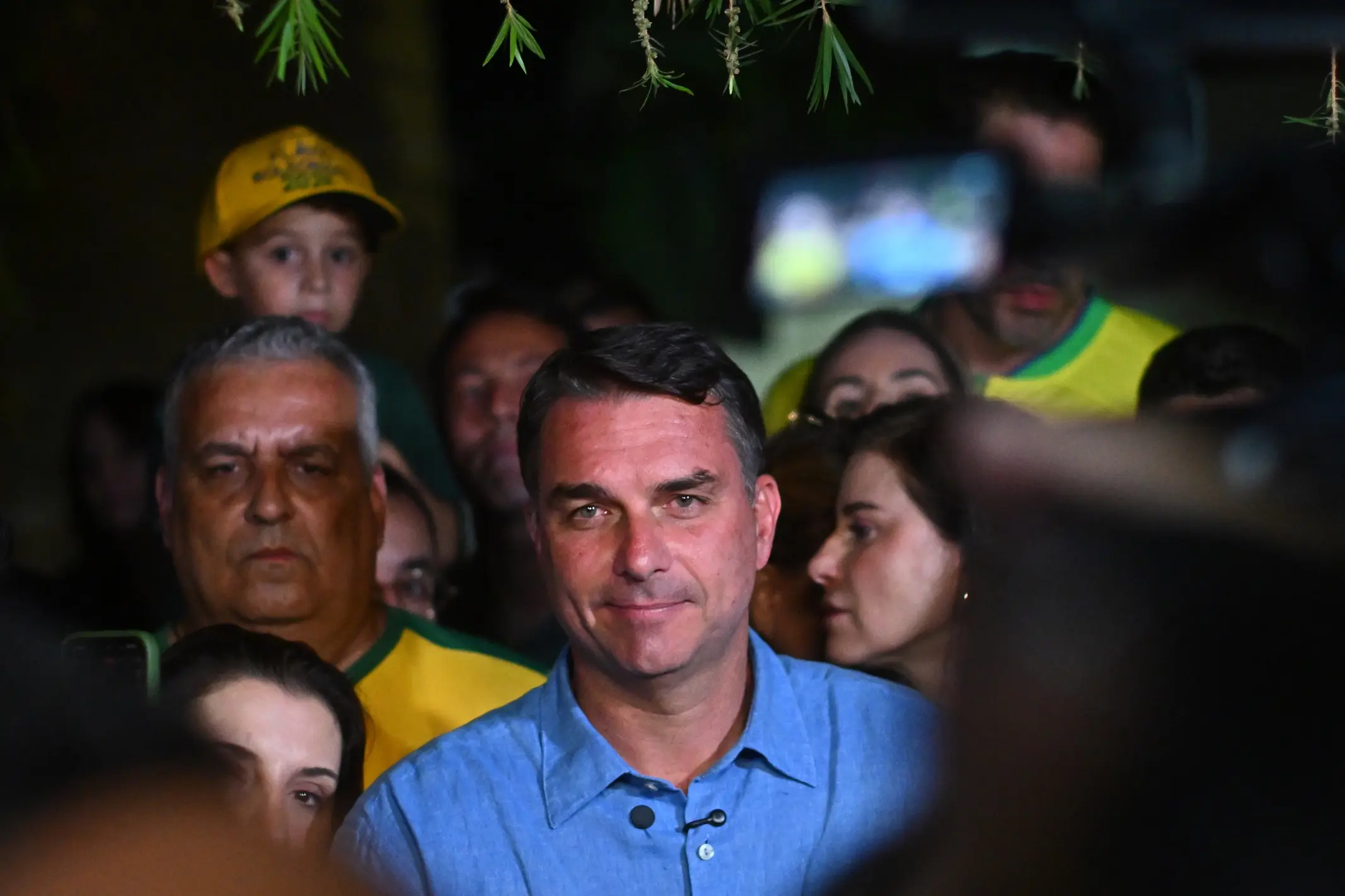
A hypothetical victory by Flávio Bolsonaro over incumbent President Luiz Inácio Lula da Silva could mean not just a change of government for Brazil, but a notable shift in its foreign economic and foreign policy strategy. As Gazeta do Povo notes, the country would face a difficult choice: move closer to the US politically and strategically without breaking vital trade ties with China or undermining MERCOSUR.
Lula’s current policy is built around the idea of “multipolar autonomy”: Brazil seeks to maintain relations with different centers of power while avoiding firm alignment with any one geopolitical camp. A possible Flávio Bolsonaro government, by contrast, could give priority to ties with Washington and Western partners.
International relations professor Marco Aurélio da Silva believes such a shift could bring Brazil certain benefits while narrowing its diplomatic room for maneuver. “Brazil would gain closer ties with Washington and potential benefits in technology and security, but it would be more exposed to shifts in US foreign policy and more constrained in its freedom of action in multilateral forums,” he warns.
Economic realities, however, make a complete break with Beijing virtually impossible. In the first eight months of the year, China bought $77.1 billion worth of Brazilian goods, accounting for 30.7% of the country’s exports. Over the same period, the US bought $24.1 billion worth of products, or 9.6% of Brazil’s exports. China remains the main market for Brazilian soybeans, iron ore, and other commodities that underpin a large share of the country’s export economy.
Economist Marcos Valle points out that the US cannot replace Chinese demand. Moreover, in agriculture and mining, Washington is in many respects a competitor to Brazil. This means that the largest agribusiness exporters, which wield considerable political influence within the country, will have an interest in maintaining close trade ties with China regardless of the future president’s foreign-policy preferences.
Flávio Bolsonaro’s likely approach would therefore be more about dividing areas of cooperation. China would remain the main buyer of Brazilian raw materials, while the US would be seen as the preferred partner in defense, intelligence, the fight against organized crime, technology supply chains, and the development of critical minerals. Flávio himself has spoken of the need for a “long-term strategic partnership” with the US on critical minerals, involving “protected investment and joint reindustrialization.”
Rare earth metals have a particular place in this strategy. For Brazil, developing the sector could be a chance to move beyond its role as a supplier of unprocessed raw materials and build higher-value production, from mineral processing to technological products. But this potential also draws the country into the US-China competition for control of supply chains.
Washington is seeking to reduce its dependence on Chinese processing and supplies of critical materials, while Chinese companies are already active in Brazil’s mining sector. In these circumstances, Brazil’s natural resources are not only a source of export revenue but also a key subject of geoeconomic bargaining between the leading powers.
A closer relationship between Flávio Bolsonaro and Donald Trump’s administration could also affect trade disputes. US tariffs apply to 23.1% of Brazilian exports to the US, and reach 37.5% for some product categories. The authors of the analysis suggest that the personal and ideological affinity between the right-wing leaders could make it easier to negotiate lower restrictions, especially given the cooler relationship between Lula and Trump.
Another potential area of cooperation with the US would be the fight against organized crime. The PCC and Comando Vermelho gangs remain a serious concern for the Brazilian right. Their activities are seen not only as a domestic security challenge, but also as grounds for expanding coordination with US agencies on intelligence, combating drug trafficking, and tackling transnational criminal networks.
A possible Flávio Bolsonaro victory could also have consequences for MERCOSUR. His potential political alliance with Argentine President Javier Milei could increase pressure for greater freedom to conclude bilateral trade agreements outside the bloc. Supporters of this approach argue that Brazil would be able to make deals with the US and other partners more quickly and flexibly, without having to take its neighbors’ positions into account.
Critics, however, fear that such a reform would weaken the customs union, the Common External Tariff, and South America’s collective bargaining power. Marcos Valle warns that if MERCOSUR becomes a looser free-trade area, major powers—especially China—could strike separate agreements with smaller countries in the region. This would increase competition from Chinese industrial goods for local producers and reduce South American countries’ ability to defend their shared interests.
This issue is particularly sensitive for Brazil, where a powerful agricultural export sector coexists with an industrial sector concerned about deindustrialization. The MERCOSUR agreement with the European Union is cited as an example of the advantages of a collective approach: acting as a unified bloc gave the group the opportunity to secure preferential access to a market of around 450 million European consumers. Weakening that common position could give Brazil greater freedom of action in the short term, but diminish its political and economic weight in future negotiations with the EU, China, and the US.
Thus, even with an ideological orientation toward Washington, a possible Flávio Bolsonaro government would face fundamental constraints. Agribusiness exporters need access to the Chinese market, technology and critical-minerals projects may seek US capital and partnerships, and domestic industry will be wary of opening the domestic market too widely.
Brazil’s central dilemma is not a simple choice between the US and China, but how to balance market access, technological development, security, industrial policy, and diplomatic independence. A political shift toward the US could change priorities, but it would hardly allow Latin America’s largest economy to give up China as a key trading partner.