Around the United States today there is again a nervous, but not uniformly hostile, atmosphere. Donald Trump’s return to the White House, a “second version” of his protectionism and a tough unilateral approach to the world, the blow to multilateral institutions, a new configuration of sanctions and tariffs, and the escalation in the Middle East — all of this pushes countries simultaneously to fear Washington and to seek advantageous deals with it. In public debates in South Africa, South Korea and India, the United States is almost always present, but as a “problematic, necessary partner”: from trade wars and potential sanctions to security, migration and energy dilemmas.
If in the South African press America appears primarily as a source of political and economic pressure, in Seoul the discussion is about how to reconcile reliance on the U.S. alliance with the need for technological sovereignty, while in the Indian debate irritation over tariffs and deportations paradoxically coexists with talk of “unprecedented opportunities” for IT and defense cooperation. At the intersection of these three regional perspectives a new picture emerges: a world in which the U.S. is no longer regarded as a moral leader, but it is still assumed that neither security nor the global economy can be built without America.
One of the key nodes of these debates is the personality of Trump and his “America First” doctrine, now logically extended into a second term. In India this is written about as a “recalibration of the strategic compass” in relations with Washington, where U.S. economic nationalism combines with a desire to use India as a counterweight to China. In Korea the Trump topic is more often integrated into a broader conversation about deglobalization and new tariffs, whereas in South Africa the current administration in Washington has become the trigger for an open diplomatic conflict.
One of the sharpest themes shared by discussions in Pretoria and New Delhi remains the U.S. use of economic levers — from tariffs to threats to revise aid — to impose its agenda. South African analysts directly speak of an “extraterritorial political risk” associated with American sanctions and trade restrictions, which can change countries’ domestic policies despite being formally economic instruments. A report from the Centre for Risk Analysis in Johannesburg emphasizes that U.S. influence on South African politics and business in 2026 and beyond is increasingly exerted through sanctions, trade restrictions and bilateral reviews of agreements, rather than through classic diplomatic mechanisms — and that this is becoming one of the country’s key political risks. South African business media discuss that the “extraterritorial reach of the U.S.” could lead to real trade losses if Pretoria continues a course of closeness with Iran, Venezuela or Russia, disregarding Washington’s sensitivity to those ties. (cra-sa.com)
The Indian discussion shows similar worries, but from a different starting point — that of a large economy deeply integrated into American markets. The term “secondary tariffs,” which emerged during Trump’s second administration, has become almost proverbial in Indian economic analysis. These “secondary tariffs,” introduced as a pressure tool not only against direct U.S. opponents but also against third countries, affected India in August 2025: Indian exports were hit with an additional 25 percent duty as punishment for purchases of Russian oil. Formally the tariff was lifted only in February 2026 after some Indian oil companies agreed to significantly reduce purchases from Moscow or to limit them to previously concluded contracts. (en.wikipedia.org)
For Indian analysts this was a lesson: Washington is ready at any moment to transform economic interdependence into an instrument of political pressure. A report from the Takshashila Institute explicitly speaks of the “aggressive tariff measures of the Trump administration” and the need for New Delhi to pursue “stepwise liberalization” and to negotiate a comprehensive trade agreement with the U.S. to minimize vulnerability to such unilateral protectionism. (takshashila.org.in)
In South Africa the discontent is more politicized and rooted in the traditions of the African National Congress. Public statements by South African politicians and columnists alternate with warnings that an “anti-American” line could be costly for the economy. Political scientist William Gumede, in a column for Business Day, argues that the ruling party’s confrontational course with the U.S. — from the Venezuela affair to friendships with Iran — is based on “outdated Cold War approaches” and underestimates how structurally the global economy has changed. He warns that prioritizing ideological solidarity with “anti-Western” regimes could lead to sanctions, loss of trade preferences and capital flight, especially as the Trump-2 administration demonstrates willingness to sharply cut aid and trade concessions. (businessday.co.za)
At the same time, right‑conservative circles in the U.S. try to present themselves as defenders of the “victims” of South African policy, which further poisons the bilateral atmosphere. The winding down of U.S. aid to South Africa and the launch of a Special Program to accept white South African refugees, anchored by Trump’s decree to halt all foreign assistance to South Africa on the pretext of “racial discrimination” in favor of the black majority, create in the local press an image of the White House drawing on an extreme-right narrative about a “white farmer genocide.” South African journalists point out that farm murder statistics depict a much more complex picture than the U.S. administration presents and interpret this policy as interference in the country’s internal affairs. (en.wikipedia.org)
In India, however, the economic conflict with Washington coexists with rhetoric about “historic opportunities” for strategic and technological partnership. In a column by the director of the Institute for Defence Studies in New Delhi for The Indian Express, it is stressed that since 2016 — when India obtained the status of “major defense partner of the U.S.” and access to the Strategic Trade Authorization‑1 regime — Indian companies became part of American aerospace supply chains, and Trump’s return to power could “remove many restrictions” on high‑technology supplies to India amid the U.S.–China rivalry. The author argues that it is precisely the geopolitical conflict with Beijing that could push Washington to offer more generous terms in AI, space technologies and civil aviation, where India is seen as an ideal recipient and co‑developer. (indianexpress.com)
Nevertheless, Indian media discourse also notes the downside of “traditionally warm” ties. Indian commentators recall that the Trump administration clearly demonstrated readiness to turn migration into a weapon: from deportations of illegal Indian migrants using military aircraft in the early months of the second term to periodic threats to cut H‑1B issuance. On a popular Indian forum they discuss how radical U.S. migration policy measures have turned the situation of labor migrants into a domestic political issue in India itself. One participant in the debate called what happened “a hard lesson for those who believed that a personal friendship between Trump and Modi guarantees protection for the diaspora.” (reddit.com)
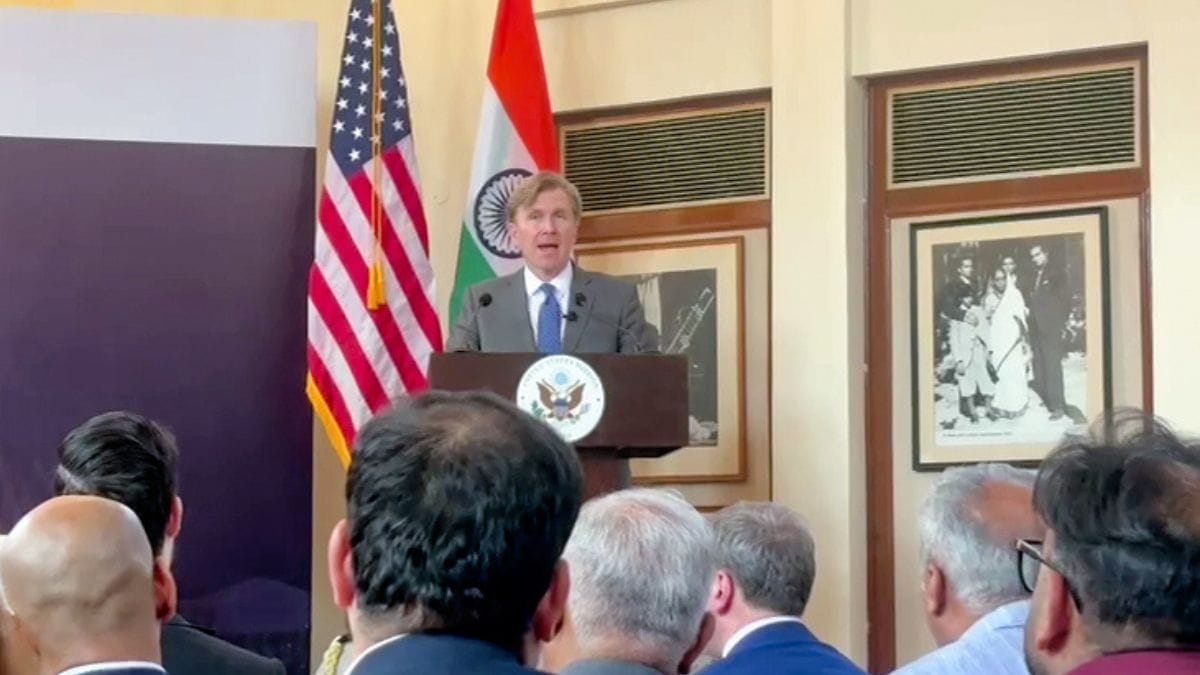
Against this backdrop, official statements by U.S. representatives in New Delhi now sound maximally pragmatic. In a recent speech by Deputy Secretary for Defense Policy Elbridge Colby, an advocate of a hard line toward China, he emphasized that India–U.S. relations are “driven not by dusty formalities, but by clear‑eyed interests.” He praises India for a “foreign policy based on national interest,” which, in his view, aligns well with the Trump administration’s approach. Colby explicitly says: when the U.S. acts for the security and prosperity of Americans, and India for Indians, these efforts “often and substantially reinforce one another.” Thus Washington normalizes the idea that partnership is built on deals rather than values. (theprint.in)
South Africans view the same processes through a different window — as another turn in the crisis of the “rules‑based” global order. U.S. influence here is associated less with opportunities and more with attempts to punish the country for its sovereign foreign policy. The latest diplomatic flare‑up was sparked by criticism from the new American ambassador, Leo Brent Bozell III, a conservative activist and Trump ally, over Pretoria’s ties with Iran and its internal policy of affirmative action in favor of the black majority. After his remarks to the business elite, where he questioned both the foreign and domestic line of the South African government, the South African foreign ministry urgently summoned him, and the ruling party publicly stated that no ambassador has the right to dictate the country’s foreign policy. “We need to make it clear to everyone we welcome in our beautiful country, including the new U.S. ambassador, that South Africa’s foreign policy will be determined only by South Africans and their government,” reads a statement published by the Johannesburg‑based The Guardian Nigeria and widely quoted in local media. (apnews.com)
Simultaneously, South African publications debate how consistent and “uninvolved” Pretoria’s foreign policy really is. Several authors remind readers that if a country calls itself non‑aligned, its positions on key conflicts — from Ukraine to Venezuela and Iran — should be based on uniform application of international law norms, not situational solidarity with those Washington labels enemies. In a statement the FW de Klerk Foundation emphasizes that South Africa “is not obliged to accept the U.S. foreign policy framework,” but must understand that certain foreign policy choices automatically trigger trade consequences, investor concern and long‑term reputational costs, especially when confronting its largest trading partner. (fwdeklerk.org)
The central background uniting South African, Korean and Indian discussions about the U.S. is the war in the Middle East and the shared sense that Washington is losing the status of a “responsible leader.” For Pretoria this is primarily a question of energy and international law. A rise in oil prices above $100 per barrel after escalation in the Strait of Hormuz is perceived as another “external shock” to which African economies are more vulnerable than developed ones. In a piece in French Le Monde on the war’s impact on Africa, South African analyst Ronak Gopaldas recalls that he modeled a U.S.–Iran crisis scenario a few years ago that would drastically worsen security and economies across the continent, from Somalia to the Sahel. Now, in his assessment, that moment has arrived, and the South African finance minister openly admits: the country is a “price taker” on the global oil market and can only watch as decisions by Washington and Tehran reshape its economic balance. (lemonde.fr)
In India the same war is discussed in another key: as the “first truly AI‑native conflict,” where American and Iranian propaganda, as well as third parties, fight for perceptions, including in India’s information space. Analysts at ThePrint note that after the Franco‑American‑Israeli strike on Iran on 28 February 2026, Indian social networks were flooded with fabricated videos and memes, often localized in language and style, attempting to push pro‑Iranian and anti‑American narratives under an “Indian” veneer. Notably, Indian experts link this flow not only to Iranian and pro‑Russian sources, but also to private and state structures in other countries that view India as a key battleground for global public opinion. The government in New Delhi, for its part, emphasizes that it is creating special mechanisms to track content that could harm “India’s bilateral relations with any partner,” including the U.S. (theprint.in)
South Korean discussions about the U.S. may seem less dramatic at first glance, but they address the same issues — trust in American leadership and the cost of dependence on it. Korean think tanks analyze in detail what the combination of a second Trump administration and the accelerating restructuring of the global economy means for Seoul. An Asan Institute brief notes that Trump’s return almost certainly means renewed pressure on Seoul regarding the “costs of the alliance”: a cost‑sharing agreement reached under Biden for stationing U.S. forces in Korea for 2026 may be reviewed with demands for a “radical increase” in Seoul’s share. The authors suggest that Korea approach this bargaining pragmatically — accept some demands in exchange for key technologies: revising nuclear agreements to expand Seoul’s fuel reprocessing and enrichment rights, joint weapons production, even discussion of returning tactical nuclear weapons. Between the lines is an important conclusion: the alliance with the U.S. is no longer seen as a guaranteed, selfless protection; it is a complex contract in which each side, including Seoul, must fiercely defend its interests. (asaninst.org)
Concurrently, the Korean media space is occupied by the theme of “Trumponomics‑2” and its consequences for export‑oriented Asian economies. Nomura analysts warn that a new wave of U.S. tariffs and export controls, including in semiconductors and AI, creates structural risks for South Korea, for which the U.S. remains both a key market and a key technology partner. In recent months Seoul closely watched the U.S.–Taiwan agreement reached in January 2026, after which the U.S. commerce secretary subjected Korean memory chip makers to additional pressure. Local reviews interpret this as a signal: Washington is ready to reforge its technology chains to minimize dependence on any single partner and to increase leverage over countries that do not fully follow the American line on China or other “problematic” directions. (hanaw.com)
Against this backdrop, isolated episodes of U.S. policy in the Western Hemisphere — for example, the new format “Shield of the Americas” — are perceived in Seoul or New Delhi not as a local anti‑narcotics project but as part of a general trend of militarization and regionalization of American foreign policy. Korean outlets, recounting Trump’s remarks at the Doral summit on 7 March 2026, where he simultaneously threatened Cuba and discussed operations against drug cartels, emphasize how easily the White House now moves from rhetoric to the use of military force far beyond the U.S., justifying it as a fight against terrorism, drug trafficking or “foreign interference.” Indian commentators see “Shield of the Americas” as an example of how the U.S. is shifting focus from universal institutions like the UN to flexible regional coalitions “based on interests,” with Washington as the unchallenged center. (en.wikipedia.org)
Where American policy directly affects ordinary people in these countries, narratives become especially emotional. South African audiences are outraged not only by the cessation of aid and the stigmatization of their country in rhetoric about “anti‑white racism,” but also by the overall sense that Washington is prepared to destroy partnerships built over decades for domestic political points. Columnists in Pretoria‑based outlets describe scenarios in which possible U.S. sanctions, withdrawal from trade agreements and refusal to cooperate on HIV/AIDS would effectively erase South Africa’s post‑pandemic and energy crisis recovery efforts. Against this backdrop there is growing public demand in South Africa for “active neutrality”: to be not just a non‑aligned country, but an actor that formulates a regional agenda independently, not adjusting to Washington, Beijing or Moscow. (cra-sa.com)
In India the most widely discussed dimension of U.S. policy remains the fate of students, IT specialists and migrants. Expert reviews directly cite research warning that a second Trump term could mean new restrictions on H‑1B and other visas, and the Indian press regularly publishes pieces on how tighter migration regimes, deportations and xenophobic rhetoric in the U.S. are changing India’s middle class attitude toward the “American dream.” One analytical review notes that a significant portion of the economic benefits the U.S. gains from relations with India — from higher education to digital services and intellectual property licensing — is based on the inflow of Indian students and professionals, but even this does not guarantee them stable status when domestic politics in Washington demands demonstrative “toughness” on migration. (nomuraconnects.com)
South Korea appears a more restrained actor in these debates, but an underlying skepticism about the reliability of the U.S. as a long‑term leader is evident. Foreign policy columns carry the idea that even if Washington remains an indispensable shield against North Korea and an increasingly assertive China, Seoul needs to accelerate development of its own defense, including missile‑nuclear components and cyber capabilities. In one essay a Korean author writes that “the U.S. is not eternal, and U.S. forces will leave someday,” concluding that Korea must today build a security architecture in which reliance on the U.S. alliance is important but not critical. This motif of self‑reliance unexpectedly echoes Indian and South African narratives — all three countries demonstrate unwillingness to be merely a “line of defense” in someone else’s grand strategy. (asaninst.org)
At the intersection of the three regional lenses a common theme emerges: the “normalization” of America as a normal great power with its sometimes harsh interests, rather than an infallible moral benchmark. South African columnists compare current U.S. policies — from the “capture” of Nicolás Maduro and the detention of Venezuelan vessels to refusal to recognize international court rulings — to the actions of other great powers and conclude that the U.S. has finally ceased to be the “guardian of international law,” becoming another actor willing to bypass norms when convenient. In India’s expert community there is growing conviction that cooperation with America should be based solely on pragmatic grounds, without illusions about a “natural alliance of democracies.” In Seoul the debate intensifies about how to reconcile a strategic alliance with Washington with trends toward regionalization and the need to build a more autonomous strategy in the Asia‑Pacific. (timeslive.co.za)
Yet in Pretoria, New Delhi and Seoul what predominates is not antagonism but complex realism. In South Africa they still recognize the U.S. as a crucial economic partner and technology donor; Indian authors stress that no other actor can offer comparable access to advanced military and space systems; Korean strategists see no replacement for the U.S. nuclear umbrella in the foreseeable future. But the notion of “U.S. leadership” is being replaced by a vision of the world as a field of multiple centers of power, where Washington is just one, and often a complicated and unpredictable, player.
This is why local voices insist on the need for “active neutrality” in South Africa, “clear‑eyed interests” in India and “preparation for autonomy” in South Korea. Each of the three countries is rearranging its relations with the United States in its own way, trying to turn asymmetry into a bargaining resource. Viewed not through the eyes of Washington analysts but through the prism of these three regional debates, it becomes clear: the main question for the world today is no longer “what does America want,” but “how to deal with it so as not to lose one’s own sovereignty and development prospects.”