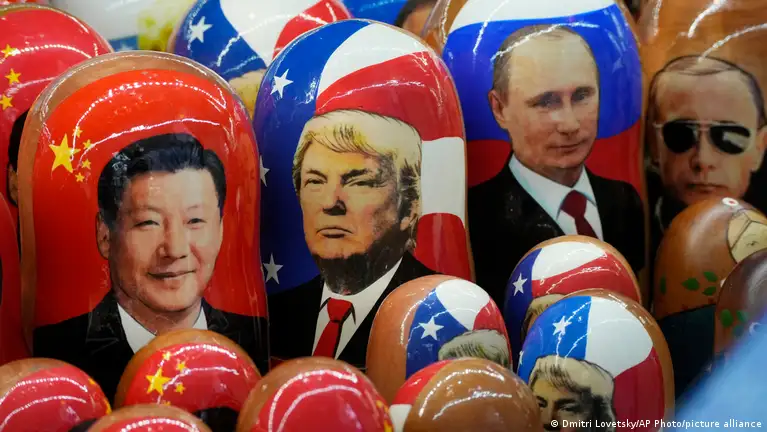
Donald Trump’s relationship with his MAGA allies and European partners, Washington’s approach to regulating artificial intelligence and dealing with Iran, and the US role in security guarantees for Ukraine and dialogue with Russia and China are all fueling debate over America’s international leadership. The focus is on the unpredictability of US strategy, the strength of its alliances, and Washington’s ability to influence the course of major conflicts. This article is based on reporting by Deutsche Welle (Germany) and Report.az (Russia).
Europe fears great-power deals made without it
In Germany, and Europe more broadly, the prospect of a summit between Xi Jinping, Donald Trump, and Vladimir Putin is alarming not so much because of the meeting itself, but because it could lead to a “grand bargain” in which Ukraine and European countries are not participants but subjects of negotiation. As noted in Deutsche Welle’s analysis, this kind of great-power diplomacy could cement a new balance of power: the old US-led order and Western alliance system would weaken, while China would gain further opportunities to expand its influence.
Experts, however, do not expect a radical rapprochement between Washington and Beijing. Instead, they foresee a limited, pragmatic truce on trade and technology. Patricia Kim of the Brookings Institution describes this as a “business détente”—a transactional approach in which each side weighs possible concessions separately, without moving toward a full political reconciliation. For Germany, whose export-driven economy is closely tied to both the US and Chinese markets, this means continued strategic uncertainty.
Ukraine remains Berlin’s chief concern. Expert Yun Sun notes that Moscow wants to show that the United States is willing to negotiate with Russia “at the table” even without Europe and Ukraine. Such a scenario is especially troubling for Europeans: questions about support for Kyiv, sanctions, deterring Russia, and the future of European security could be discussed without those most directly affected.
Germany has traditionally based its security policy on the transatlantic alliance. But negotiations framed in terms of spheres of influence cast doubt on Berlin’s political weight and the European Union’s ability to defend its interests independently. Paris-based political scientist Zhang Long puts the possible consequences starkly: because of the Trump administration’s favorable stance toward Vladimir Putin, it is becoming harder for Ukraine to resist Russia, and “ultimately, Europe will have to foot the bill for the war.”
Behind this assessment lies a widespread fear: if US support for Kyiv is reduced or Washington reaches a compromise with Moscow, European countries will face additional costs for defense, aid to Ukraine, refugee assistance, and the long-term containment of Russia.
China occupies a distinct place in this picture. As Michael Kimmage sees it, Beijing is not necessarily interested in a decisive Russian victory, but it wants to prevent Putin’s defeat. Russia remains an important energy supplier to China and a diplomatic counterweight to the United States. From Europe’s perspective, this creates conditions for a protracted conflict: China can maintain economic ties with Europe while helping Russia remain resilient.
The summit in Shenzhen is also seen as a demonstration of Beijing’s diplomatic reach. Alicia Bachulska of ECFR believes China will seek to show that it can bring great powers together at the same table and sustain international dialogue, without making significant concessions on Ukraine or arms control. For Berlin, this does not look like neutral mediation. Rather, it is seen as part of a contest over a new global hierarchy in which China benefits from a weaker West and divided allies.
In this sense, Deutsche Welle’s article is less a report on upcoming talks than an assessment of a broader shift in international politics. By this logic, the United States is losing its “moral authority,” the postwar alliance system is being tested, Russia is seeking international legitimacy, and China is turning crises into an asset that strengthens its diplomatic clout. The key question for Europe remains open: can it preserve its political agency in a world where key decisions are increasingly made in Washington, Beijing, and Moscow?
Kushner links guarantees for Ukraine to dialogue between Europe and Russia
US presidential envoy Jared Kushner said Washington had managed to persuade Moscow to accept the principle of security guarantees for Ukraine comparable to Article 5 of NATO. At the same time, he stressed that any such commitments must be part of a broader European security agreement and accompanied by the resumption of dialogue between Europe and Russia, Report.az reports, citing The Guardian.
According to Kushner, the Russian side views the proposal with “considerable skepticism and distrust.” He said that advancing a possible agreement would require taking into account not only Ukraine’s need for protection, but also US interests and the broader security situation on the European continent.
However, the published report cites no official confirmation from the Kremlin, Russia’s Foreign Ministry, or other Russian representatives that Moscow has agreed to such a framework for guarantees. Kushner’s statement therefore reflects Washington’s position and assessment of the negotiations rather than an agreement that has been reached and publicly confirmed.
For Moscow, guarantees to Kyiv modeled on NATO’s collective defense mechanisms remain one of the most sensitive issues. Even without Ukraine’s formal accession to the alliance, such commitments could be seen by Russia as creating a de facto system of military protection for Ukraine by Western countries and further entrenching NATO’s presence in the post-Soviet space.
At the same time, Kushner’s call to “resume dialogue between Europe and Russia” echoes a point Moscow regularly raises in discussions about the future of continental security. Russian officials have repeatedly said that a sustainable security system in Europe cannot be established without Russia’s participation and without taking its interests into account, including on military infrastructure, troop deployments, and limits on the expansion of NATO’s military commitments.
Thus, the US side proposes treating guarantees for Ukraine not as a standalone mechanism, but as one element of a broader package. In Russia’s view, such an approach could open the door to linking the Ukraine question with Moscow’s wider demands: the future relationship between Russia and NATO, the scale of the military presence in Europe, the role of the United States, and the resumption of direct political dialogue with European countries.
For now, Kushner’s remarks are primarily a public interpretation of the situation. They show that Washington sees a potential way to combine Western guarantees for Ukraine with a new format for European-Russian dialogue. But without official confirmation from Moscow, it cannot be said that Russia has agreed to a model resembling Article 5 of NATO or that the terms of any potential deal have been settled.