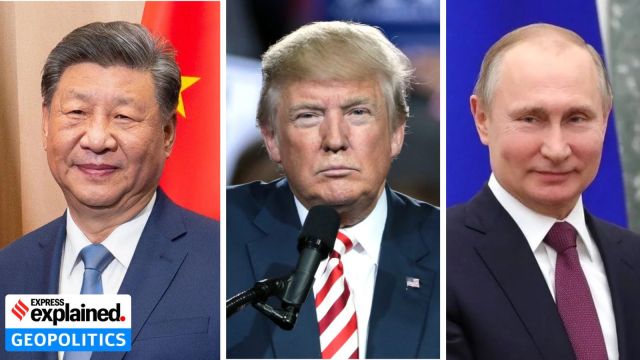
The main American story to draw a notable response in China, Ukraine, and India in recent days was not Washington’s domestic agenda itself, but its foreign-policy expression: the first in-person trilateral meeting of the leaders of the United States, China, and Russia in Shenzhen on November 19, alongside the Trump administration’s push to accelerate negotiations to end Russia’s war against Ukraine. For Beijing, this is almost a model of the kind of peace it wants: great powers talk directly without turning competition into a rupture in ties. For New Delhi, the same format looks more troubling: it could normalize the division of spheres of influence and undermine confidence in the United States as a reliable partner in Asia. In Kyiv, meanwhile, there are fears that Washington’s diplomatic urgency could give Russia an opportunity to achieve politically what it has not been able to achieve fully by force.
China’s debate around the summit has focused above all on Beijing’s symbolic victory. In a CGTN analysis, Zheng Changzhong, a professor at Fudan University, calls the fact that the three powers spoke directly a signal of “restraint and rationality,” and insists that China is not building an exclusive bloc or seeking to act as an arbiter between Moscow and Washington. This caveat matters: official Chinese rhetoric seeks to present Shenzhen not as a new “Yalta,” where the powerful divide up the world, but as infrastructure for ongoing crisis communication.
That is why, in Chinese commentary, the creation of a forum matters more than the lack of a breakthrough on Ukraine. In the official account of the meeting, Xi Jinping set out China’s position in stark terms: “When great powers get along, the world is at peace; when they fight, the world is thrown into turmoil.” He called not for “decoupling supply chains” or power-based rivalry, but for trade cooperation, stable energy supplies, and mechanisms to prevent miscalculation and escalation. In the declaration adopted after the meeting, the parties recorded their intention to discuss reducing nuclear risks, ensuring stable energy flows, and reforming the UN—but they produced neither a road map for Ukraine nor a new arms-control agreement. (thepaper.cn)
Beijing sees this as evidence that the United States, despite its strategic rivalry with China, has to recognize China as an equal interlocutor on global issues. But China’s reaction is far from a simple triumphal celebration. Even writers close to the official discourse stress that the summit’s significance lies not in a major one-off deal, but in creating a channel of communication that can help manage conflicts. In other words, the ideal outcome for China is not an American concession, but the entrenchment of a model in which Washington cannot make decisions about global security without Beijing.
India’s response to the same picture is markedly less favorable. In an editorial in The Indian Express, the Shenzhen format is viewed through a double lens of risk: closer China-Russia ties and the Trump administration’s willingness to strike situational deals with Beijing and Moscow. The paper writes explicitly that traditional US security guarantees in Asia can no longer be taken for granted because of the “America First” doctrine and US involvement in wars in Eastern Europe and West Asia.
For India, the problem is not dialogue between the United States and China or Russia in itself. New Delhi has long built its diplomacy around working with multiple centers of power at once. The concern is something else: if agreements between Washington, Beijing, and Moscow become the preserve of a closed club, countries directly affected by their decisions will have too little influence. In an explainer for The Indian Express, journalist Shubhajit Roy links this concern to a concrete Indian interest: its long border with China. In his view, a stronger Beijing without clear constraints could increase pressure on India in the Himalayas. New Delhi therefore sees the meeting of the US, Chinese, and Russian leaders not as the end of rivalry, but as a test: will Washington retain the ability to negotiate with China while also deterring its coercion in the Indo-Pacific?
Indian political scientist C. Raja Mohan offers a particularly characteristic formulation in his column: today, great powers are “balancing and bargaining” at the same time. In other words, the United States may strengthen the Quad—a grouping of the United States, India, Japan, and Australia—and almost simultaneously seek a personal understanding with Xi Jinping and Vladimir Putin. New Delhi’s conclusion is not that it must choose a side, but that it should expand its own capabilities and ties with ASEAN, Japan, Australia, and the United States. Under Trump, American policy is seen not as a foundation on which India can rely unconditionally, but as an important, if changeable, resource.
Trilateral diplomacy has the most painful repercussions in Ukraine. The Ukrainian response focuses less on the Shenzhen summit itself than on the question of what kind of peace Washington wants to bring closer. President Volodymyr Zelenskyy said the American side had raised a hypothetical question: would Ukraine agree to leave the unoccupied part of Donetsk Oblast in exchange for NATO membership? In a DW article in Ukrainian, experts interviewed call the idea speculative and dangerous because it ties the country’s security to giving up territory that Russia has not even been able to capture in full.
For Kyiv, the key difference between the Chinese and Ukrainian perspectives is that China sees negotiations among great powers as a way to reduce the risk of war, while Ukraine fears that the great powers will start discussing its future without it. Ukrainian diplomat Yevhen Perelyhin warns in a column for Ukrainska Pravda that Russia’s formula of “eliminating the root causes of the conflict” conceals an effort to restore its sphere of influence and establish a new European security order in which Ukraine would be an object, not a participant, in negotiations. This is no abstract dispute over terminology. For Ukrainian audiences, “compromise” is acceptable only if it does not reward aggression or leave Russia in a position to start another war.
Reports about the timeline Washington is setting are adding to the concern. Citing the Financial Times, Ukrainska Pravda reported that the US administration would like to secure a peace agreement by early January 2027. From Ukraine’s perspective, the haste is dangerous in itself: Moscow can afford to wait, while Kyiv risks coming under deadline pressure. The words of an unnamed European source—“The Americans are in a hurry, but Putin isn’t”—neatly capture the anxiety behind the local debate. [“The Americans are in a hurry, but Putin isn’t.”] (pravda.com.ua)
Against this backdrop, China, India, and Ukraine share a broader conclusion about the United States after the US midterm elections: Trump’s domestic political weakening does not automatically mean a change in foreign policy. Chinese experts cited by Fudan University believe the bipartisan consensus on viewing China as the main economic and geopolitical rival will endure; a change in control of Congress may only increase the “friction factor.” Indian commentators likewise see the elections as a constraint on the president, but not as an end to his freedom of maneuver in foreign policy. Ukraine, by contrast, fears the opposite effect: eager to secure a diplomatic legacy before the new Congress takes office, the White House could push negotiations faster than military and political realities warrant.
The most unexpected feature of today’s international view of America is that the United States is seen simultaneously as indispensable and as a source of uncertainty. China welcomes a Washington prepared to acknowledge the need for dialogue among great powers, but does not believe the United States will give up competing with it. India wants closer cooperation with America in the Indo-Pacific, but is preparing for the possibility that Trump will seek bilateral deals with its rivals. Ukraine still needs US involvement for its own security, but fears that American mediation could turn the question of a just peace into a question of how quickly a deal can be reached.
Shenzhen has therefore not created a new world order, but it has sharply brought its contours into focus. China proposes treating direct dialogue among great powers as insurance against chaos. India insists that such dialogue must not replace rules and alliances with closed-door bargaining. Ukraine reminds the world that a lasting peace is impossible if the country where the war is being fought is relegated to the role of a spectator. US foreign policy is at the center of all three discussions today—but in none of them does the United States look like the sole author of the script.