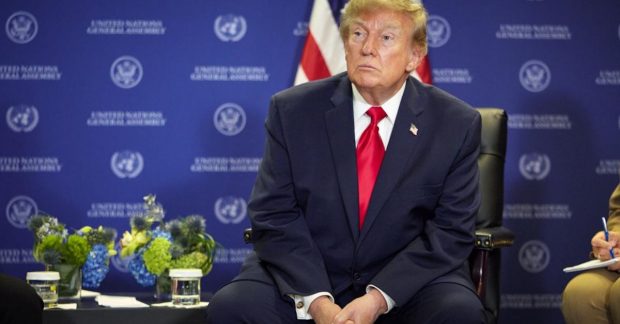
Three stories about the United States have converged in Ukrainian, Chinese and Japanese discussions: Washington’s diplomatic push over Russia’s war against Ukraine; the APEC summit opening in Shenzhen on November 18 and the first in-person meeting of the leaders of China, Russia and the United States, scheduled for November 19; and the fallout from the Republicans’ defeat in the US midterm elections. In Kyiv, Beijing and Tokyo, the debate is less about US domestic politics itself than about what Donald Trump’s weakened position at home means for his room to maneuver abroad. The shared concern is that a president constrained by Congress may be even more inclined to seek a quick, high-profile foreign policy win. But the implications of that concern differ sharply. For Ukraine, the risk is a peace deal struck at its expense; for China, a chance to entrench a model of “managed competition” with the United States; and for Japan, the danger that East Asian security will become a bargaining chip in a grand US-China deal. Japanese economist Toru Nishihama, in an analysis for the Dai-ichi Life Research Institute, calls the Shenzhen meeting a possible “major milestone” in the debate over the postwar international order, linking it to Trump’s desire to build a political legacy after the Democrats’ success in the elections. (dlri.co.jp)
Ukraine’s response centers on the United States’ efforts to expand ceasefire negotiations into a discussion of the European security architecture—including NATO rules and the deployment of troops in Europe. For Kyiv, this is not a technical detail but a dangerous shift in the framework: if the deal covers not only a ceasefire and guarantees for Ukraine but also Russia’s demands regarding NATO, the aggressor could turn its invasion into a tool for reshaping security across the entire continent. ZN.ua reports that US envoys Jared Kushner and Steve Witkoff are pressing Europeans and Ukrainians to discuss these issues, and that the talks are being accelerated because a new Congress with a Democratic majority will take office in January 2027. (zn.ua)
This explains Ukraine’s characteristic distrust of Washington’s “urgency.” Political scientist Ihor Petrenko writes in a column for UNIAN that behind the sound phrases about ongoing consultations, crisis communications and military transparency may lie pressure on a country at war to accept a quick deal. His conclusion is particularly important: diplomatic activity does not in itself amount to security if it creates a mechanism through which Moscow gains veto power over Ukraine’s European choices. A poll by the Kyiv International Institute of Sociology also confirms this public wariness: the share of Ukrainians who believe the United States is tired of the war and is pushing Kyiv toward an unjust peace has risen to 52%. (unian.ua) Ukraine’s distinctive perspective is that it does not expect US policy to automatically change when the balance in Congress shifts. In an analysis for Ukrainska Pravda, Serpens Center Executive Director Maryna Hrytsenko stresses that Ukraine will have to compete for the attention of US lawmakers with Iran, investigations into the administration, budget disputes and rising fuel prices. (pravda.com.ua) In other words, Ukrainians see a Democratic Congress not as a guarantee of aid, but as an additional channel for pressuring and overseeing the White House.
China’s discussion ahead of the summit is structured differently: Beijing presents the November 19 meeting not as a personal triumph for Trump or as negotiations over dividing spheres of influence, but as an opportunity for three permanent members of the UN Security Council to “manage their differences” and stabilize relations. Foreign Ministry spokesperson Mao Ning called the upcoming meeting of the Chinese, Russian and US leaders the first in-person format of its kind in history, saying closer communication among the three countries serves not only the participants’ interests but those of the international community as well. This formula—“stability through communication”—recurs in Chinese coverage. The Paper stresses the need for dialogue and managing differences, while another article by the outlet describes US-China contacts as a network of talks on trade, security, military ties, people-to-people exchanges and artificial intelligence. (thepaper.cn)
Yet behind the language of stability lies a much more practical Chinese calculation. Chinese commentators see Trump’s visit to Shenzhen amid his domestic political difficulties as proof that even an administration elected on hard-line rhetoric needs predictable economic relations with China. In Beijing’s reading, this is not an American surrender but an acknowledgment of mutual dependence: a trade truce, tariff exemptions, investment channels and dialogue on AI risks matter more than slogans about severing economic ties. Significantly, China contrasts “de-risking” with a complete rupture in relations: the point is to institutionally constrain competition, not to end it. (thepaper.cn) Beijing stands to benefit particularly from the image of China as the venue where America and Russia talk—not to each other amid a crisis, but with China as host. This allows China to raise its standing as a convening power while pushing US efforts to build an anti-China bloc in Asia into the background.
Japan’s reaction is the most nervous, precisely because Tokyo is a US ally but not a participant in the US-China-Russia format. In Japanese commentary, Trump appears politically weakened after the midterm elections, but all the more capable of pursuing riskier personal diplomacy. Nippon.com warns that Trump becoming a “lame duck”—a politician with diminishing ability to advance his domestic agenda—could push him toward rash, poorly calculated foreign policy moves in pursuit of a legacy. (nippon.com) And Toyo Keizai states Japan’s main fear even more directly: in pursuit of a major trade deal with Xi Jinping or a symbolic diplomatic victory, Washington might put Taiwan on the bargaining table, along with the scope and mission of the US military presence in Japan and South Korea. (toyokeizai.net)
This is how an unusual divergence emerges among the three perspectives. China sees a weakened America as a partner more inclined toward pragmatic dialogue; Ukraine sees a mediator who may favor speed over justice; Japan sees an ally whose unpredictability has become a threat in its own right. At the same time, all three countries agree on one thing: the decisive factor is not some abstract “American power” but Trump’s personal diplomacy, increasingly detached from a stable domestic political mandate. The Shenzhen summit is therefore seen as more than just another leaders’ meeting. For China, it is a test of whether it can turn competition with the United States into a managed order; for Ukraine, a test of whether European security will become the price of an American political deadline; for Japan, a moment to find out whether its alliance with the United States will remain the foundation of the regional balance or become one item in a grand bargain among powers.