Today’s roundup looks at concerns that U.S. diplomacy on Donbas could give way to Russia’s territorial demands, and Washington’s caution toward Iran. Reports from Japan show how election results and parliamentary processes constrain Trump’s options, complicate his tariff agenda, and cast doubt on the durability of U.S.-China relations—an issue of major importance to Tokyo. Disputes over the accountability of the administration and military leadership are also in focus. The roundup is based on reporting by Zaxid.net (Ukraine) and Asahi Shimbun (Japan).
Kyiv Rejects Giving Up Donbas in Exchange for Peace
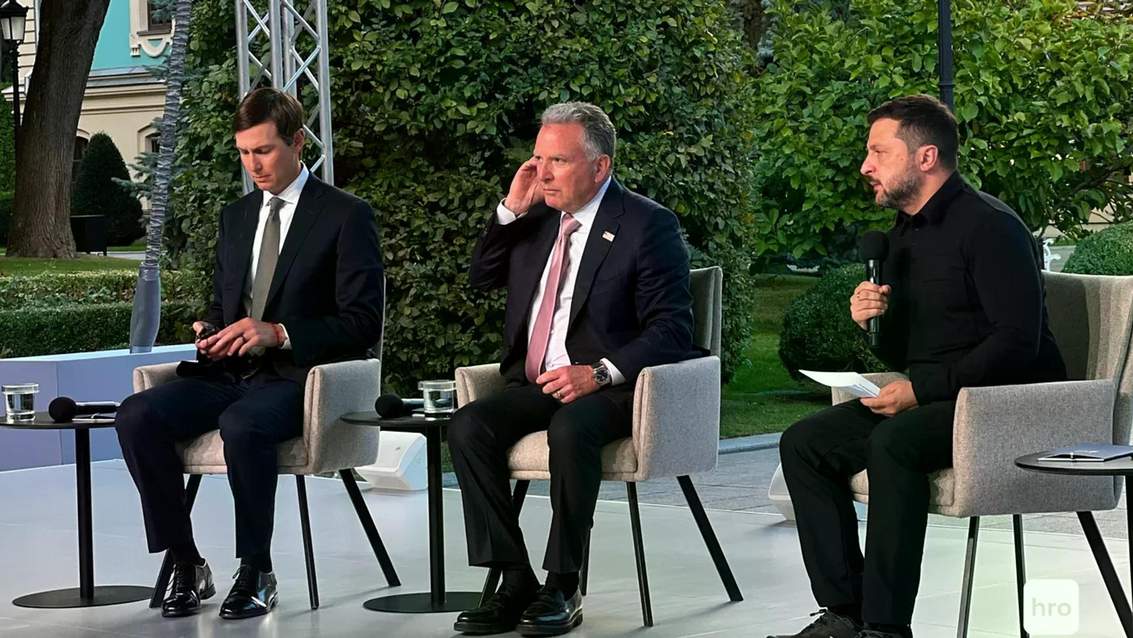
Ukraine is not prepared to discuss ending the war at the cost of voluntarily giving up Donbas, President Volodymyr Zelensky said amid reports of possible U.S. proposals for a peace settlement. According to ZAXID.NET, Washington has had to look for other “modifications” to its approach to the region because territorial concessions remain fundamentally unacceptable to Kyiv.
Speaking in Dublin, Zelensky rejected the suggestion that Ukraine should “leave” Donbas to reach an agreement with Russia. He said such an approach concerns not an ordinary territorial dispute, but the foundations of Ukrainian statehood. “You cannot talk to us that way when the independence of our country is at stake,” the president stressed.
Zelensky did not disclose all the options discussed with the U.S. side, but noted that he had heard various proposals. In Kyiv, this is seen as a sign that Ukraine has not accepted the initial premise—that giving up Donbas might be a condition for peace. The United States is therefore being forced to seek formulas that would not look like a direct reward to Russia for invading and seizing Ukrainian territory.
For Ukraine, Donbas matters militarily, legally, politically, and socially. Giving up territory would contradict the principle of the country’s territorial integrity and set a precedent for further demands from Moscow. Bringing Ukrainian-held cities under Russian control would threaten their residents, local self-government, economies, and Ukrainian identity.
Kyiv is also concerned that changing borders to allow Russia to declare the complete capture of Donetsk and Luhansk regions would amount to diplomatic recognition of its military conquests. Ukraine’s distrust of such scenarios is reinforced by its experience since 2014: the occupation of Crimea, the start of the war in Donbas, and the failure of previous agreements to secure lasting peace.
The Ukrainian president also underscored the role of the United States. In his view, achieving peace depends largely on whether Washington puts pressure on Russia rather than demanding concessions from a country that has been subjected to aggression. Ukraine’s position is that the outcome of negotiations should be determined by the partners’ ability to make Moscow end the war, not by Kyiv’s willingness to accept the loss of part of its territory.
Against this backdrop, Donald Trump’s remarks about a possible “big, beautiful deal” after which Ukraine would survive but be “a little different in shape” have raised concerns in Ukraine. In American political rhetoric, this might describe a pragmatic compromise. But in Ukraine, such wording is directly associated with the risk of losing sovereignty and legitimizing the occupation.
For Kyiv, then, Donbas is neither a bargaining chip nor a technical question of administrative borders. Any peace proposal will be judged above all by whether it strengthens Ukraine’s security and independence or entrenches the consequences of Russian aggression.
Japan Fears a U.S.-China “Stability Trap”
Closer ties between Washington and Beijing could alter Japan’s strategic position and risk leaving Tokyo on the sidelines of decisions made by the world’s two largest powers. That is the conclusion drawn in an interview with Asahi Shimbun by University of Tokyo professor Ryo Sahashi, who warns that U.S. efforts to stabilize relations with China do not necessarily serve the interests of their Asian ally.
Sahashi believes Washington is increasingly interested not in sustained competition with Beijing, but in managing bilateral relations predictably. One factor has been China’s restrictions on rare earth exports, which have shown how costly and ineffective a prolonged confrontation can be. The U.S. approach is changing, the expert says: “Stabilizing relations is more advantageous in terms of costs and returns.” At the same time, he believes China’s strategic priority for the United States is declining.
This trend is alarming for Japan. The country lies close to China, has serious territorial and military-political disputes with it in the East China Sea, and directly links its own security to stability around Taiwan. Tokyo therefore sees a thaw between the United States and China not as an unequivocally positive development, but as a possible source of new risks.
A scenario in which stability between Washington and Beijing is secured through concessions to China would be especially dangerous for Japan. This could include limiting U.S. arms sales to Taiwan. Such steps could weaken regional deterrence, change the balance of power in the Taiwan Strait, and indirectly increase Japan’s own vulnerability.
Sahashi believes China is skillfully exploiting the Donald Trump administration’s desire for “structural stability” between the two powers. “The situation is developing entirely in China’s favor,” he says. In his view, stable relations with the United States give Beijing an opportunity to pursue at least two important goals: curbing U.S. arms sales to Taiwan and strengthening its own historical and political interpretation of the postwar international order.
Japan’s circumstances make this issue particularly sensitive. The article notes that a year has passed since Prime Minister Sanae Takaichi’s parliamentary remarks about the possibility of a crisis involving Taiwan. Relations between Tokyo and Beijing have deteriorated since then, while the United States and China have held a series of summits and sought to establish a more durable framework for negotiations.
This contrast reflects Japan’s main fear: the two superpowers could agree on the rules for dealing with each other without fully taking their allies’ interests into account. In that case, Tokyo risks having to adapt to decisions already made, despite their direct consequences for security in East Asia.
Japanese diplomacy still faces a difficult dual task. On the one hand, the country needs a reliable alliance with the United States and stronger defense capabilities of its own. On the other, Japan cannot ignore China as its largest neighbor, a vital economic partner, and a source of major regional risks. This makes it necessary to restore working channels with Beijing even amid political and military disagreements.
Sahashi’s interview suggests that U.S.-China “stability” should be viewed not only as a means of preventing conflict. If it allows Beijing to pursue its political goals without giving up pressure on Taiwan, Japan, and the existing regional order, that stability could become a trap for Tokyo.