In early May 2026 the image of the United States in the international press increasingly resembles less the old stereotype of a “pillar of stability” and more a country that, while still indispensable, provokes growing frustration with its inconsistency. In Ukrainian, French and Israeli debates about the US the same themes keep resurfacing: fatigue with American volatility, anxiety about deals “over allies’ heads,” and an effort to adapt to a world in which Washington remains powerful but is no longer predictable.
In the Ukrainian discourse America is still the main foreign-policy factor determining the outcome of the war and the shape of the future peace. But the tone has noticeably grown more nervous. Kyiv commentators write about a “reassessment” of America’s role in NATO and in Ukraine after Donald Trump’s statements that the US “should not have intervened in a war” thousands of miles from its shores; European Pravda cites this, emphasizing that the same doubts extend to Alliance membership itself.(eurointegration.com.ua) Ukrainian analysts note that the new American team is simultaneously negotiating peace with Russia in Abu Dhabi and Geneva, tying even future security guarantees to Kyiv’s willingness to make concessions over Donbas. In a review of early February talks the Ukrainian Institute for the Future explicitly writes that, according to sources, the US is willing to grant guarantees only after Ukraine agrees to a treaty and troop withdrawals — which in Kyiv is read as pressure toward a “peace at the expense of territory.”(uiamp.org)
The French perspective is structured differently. In Paris the discussion about the US long ago turned into a conversation about Europe itself. The Ukrainian site European Pravda, which has a wide Western audience, published a column by Anton Filippov on how Trump changed US foreign policy and pushed Europe toward strategic autonomy: the less confidence there is in Washington’s willingness to “unconditionally guarantee the continent’s security,” the more actively Paris and Brussels build their own defense architecture.(eurointegration.com.ua) In the French and France-adjacent expert field this idea is taken further. In a “dispatch from Kyiv” for the Atlantic Council it is emphasized that the new American line — reduced aid to Ukraine, easing sanctions on Russian oil, a more conciliatory stance toward Moscow in talks — was a shock for Europe but also a catalyst: Paris is taking on the role of engine of the coalition supporting Kyiv, including through proposals discussed in France to deploy limited allied contingents “far from the front line,” which President Emmanuel Macron in 2025 explicitly distinguished from classic “peacekeeping.”(atlanticcouncil.org) In this logic the US is no longer the “senior partner” but a large, capricious power to be dealt with pragmatically.
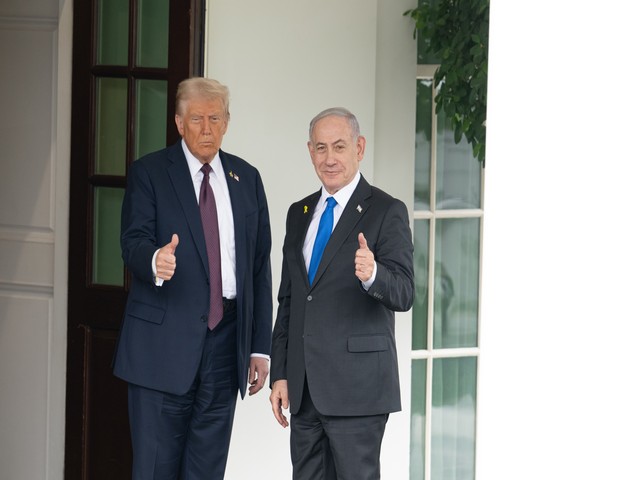
The Israeli perspective predictably centers on the triangle “US — Israel — Iran,” but here too the key word is uncertainty. Against the backdrop of a shift from intense combat to diplomacy on multiple fronts — Iran, Lebanon, the Gaza Strip — Israeli analysts stress that the US sets the parameters: the Washington foreign-policy establishment itself frames that two of the three critical tracks for moving “from war to diplomacy” — on Iran and Gaza — are effectively being led under American auspices.(washingtoninstitute.org) At the same time, in the right‑wing press such as Israel Hayom Benjamin Netanyahu’s trip to Washington in February was described not as a routine ally visit but as a defensive mission: the Israeli prime minister, in their formulation, fears a “limited nuclear deal” between the US and Tehran that would not touch Iran’s proxy networks, missile arsenal, and the regime’s repressive behavior.(israelhayom.com) On another flank, analysts from the right‑leaning research center Misgav, reviewing the recent large-scale Operation Epic Fury against Iran, try to remind audiences what a “real US–Israel alliance” looks like: coordinated strikes, intelligence sharing, involvement of US Arab partners. But even they acknowledge that 2026 is not 2003 and that American society and politics are far less prepared for a prolonged conflict.(misgavins.org)
A common theme across all three countries is the sense that US foreign policy is no longer a linear extension of past commitments. Ukrainian publications emphasize that in 2025 American support sharply declined, and in 2026 its absence became a “key reason” for Ukraine’s increased vulnerability, as noted in the Swedish analytical report by SCEEUS, which is widely cited in Kyiv.(ui.se) Against this background ideas are emerging about closer military-technical cooperation as a way to keep America engaged: Ukraine proposes to the US and Europeans an exchange of “Ukrainian drones for American systems” within post-war arrangements — a topic raised by European Pravda, which emphasizes that by 2026 Ukraine’s readiness for such a deal has only grown.(eurointegration.com.ua) From the Ukrainian point of view, this is a pragmatic response to the new Washington: if ideological solidarity has weakened, one must offer mutually beneficial formulas.
In France, by contrast, talk about the US is increasingly used as an argument for strengthening national sovereignty. For French and pro‑French analysts it is telling that the same Washington, which today is restrained in supporting Ukraine, is simultaneously “shifting focus” to a war with Iran, as Defense News notes in a piece on how the Middle East conflict is “sapping” resources needed to monitor a peace agreement for Ukraine. The article cites CSIS experts who state bluntly: without the American “umbrella” of air-defense, intelligence, and rapid-reaction forces even an enhanced European peace mission would be fragile.(defensenews.com) French commentators interpret this two ways: on one hand, confirmation of US indispensability; on the other, a signal that Europe should be ready to substitute part of the American role if Washington ultimately chooses the Middle East over Eastern Europe.
The Israeli conversation about America is even more contradictory. On one hand, reports from influence groups like AIPAC proudly highlight that the US budget for fiscal year 2026 again includes billions for joint security and defense programs, from missile defense to joint scientific projects; this is presented as proof that the “special relationship” is alive.(aipac.org) On the other hand, a fresh poll by the Jewish People Policy Institute (JPPI) shows that within Israeli society attitudes toward continuing the war and negotiating its end are strongly tied to the US factor. A significant portion of the population allows for continued hostilities, but the poll records a noticeable desire to “stop and move to agreements if done in coordination with the US”; this is particularly pronounced among centrist and center-left segments.(jppi.org.il) Israelis, judging by this data, intuitively understand: without the American umbrella and diplomatic backing any move — whether to continue the war or to pursue peace — becomes too risky.
Another, less obvious but striking theme is the changing image of Israel within American society and its reciprocal impact. An analytical note from the Israeli Institute for National Security Studies (INSS) states that in a recent international comparative survey Israel was perceived as closer to countries “viewed as hostile to the US” — Russia, Iran, China — than to traditional allies, and even less favorably perceived than problematic partners like Saudi Arabia and Turkey.(inss.org.il) For Israeli elites this is an alarming signal: if the political “cover” in Washington that Israel relied on for decades erodes under public opinion pressure, then the US itself will become a less reliable partner. That is why the Israeli press scrutinizes every prime ministerial visit to the White House, every hint of a “limited deal” with Iran, every delay in the next package of military aid so intensely.
Curiously, the Ukrainian and Israeli discourses sometimes mirror each other. In Kyiv reports are quoted with irritation that the Pentagon allegedly considers redirecting important weapons intended for Ukraine to the war with Iran; Secretary of State Marco Rubio had to publicly deny such plans while at the same time “not rule out” such a scenario in the future, which in the Ukrainian press sounds ambiguous.(eurointegration.com.ua) In Israeli analytical circles, however, a war with Iran and an increased American presence in the Middle East are seen as a necessary condition to deter Tehran — even if it comes at the cost of weakening the American focus on Eastern Europe. The same adjustment of American priorities is perceived differently by countries standing on opposite sides of the conditional front line “Ukraine — Iran.”
Against this backdrop the French debate about the US seems almost philosophical. For French strategists what matters is not only Washington’s reaction to specific crises but also the broader evolution of America’s role in the world. European analysis increasingly uses the term “reassessment” of American guarantees, not only in the military but also in the economic sphere: French economic reviews and Israeli macroeconomic digests closely watch US growth indicators and the dynamics of the S&P 500, Nasdaq and Dow Jones, since America’s financial power remains the foundation of its foreign-policy influence.(gov.il) But now that influence is perceived as less disinterested: the US increasingly acts like a “portfolio investor” reallocating resources among “assets” — Ukraine, Israel, Iran — in search of better strategic “returns.”
Each country also develops its own, sometimes unexpected, emphases compared with the American press. In Ukraine, where the war has become the central nerve of society, US foreign policy is discussed not just as abstract geopolitics but as a factor in the survival of universities, the social system and the economy. A spring study on the emigration of Ukrainian scholars directly links the scale of researcher outflow to fluctuations in Western, and especially American, aid, which determines the possibility of continuing scientific projects at home.(arxiv.org) This is a very different angle on the same “American inconsistency” than the one found within the US.
In France the topic of America is tightly interwoven with internal cultural debates: the US is simultaneously criticized for “rough unilateral realism” and seen as a source of inspiration for discussions about democracy, the rule of law and minority rights. But a fatigue with the role of “junior partner” is notable: many commentators clearly want to speak about the US not as the main protagonist on the European stage, but as an important — though not sole — player.
Israeli texts about the US are often structured as attempts to delineate where the boundary of permissible disagreement with Washington lies today. How much autonomy can Israel allow itself on the Iran, Palestinian and Lebanese tracks without risking the alliance? In analyses by Misgav, INSS and other centers this issue is almost obsessive: Israel must simultaneously convince the American elite that it remains an indispensable military partner in the era of “Iran‑2026, which is nothing like Iraq‑2003,” and reassure Israeli society that without the American partner the country will not be left to face regional threats alone.(inss.org.il)
Putting these three different perspectives together produces not a black‑and‑white image of America as hegemon or “declining empire,” but a much more complex picture: the US remains the center of global power distribution, but it has ceased to be a moral and political “constant luminary” even in the eyes of its closest partners. For Ukraine it is a source of anxiety and an incentive to seek pragmatic, mutually beneficial formulas with Washington — from arms deals to tough negotiations over security guarantees. For France it is a reason to build a Europe capable of acting with the US and, if necessary, without it. For Israel it is a painful recalibration of the boundaries of trust in American public opinion and elites, on whom the very existence of the familiar construct of “special relations” depends.
In this sense today’s foreign conversations about America are less about discussing Washington than an admission that the era of unconditional reliance on the US is over. Now each country — from war‑torn Ukraine to longstanding ally Israel and the European power France — must learn to live in a world where America remains necessary but is no longer guaranteed.