At the start of 2026, conversations about America in New Delhi, Canberra and Seoul are surprisingly similar and at the same time very different. Everywhere people are discussing a new turn in Washington’s tariff policy, the return of Donald Trump’s harsh, personalized style of foreign policy, his struggle with China and the fate of US alliances in Asia. But in each country this is refracted through its own fears and interests: in India — through the painful experience of a trade war and the dispute over Russian oil; in Australia — through anxiety about a possible war over Taiwan and the militarization of the Pacific; in South Korea — through the question of how reliable the American “nuclear umbrella” remains and how to behave between an unpredictable Washington, Beijing and Pyongyang.
The central themes now shaping the discussion about the US can be reduced to three. First, the radically changed trade and economic policy of Washington, from global “universal” tariffs to a sudden easing toward India. Second, the China factor: Taiwan, the South China Sea, US military presence in the Pacific and the creation of new alliances into which Washington is actively drawing India and Australia, and in a softer form — South Korea. Third, America’s image and the degree of trust in the US as a global leader and a democracy: here Trump has become as important a theme as US institutions themselves.
Trade storm and a “quiet” revision: how India reads between Washington’s lines
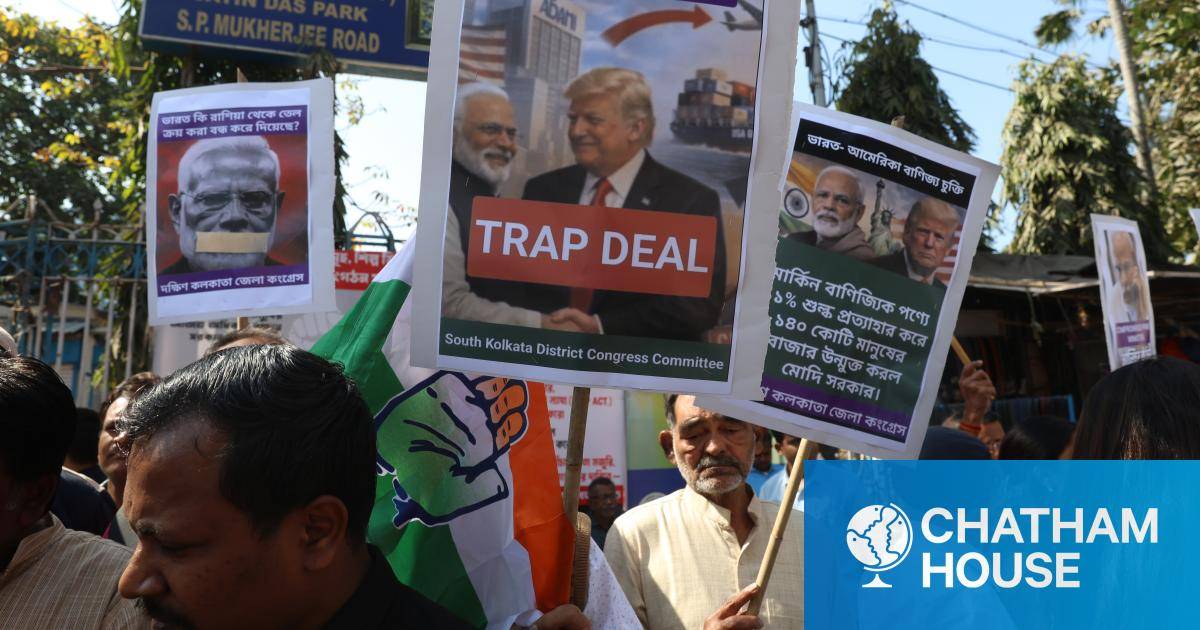
In none of the three countries is current US trade policy discussed as emotionally as it is in India. After almost a year and a half of a tariff war, when the overall level of duties on Indian exports to the US rose to 50% and was among the highest in the world, February’s “reset” in relations — a cut to 18% as part of an interim agreement — is perceived simultaneously as relief and as a warning. Analyst Chietigj Bajpaee, in a comment for Chatham House, emphasizes that the agreement, which formally opens the way to a bilateral trade deal, only partially eases tensions and leaves many ambiguities, especially around India’s promises to reduce purchases of Russian oil and the scale of its future purchases of American energy and technologies. As he notes, a year of hostile tariff rhetoric and Trump’s disparaging comments about India’s “dead economy” have left a deep mark, and New Delhi is settling on a strategy of “pragmatic hedging” — expanding a network of other trade deals from the EU to New Zealand so as not to be hostage to a single Washington. This analysis spells it out clearly: even a “victory” in the form of lower tariffs does not restore trust — India will remain committed to strategic autonomy and will view the US as an important but insecure partner. (chathamhouse.org)
Inside India itself the agreement became a reason for more political scrutiny. In a blog on ABP Live political commentator Arian Kumar carefully analyzes the “politics of words” in the revised White House fact sheet. Initially Washington had publicly written that India had “committed” to purchase more than $500 billion of American goods, to cut the digital tax and to lower duties on some agricultural products — including pulses sensitive to Indian farmers. After objections from New Delhi those formulations were quietly softened: “committed” was changed to “intends”, mentions of pulses and of an immediate repeal of the digital tax disappeared. Kumar shows how a technical document turned into a “political spark”: Washington wanted to present the deal as a unilateral Trump victory in the name of the American farmer and corporations, while Modi needed to convince his audience that rural interests and fiscal sovereignty had not been surrendered. In the Indian press this episode is read as a symptom of a broader problem: under Trump the US tends to first oversell any agreement to domestic audiences and only then adjust details if partners protest. (news.abplive.com)
Here an interesting counterpoint arises: economic analysts cited, for example, in the monitoring of the Indian economy on the website of the Embassy of India in Thailand try to reassure business by saying that the new “global” tariff of 10–15% after a US Supreme Court decision limiting Trump’s emergency powers to impose tariffs even makes India’s position relative to other countries not so bad. Market veteran Samir Arora emphasizes that because the tariff was raised for everyone, India is “not singled out” as a target, and its export-promotion programs partially cushion the blow. Indian think tanks see the US court decision as a restoration of Congressional control over trade policy — and a geopolitical “window of opportunity” to renegotiate a more predictable deal with the US. (thaiindia.net)
The Australian view: between “America’s spear” and “China’s target”
For Australia the United States is first and foremost about the military and political architecture in the Indo-Pacific region, not tariffs. The leitmotif here is duality: the US is still seen as the main guarantor of security, but trust in American leadership and in the image of Trump is clearly eroded.
Last year ABC looked in detail at how the US is turning Pacific islands — Guam, Palau, the Federated States of Micronesia — into a “second island line” of military deterrence against China: building radar stations, modernizing ports, reviving World War II–era airstrips, and the US defense secretary called the islands “the tip of America’s spear.” For people in the region, quoted by Australian journalists, that metaphor sounds ominous: former Guam delegate to the US Congress Robert Underwood says, “if you live in Guam, you feel like expendable material in the event of a conflict,” and locals are not thinking about geostrategy but about their homes becoming “targets” for Chinese missiles. (abc.net.au)
Australian writers use these stories as a mirror of their own fears. The growing US military presence in the region, cooperation under AUKUS and the expansion of American infrastructure in Australia are seen simultaneously as a “insurance policy” against China and as a factor that makes Australian bases primary targets in the event of war. It is important that Australian coverage actively cites public-opinion experts: a Pew poll referenced by ABC showed that most Australians now prefer to deepen economic ties with China rather than with the US, even though views of China and Xi Jinping remain largely negative. The result is a paradox: in security Australia is leaning ever more heavily on Washington, but economically society is moving closer to Beijing. (abc.net.au)
This ambivalence is especially pronounced in reactions to US decisions on Taiwan and the South China Sea. When ABC reports Trump’s statement that he will “soon decide” whether to send additional arms to Taiwan, despite direct warnings from Xi Jinping, it is presented as another episode in a chain of steps “capable of angering China” and accelerating an arms race. The same piece also discusses US plans to deploy new missile systems in the Philippines and the joint Washington-Manila statement condemning China’s “illegal, aggressive and deceptive” activity in the South China Sea. For an Australian audience all this is woven into a single picture: the US is gradually returning to a strategy of hard deterrence, but under a leader whose impulsive decisions, in the eyes of many voters and experts, add extra risk. (abc.net.au)
Especially notable in the Australian debate are comparisons with China as an “alternative pole.” In coverage of the global Pew study ABC highlights that the share of Australians who consider it more important to develop economic ties with China rose from 39% to 53%, while preference for the US fell from 52% to 42%. At the same time, Trump’s image drags down perceptions of the US itself: trust that an American president “will do the right things in world affairs” fell more sharply than general attitudes toward the American people. For Australia this is not abstract: how predictable American policy seems will affect the willingness of elites and the public to take further steps to deepen military cooperation, whether that means hosting American bombers or joint submarine programs. (abc.net.au)
South Korea: America as a source of global turbulence
In South Korea current American policy is discussed less as a bilateral problem and more as part of global instability. Korean analysis, often published in the form of columns and digests, portrays Trump’s US as one of three “chaotizing” centers alongside revisionist Russia and an ambitious China. In a 2026 New Year review economic and political commentator Kevin Kim, writing for a Korean audience, calls the year marking the 250th anniversary of the founding of the US a time when the country “has never been so torn,” and its domestic polarization directly affects the global economy and security. He notes that even if Democrats win the midterms, Trump will continue to “pull tariff and executive-order levers arbitrarily,” undermining the predictability of international regimes on trade, climate and security. (seoultokyo.beehiiv.com)
Korean commentators draw an interesting line from American policy to local financial markets: already during the 2024 campaign the Korean business press wrote about how expectations about the US election outcome rock global markets, and the notion of a “Trump trade” became a symbol of bets on sharp moves in the dollar, Fed rates and defense stocks. This continues to resonate now, as the US Supreme Court’s decision to limit Trump’s use of emergency powers to impose tariffs is seen in Seoul as a rare example of how American institutions can “tame” the president’s personalistic style. (thaiindia.net)
At the same time, the theme of the reliability of American security guarantees almost inevitably arises in the Korean discourse. There are few direct, sharp anti-American outbursts right now, but a nervous question is heard beneath the surface: if the US so easily changes tariff policy toward allies and partners, how solid are its commitments to defend South Korea from the North? This intensifies a long-standing debate over a domestic nuclear option, the need for greater autonomy in intelligence and missile defense, and the diversification of foreign-policy ties, including a cautious cultivation of channels with China.
The common motif of Korean analytical texts is that the world is entering an era of “ad-hoc agreements,” when instead of the stable multilateral regimes that the US once played a leading role in building, we increasingly see temporary, situational alliances and deals: from arms supplies to Taiwan to narrowly specialized technology blocs. In this light America is no longer so much the “anchor” of the world order as another source of turbulence that one must learn to live with.
Common lines and unexpected differences
If you bring together these three sets of reactions, several common themes stand out.
First — a rise in strategic caution toward the US. India, even after tariff reductions, is building an “insurance net” of agreements with the EU, the UK and other partners and makes clear that its participation in American initiatives — from trade to new technological alliances — is limited by strategic autonomy. Australia is strengthening its military alliance with the US, but public opinion is clearly shifting toward economic rapprochement with China, which in the long term may limit how far any Australian government can go in anti-China steps. South Korea is moving the discussion to institutional guarantees: it is important that not only Trump’s words but also US courts, Congress and bureaucracy keep the country within predictable bounds.
Second — an erosion of America’s moral authority. Indian and Korean texts refer to American internal conflicts, polarization, disputes over the role of the Supreme Court, which undermine the traditional image of the US as an exemplar of democracy and the rule of law. Australian sociological data show a worrying trend for Washington: trust in Chinese leadership remains low, but faith in American leadership capacity has fallen significantly; the US is no longer perceived as the “natural” first choice for economic partnership. (abc.net.au)
Third — the “geo-economic” framing of the entire discourse about the US. Even when talking about military moves — missiles in the Philippines, arms shipments to Taiwan, bases in the Pacific — Indian, Australian and Korean writers almost always come back to consequences for trade, investment, currency stability and supply chains. For India the key question is whether its exporters of electronics and pharmaceuticals will benefit from new access to the US market or whether American tariffs and legal uncertainty will again leave them vulnerable. For Australia — how to balance income from trade with China and obligations to the American alliance. For South Korea — how to fit its high-tech industries into the US-China struggle over control of value chains without losing the Chinese market.
Against this backdrop the image of the US becomes less monolithic. Local commentators increasingly separate “America as a country” from “America as the Trump administration.” The Indian press can welcome lower tariffs and at the same time recall with irritation how easily those same tariffs were raised a year ago. Australian journalists can applaud US firmness in defending freedom of navigation while also showing how people in Guam or Palau feel like pawns on the great-power chessboard. Korean analysts can still see the American market and financial system as central to the global economy, but view the White House as a source of unpredictable shocks to be hedged against.
That is the main difference between today’s picture and the one that existed ten to fifteen years ago. Then the US was seen by many as an “imperfect but indispensable” center of order. Today India, Australia and South Korea describe America much more instrumentally: as an important, sometimes necessary, but by no means the only resource in the struggle for their own security, growth and autonomy. And the more chaotic and personalized Washington’s policy appears, the more persistently these countries seek ways to build a world in which their tomorrow does not depend on a single swing in American mood.