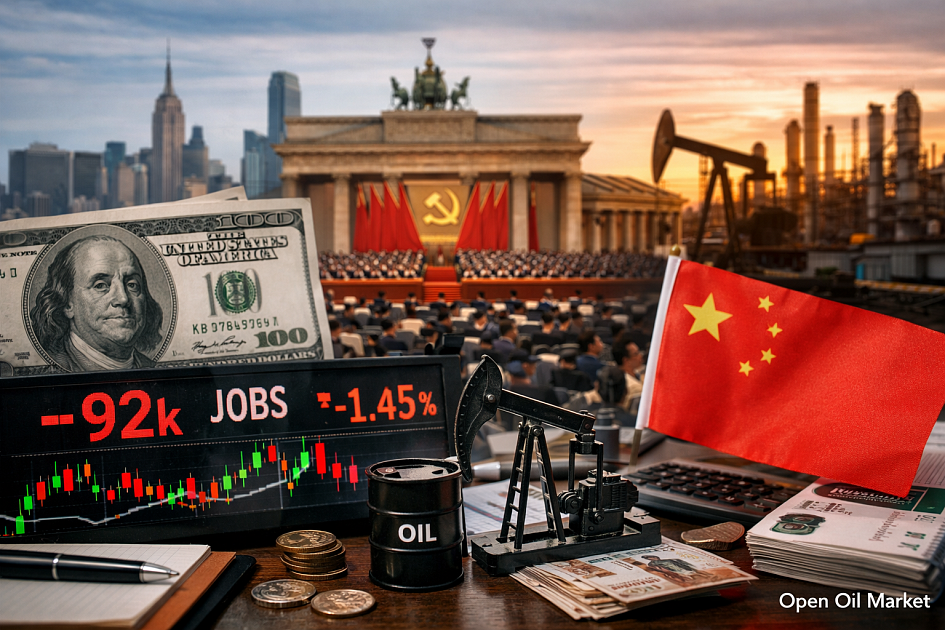
At the beginning of March 2026, the United States is seen almost everywhere primarily as a country of war and risk — military, financial, political. In the news, columns and expert texts from South Korea, France and China, the US appears in three major roles: as the main military actor in the new escalation in the Middle East, as a source of global economic uncertainty, and as an increasingly unpredictable political center under Donald Trump’s second term. In each society, discussion of America is closely intertwined with domestic fears and hopes: Koreans think about security and tariffs, the French about Europe’s sovereignty and inflation, and the Chinese about the risks of war and technological strangulation.
The first major storyline is the rapid buildup of US military presence in the Middle East and the related escalation around Iran. French analytical texts emphasize that this is “the largest US deployment in the region since the 2003 invasion of Iraq,” with massive use of air power, the navy and air defense systems against the backdrop of tough confrontation with Tehran over its nuclear program and the bloody suppression of protests in Iran in 2025–2026. (fr.wikipedia.org) French columnists see two threads here at once: on one hand, it is a return of the “old America” — a power that resolves crises through displays of force; on the other hand, it is a test of how willing European allies are to be drawn into a conflict they do not control. In one French piece on the “geopolitical shock of March 2026” the author directly links European market nervousness to expectations about US employment and Fed actions: the riskier Washington’s stance in the region looks, the more investors fret and the more attention is paid to any US economic data. (boursetechnique.com)
Chinese commentary views the same crisis very differently. In the Chinese media space there are assessments that American outlets “in their editorials repeatedly instill: ‘if a war starts between the US and China, China will have nowhere to go’” — described as part of an information war rather than sober military analysis. The author of a popular Chinese column reminds readers that the US military‑industrial complex is deeply tied to China’s raw materials base: about 87% of US defense-related rare earth needs are supplied by China, a single F‑35 requires hundreds of kilograms of rare earths, and after Chinese export restrictions prices for some items allegedly nearly tripled, forcing some projects to “slow down rather than simply ‘change suppliers’.” (toutiao.com) In this Chinese narrative, the US military buildup in the Middle East is another sign of an “empire running on fumes” that simultaneously depends on China and tries to contain it.
Overlaying this is a very recent agenda around US strikes on Iran and the broader Middle Eastern crisis: Chinese and overseas Chinese-language platforms discuss reports that “Trump finally struck Iran,” explosions near the US embassy in Saudi Arabia, Iranian threats to close the strait, and a “final battle in the Middle East.” (chineseinla.com) In these discussions the US appears both as an aggressor and as a player that is trapping itself in a protracted conflict. For France, by contrast, the American military pivot in the region becomes an argument for Europe’s “strategic autonomy”: if Washington is occupied with Iran and internal crises, the EU should rely less on the American umbrella.
The second persistent theme is the US economy as a source of global instability. French economic commentators in early March almost simultaneously write about the “markets’ nervous evaluation of US employment data” and debate whether the American economy will hit a “deflationary wall” or, conversely, trigger a new wave of inflation in 2026. One French analytical site reminds readers that with historically low household savings rates in 2024–2025, if the Fed continues to cut rates, inflation “is highly likely to return by the third quarter of 2026.” (lesakerfrancophone.fr) On another resource the author dissects how each new US labor market figure instantly reshapes expectations about Fed rates and stock prices: weak employment growth both pushes the Fed toward easier policy and signals an economic slowdown, and the balance between those factors determines the fate of growth sectors and cyclic industries worldwide. (sergeytereshkin.fr)
Chinese analytical texts go further and literally deconstruct the myth of “American exceptionalism.” One review piece cites the rise in the US deficit and debt burden, rating downgrades and forecasts from international institutions that say tariffs imposed by Washington “will primarily hit the American economy itself by 2026,” not China. (mbrb.greatwuyi.com) Chinese economists emphasize that sanctions and tariffs are a “double-edged sword”: in the semiconductor chain alone up to 400,000 US jobs are directly linked to exports to China, and January’s collapse in NVIDIA’s market value by tens of billions of dollars amid worsening expectations for the Chinese market is cited as an example that “sanctions and those punished by them ultimately converge on the same line in the profit and loss statement.” (toutiao.com)
The South Korean perspective is more pragmatic and alarmed at the same time. Here America is not an abstract center of capitalism but a key market and political suzerain capable at any moment of shaking up the rules of the game. Korean experts in studies on “dual uncertainty” directly warn that a second Trump administration means a hard “America First,” universal tariffs and pressure on allies over defense spending, and Seoul must be ready to adapt economic and defense policy to the “new America.” (freiheit.org) In analysis aimed at a business audience it is emphasized that major Korean investors in the US — battery, chip and car manufacturers — planned under Biden’s green and industrial agenda, and now fear a turn toward tariff wars and subsidy renegotiations. (reddit.com)
From this flows the third major block — perceptions of US politics and of Donald Trump. For South Korea this is primarily a matter of security and tariffs. Even during Trump’s first term many Koreans were outraged by his accusations that Seoul “does not pay enough for defense,” a point recalled in later English-language reviews. (aljazeera.com) The second term has intensified these fears: analysts in Seoul describe the situation as “double uncertainty” — domestic political turbulence after the emergency powers crisis and the simultaneous return to Washington of a leader who could “take” factories, jobs and even the foundations of the alliance. One Korean commentary quotes Trump saying that upon returning to the White House he would “bring back” factories and jobs from countries like South Korea to the US, triggering a “mass exodus” of production — that is exactly how it is framed in the discussion. (reddit.com) For Korean industry this is not just a threat: it is a risk of weakening a growth model built for decades on exports to America.
In France, the image of Trump is more a symbol of political radicalization and American domestic polarization, increasingly seen as a factor of external instability. In a recent French article about the Israel‑US war and the “political stakes” in America, the author writes about how the Middle Eastern agenda is intertwined with electoral calculations in Washington and stresses that any White House move is now read through the prism of Trump’s efforts to solidify his base. (nouvelles-du-monde.com) For the French public, Trump’s America is not only a risk for the Middle East but also a mirror of European right‑wing populism: many columnists compare MAGA rhetoric with nationalist‑populist discourses in France, asking whether Europe might repeat the American scenario.
Chinese voices, by contrast, use Trump’s return as an illustration of a “long crisis of American democracy” and Washington’s “unpredictability.” In academic and semi-academic texts on US foreign policy they emphasize that the change of administrations — from Biden to Trump‑2 — has not altered the course of containing China, but has made it more chaotic: from trade pressure to harsh statements about Chinese port projects and maritime routes. (cicir.ac.cn) At the popular level in the Chinese media environment accounts of Trump’s “irresponsible” statements, whether about China, Iran or NATO allies, are presented as proof that the world must prepare for “an America that behaves like a large but emotional power.”
A fourth, less visible but telling storyline is how the US figures in Chinese debate about war and peace. One recent Chinese publication offers an ironic dialogue: “Foreign journalist: ‘There will be no war in China because Chinese people love peace.’” (sina.cn) Against this backdrop scenarios are analyzed in which US sanctions, energy shocks in the Middle East and the conflict around Ukraine intersect, creating a triple challenge for China. In a piece comparing measures to combat “bubbles” in the US and China the author stresses that Fed and White House decisions resonate worldwide — from oil prices to confidence in the dollar — and Beijing seeks to build a more “resilient” model, including by reducing dependence on American financial cycles. (sina.cn)
Finally, a number of Chinese and international pieces remind readers that US foreign policy in 2026 is not only about the Middle East but also Latin America. The scandalous story of a US military strike on Venezuela, which provoked international resonance and a sharp reaction from the UN Secretary‑General, is used in the Chinese and broader non‑Western discourse as an example of Washington’s “unilateral use of force.” An Ipsos poll showing American societal division over the strike is only the background for a much more important point: many in the global audience believe US external actions increasingly undermine trust in international norms. (zh.wikipedia.org) For some Chinese and French commentators this prompts the question of whether America is hastening a shift toward a more plural world order in which its decisions will increasingly meet not only criticism but active resistance.
Across all these conversations — from Seoul think tanks to Paris economic blogs and Beijing analytical journals — there is a common thread: the US remains a central actor, but is no longer perceived as a source of predictability. For South Korea Washington is simultaneously a security guarantor and a potential destroyer of its export model. For France it is a necessary ally whose military decisions and monetary policy can at any moment topple European markets. For China it is the main competitor and, at the same time, the largest client and provider of technologies, with which it is impossible either to divorce or to reconcile. Thus discussions about America in Seoul, Paris and Beijing increasingly resemble not commentary on the “outside world” but attempts to make sense of their own futures: how prepared is each country to live in a world where the US remains powerful but is increasingly unmanageable even for itself?