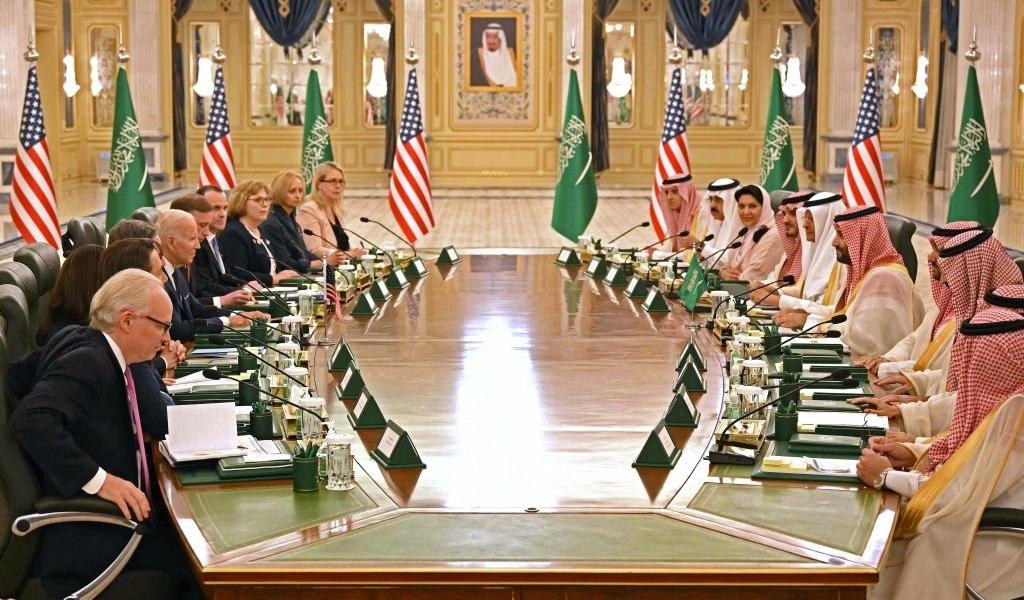
At the end of February 2026, the United States again finds itself at the center of heated international debates, but the perspectives in these disputes differ sharply depending on the vantage point within the global South. In Jerusalem, every signal from Washington about the war in Gaza, a potential annexation of the West Bank and long-term security guarantees for Israel is read closely. In Riyadh, discussions focus on how to leverage American engagement in Middle East processes without becoming dependent on the whims of Washington policy. In South Africa, many still view the US not only as a rival superpower but also as a symbol of Western hypocrisy when it comes to human rights, wars and sanctions regimes.
On the surface it seems everyone is discussing the same thing — American policy in the Middle East and its consequences. But listening to local voices reveals a more complex picture: Israel disputes with the US over how “unconditional” American support should be; Saudi Arabia debates how to combine partnership with Washington and strategic autonomy; South Africa questions whether a “just” world order is possible under the leadership of a country that, in the view of many South African commentators, violates the very principles it preaches. Meanwhile, Washington’s new moves — from a “Board of Peace” for Gaza to a strengthened military alliance with Israel and tough rhetoric on Iran and Venezuela — add fuel to each of these debates. (apnews.com)
One central issue provoking cross-cutting reactions remains the role of the US in the postwar order in Gaza and, more broadly, in the Middle East security architecture. In Washington, the Trump administration presents the launch of the Board of Peace and a multilateral mission in Gaza as a turning point: at the first meeting in the US capital the president announced multibillion-dollar pledges for Gaza’s reconstruction and the creation of multinational stabilization forces that will include contingents from Muslim countries such as Indonesia, Morocco and Kazakhstan. (apnews.com) Formally, this is supposed to look like a move away from the logic of unilateral American interventions of the Iraq era toward a model of “collective conflict management.” However, these steps are read differently across world regions.
Israeli analysts see in the new format primarily an attempt by Washington to institutionalize its dominance. Israeli media compare the Board of Peace to an “alternative UN” which, in the words of one commentator, “allows the US to choose which conflicts deserve attention and which do not, and who sits at the table and who is left outside the door.” It is also emphasized that American involvement is accompanied by unprecedented packages of military aid to Israel: in late 2025 the Pentagon signed a contract for the delivery of dozens of the latest F‑15IA aircraft worth up to $8.6 billion, while parallel negotiations began on a new ten‑year security agreement that is meant to replace the military aid memorandum expiring in 2028. (en.wikipedia.org) Against this backdrop, some Israeli commentators view the Board of Peace as a tool to cement the US–Israel strategic linkage for decades to come.
But even within Israel there is no consensus on the American initiative. Right‑wing commentators stress that the participation of Muslim countries in multinational forces in Gaza is a “double shield” for Israel: on the one hand, it shifts some security responsibility onto others; on the other, it gives Washington political cover before the Islamic world. Left‑wing and centrist commentators question whether this will result in the US once again “freezing” the conflict without addressing the key issue — the status of Palestinian statehood. They point out that simultaneously with the launch of the Board of Peace, the Israeli government is moving toward the de‑facto annexation of a significant part of the West Bank by mass designations of land as “state property,” and a number of lawyers openly call this preparation for a formal extension of sovereignty. (en.wikipedia.org) Washington’s reluctance to strongly criticize these steps is interpreted as tacit acceptance of a de facto abandonment of the “two‑state” solution.
In Riyadh the view on the same US moves is different. Saudi commentators in pro‑government media note that US engagement in Gaza’s postwar order and the strengthening of its alliance with Israel objectively expand the space for Saudi maneuver: Washington must reckon with the kingdom’s role as a key player in the Arab and Islamic worlds. Against the backdrop of recent experiences — from sharp clashes over OPEC+ production cuts to American attempts to limit military cooperation with Riyadh that provoked strong criticism in Saudi media — many authors emphasize that the kingdom is ready to cooperate with the US but does not intend to play the “junior partner.” In one article about past disputes over oil policy, American accusations of “politicizing oil” were called “populist rhetoric” that ignores that “the kingdom has its own long‑term interests and alternative options.” (alamatonline.com)
This produces an ambivalent reaction to the idea of a Board of Peace: on the one hand, Saudi diplomats are interested in being part of a key format that shapes Gaza’s future and broader Middle East settlement; on the other hand, Saudi analytical texts show wariness toward any initiative where Washington acts as the “director” and assigns roles. Unlike in Israel, Riyadh more often stresses that new structures should not replace the UN and existing international norms — this is an important marker of a desire to prevent the US from monopolizing the “legitimacy” of military and political decisions in the Middle East.
South Africa views the US project of a Board of Peace through the lens of its own quarrels with Washington over double standards. In recent years South Africa has actively positioned itself as a voice of the global South, opposing the “selective” application of international law — from Palestine to Ukraine. South African editorial columns on American foreign policy often raise the question: why is Washington willing to create parallel formats when conflicts involve its allies, but insist on strict UN procedures in cases where that helps to contain rivals? For South African commentators this approach calls into question the very idea of the US as a “global arbiter.”
A second thread of debate, present in all three countries, concerns how consistent the US is on sovereignty and interventions. For many, the key example was the US military operation in Venezuela in 2026, which included strikes on drug cartels and the arrest of President Nicolás Maduro. Washington’s official discourse framed the action as a fight against a “narco‑state” and the defense of democracy, but in Venezuela and more broadly in Latin America it was perceived as an attempt to “seize resources,” primarily oil; Vice President Delcy Rodríguez declared that the country “will never again be anyone’s colony — of old empires, of new ones, or of empires in decline.” (en.wikipedia.org)
In Israel the Venezuelan episode is discussed far less often, but experts draw parallels: if the US is willing to act so decisively in Latin America where it does not have allies on the scale of Israel, how reliable are its guarantees not to interfere in the internal affairs of partners if political winds change in Washington? Conservative commentators conclude that Israel must rely even more on its own “self‑sufficient power,” even while receiving unprecedented weapons packages from the US. Liberal authors, by contrast, see the Venezuelan operation as confirmation that the American elite has not abandoned the logic of “regime change,” and therefore Israel cannot indefinitely ignore international norms while counting on automatic American cover.
In Saudi Arabia, discussion of the Venezuelan case overlays a long‑standing fear that any radical internal transformation in the kingdom could become a pretext for external pressure under the banners of human rights or counter‑terrorism. Saudi analysts recall the Iraqi and Libyan scenarios, contrasting them with the current course of elite‑led reforms without allowing chaos. In this context the American intervention in Latin America is perceived as a reminder: Washington is still ready to act by force if it deems its interests — energy or geopolitical — threatened, and rhetoric about democracy is tailored to the situation. For Saudi commentators this is an argument for strengthening ties with China and other alternative power centers — not to replace the US, but to balance it.
South African media and experts typically view the Venezuelan operation through the historical lens of anti‑colonial struggle. Commentators often say that in Latin America, as once in Africa, “only the forms of dependence have changed.” For a South African audience where the memory of third‑world support for the anti‑apartheid struggle remains strong, arguments about the “end of empires” and “new empires in decline” resonate emotionally. They reinforce skepticism toward any unilateral US actions and push support for multilateral platforms like BRICS as an alternative to American leadership.
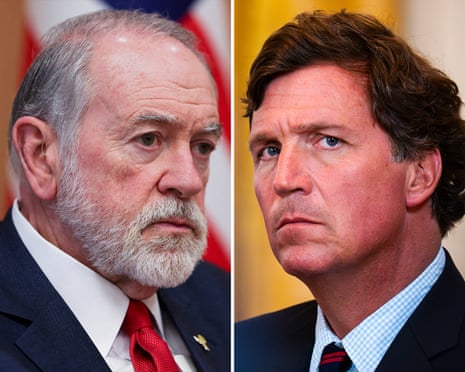
A third major theme uniting debates in Israel, Saudi Arabia and South Africa is the domestic American political dispute over Israel and how it projects onto the rest of the world. A recent interview with US Ambassador to Israel Mike Huckabee, in which he appealed to biblical borders “from the Nile to the Euphrates” and effectively said it “would be fine if Israel took everything,” unleashed a storm of criticism in the Arab and Muslim world. Egypt, Saudi Arabia and other members of the Organisation of Islamic Cooperation condemned those words as “incendiary” and contrary to international law, demanding clear clarifications from the State Department. (apnews.com)
For Israel’s right‑wing audience Huckabee’s statements confirm that Christian‑Zionist currents remain strong in the American elite and are ready to justify almost any Israeli territorial claims with religious arguments. But even in Israel many commentators saw the remarks as a double signal: on one hand, an expression of “unconditional love”; on the other, further evidence that the fate of the region in Washington is still often viewed through ideological and theological lenses rather than the prism of actual balances of power and Palestinian rights. Left‑wing and centrist observers fear that such statements only deepen Israel’s international isolation, reinforcing the narrative that its support is based not on universal principles but on a specific religious‑political alliance within the US.
In the Saudi and broader Arab press the reaction was much harsher. There Huckabee is perceived not as an eccentric politician but as an official representative of a country whose word carries weight in the UN Security Council and military coalitions. Saudi newspapers described his words as “a dangerous revanchist discourse” that could inflame radical sentiments on both sides of the conflict. At the same time Saudi authors note the domestic American context: the interview is part of a wider Republican debate in which figures akin to Tucker‑Carlson‑style nationalists increasingly ask why Israel holds such a privileged place in American politics when the US itself faces growing social and economic problems. (theguardian.com)
For South Africa these debates within the American right are further confirmation that US support for Israel is not monolithic, and therefore pressure from the global South and international law can, over time, shift the balance. South African lawyers and activists pursuing accountability for Israel’s actions in the occupied territories are watching such signals closely, seeing in them an opportunity to fracture Western consensus.
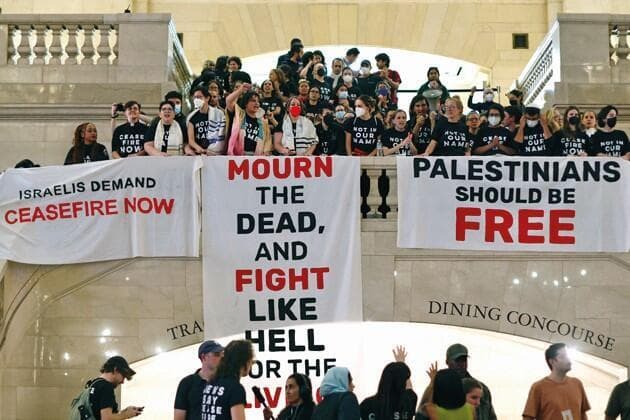
Finally, in all three countries discussion continues about the “softer” dimensions of American influence — from cultural and educational policy to diaspora dynamics. In Israel there is active reporting on a shift among some American Jews, especially youth, who increasingly participate in anti‑Israel campus protests and form progressive Jewish organizations critical of Israeli policy in Gaza and the West Bank. In one Israeli piece these groups were described as “a dangerous phenomenon” capable of splitting the American Jewish community and weakening the traditional pro‑Israel lobby in Washington. (ynet.co.il)
Saudi Arabia, for its part, watches how the US treats foreign students and academic exchange. Scandals over visa cancellations and expulsions of foreign professors for participating in protests are raised in English‑language diplomatic outlets, where former ambassadors and senior officials warn that a campaign against “undesirable speech” by foreigners undermines the image of the US as a center of free thought and limits its soft power. (afsa.org) For Riyadh, which invests heavily in international education and sending students abroad, this is troubling: if access to American universities becomes politicized, incentives will grow to turn to alternative educational centers in Europe and Asia.
In South Africa all these issues — from campus politics in the US to reforms in global health under an “America First” slogan — fit into a larger debate about whether the United States remains an attractive model to emulate. Many South African commentators worry that by cutting aid while tightening control over who may speak on American soil, Washington sends the world a message: values are giving way to transactional calculations.
Taken together, these varied reactions produce a contradictory but revealing picture. For Israel, the US remains an indispensable strategic patron, but the more tangible that support becomes, the greater the concern that it may “blind” the country, pushing it toward actions that further complicate its international standing. For Saudi Arabia, America is a necessary but not the only partner: Riyadh seeks to use American power to stabilize the region without allowing it to dictate the kingdom’s internal and energy policies. For South Africa, the US is an important but far from flawless actor whose interventions and human‑rights rhetoric are inevitably viewed through the prism of a colonial past and the struggle for genuine, not declaratory, equality among states.
In that sense, today’s debate about America in Israel, Saudi Arabia and South Africa is not merely a set of local reactions to particular statements or operations. It is part of a broader reassessment of the US role in the world, where fewer countries are willing to regard Washington as the sole center of legitimacy and security, yet many still consider it too powerful to simply ignore. It appears that attitudes toward the United States in the coming years will unfold between these poles — necessity and caution.