By the end of August 2026, the United States had simultaneously become the center of three interconnected crises: the protracted standoff with Iran over the Strait of Hormuz, a new escalation in the economic and technological confrontation with China, and the increasingly visible domestic constraints on Donald Trump’s administration. In France, Saudi Arabia and China, these developments are viewed not as separate American news stories, but as signs of a larger shift: Washington remains capable of imposing sanctions, blocking markets and demonstrating military force, but is becoming less and less able to turn pressure into a durable political outcome.
The most acute issue is Iran. In the French debate, the American approach looks above all like a trap created by the White House itself. In a Le Monde analysis, the current strategy is described as a shift from military coercion to “economic strangulation”: after six months of operations, the United States has achieved neither Tehran’s surrender nor a genuine peace, and is attempting to compensate for the military deadlock with new sanctions. The French perspective is particularly important here: Paris sees not only a U.S.-Iran conflict, but also the risk of extraterritorial American pressure on third countries, including European institutions and banks. U.S. sanctions policy is portrayed not as a precise instrument, but as a mechanism that expands the conflict far beyond its original boundaries.
The Saudi reaction is markedly less ideological and much more practical. For Saudi observers, the question is not whether the United States is right in its dispute with Iran, but whether freedom of navigation through the Strait of Hormuz—the key export route for energy from the Persian Gulf—can be guaranteed. The Saudi newspaper Okaz emphasizes the restoration of vessel traffic and links it to the presence of the U.S. Navy; in its interpretation, the increase in maritime traffic means that Tehran is gradually losing its ability to dictate terms in the strait. But this is by no means an unconditional endorsement of the American war. In another article, Okaz notes that Washington is linking an extension of the truce to the full reopening of Hormuz, while Iran is demanding an end to the blockade and sanctions. (okaz.com.sa) For Riyadh, the United States remains an indispensable military partner, but the American campaign is valuable only insofar as it reduces, rather than multiplies, regional instability.
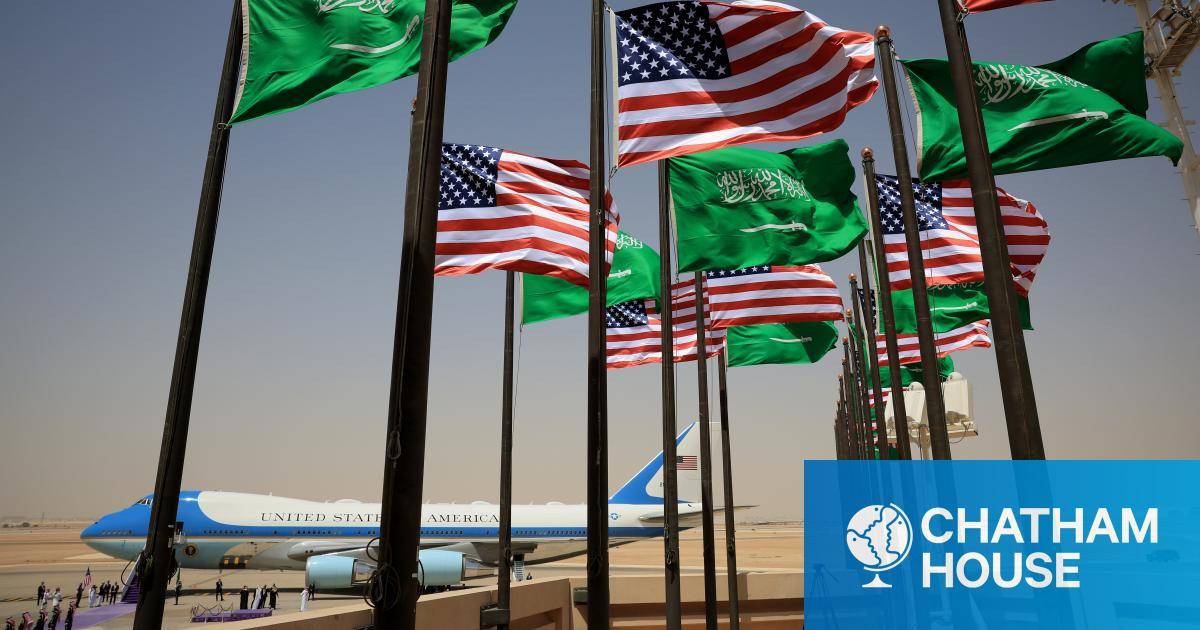
This is precisely where the French and Saudi views diverge significantly. France primarily sees American policy as a threat of endless war and to Europe’s diplomatic autonomy. Saudi Arabia sees it as a necessary, though risky, shield against disruption to trade and Iranian pressure. As Chatham House expert Neil Quilliam noted in his commentary, Riyadh seeks to assume greater responsibility for regional security while simultaneously demonstrating its own strategic indispensability to Washington. (chathamhouse.org) This is a characteristic Saudi qualification to the widespread European idea of an “America in retreat”: Riyadh is not expecting the United States to disappear from the Middle East, but is seeking to make its dependence on Washington less one-sided.
China’s reaction links the war with Iran to the trade war against Beijing. In China’s official analysis, the U.S.-Iran confrontation is interpreted as the “middle game,” in which Washington’s options are limited: military fatigue, domestic political resistance and electoral pressure are pushing the Trump administration to keep the conflict at a low intensity rather than seek a decisive breakthrough. Xinhua directly links the U.S. shift toward blockades and sanctions to the absence of a convincing military solution. (news.cn) For Beijing, this is not merely an assessment of the American campaign; it is an argument against the model of American coercion itself—force, sanctions and control over financial flows.
This logic became even more apparent in the August exchange of restrictive measures between the United States and China. After Washington imposed measures against Chinese companies and restrictions in the technology sectors, Beijing tightened export controls on drones and their components destined for the United States, introduced restrictions against American organizations and launched the first national-security investigation in the field of foreign trade in its history. China’s Ministry of Commerce called the American actions a violation of agreements reached by the two countries’ leaders and said the countermeasures were “restrained.” (news.cn)
But the Chinese press goes beyond the official formula of a “necessary response.” In an editorial in Global Times, U.S. restrictions on Chinese robots, inverters, photovoltaic products and optical technologies are described as an attempt to build supply chains without China—a project that, the authors argue, will harm America’s own energy sector, AI infrastructure and innovation economy. (opinion.people.com.cn) The Chinese view thus differs from the French and Saudi perspectives: while Paris is concerned by Washington’s unpredictability and Riyadh measures it by its impact on security in the strait, Beijing believes that America is trying to turn the concept of national security into a universal tool of industrial protectionism.
Across all three countries, one common idea is particularly noticeable: Trump’s threats are no longer perceived as an automatic mechanism that forces others to give way. Arab commentator Abdelazim Muhammad Abdelrahim writes in an article for Al Jazeera that the constant escalation and promises of tough action have ceased to produce their previous effect: the limits of the administration’s capabilities have become visible to courts, markets and U.S. rivals alike. (aljazeera.net) French articles reach a similar conclusion through the story of Iran; Chinese ones through the language of “countermeasures” and technological interdependence; Saudi ones through a cold calculation of the cost of security in Hormuz.
The most interesting local conclusion is heard not in Paris or Beijing, but in Riyadh. The Saudi perspective does not assume that a weakening of the United States’ ability to impose its decisions would automatically benefit the region. On the contrary, a less decisive but still heavily armed Washington may be more dangerous than the former American hegemony, because it retains the power to escalate but no longer has sufficient political resources to bring conflicts to a rapid conclusion. French anxiety over unilateral American pressure, Chinese criticism of the “small yard and high fence,” and the Saudi emphasis on the security of shipping converge at one point: the world is learning to live not without American power, but with American power that has become more nervous, more economically driven and less convincing.