In German, Russian and Ukrainian discussions about the United States, three storylines have converged in recent days: CIA Director John Ratcliffe’s unexpected visit to Moscow on August 25, Washington’s attempt to shift from war with Iran to economic coercion, and the ongoing reassessment of the American military presence in Europe. On the surface, these are separate stories. But local commentators see one question connecting them: Is America acting as a guarantor of order, as a negotiator seeking a quick deal, or as a power ready at any moment to redistribute its commitments in line with its domestic political needs?
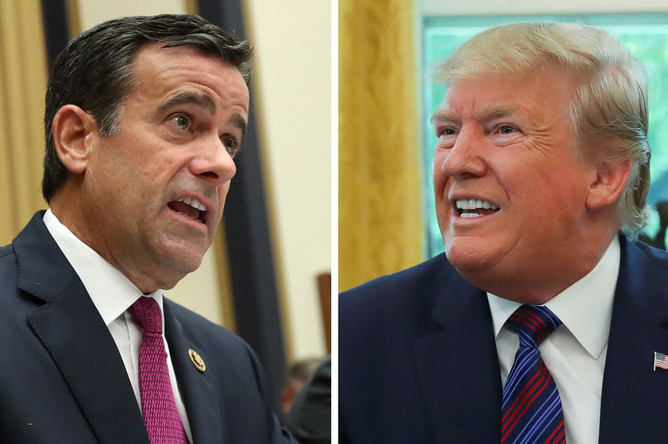
Ratcliffe’s visit became a particularly striking symbol of this uncertainty. Russia’s reaction has been notably restrained and pragmatic. The Kremlin confirmed only contacts through the intelligence services, emphasizing that there had been no meeting with Vladimir Putin; RBC presented this wording as a deliberate effort to limit public expectations surrounding the trip. In RBC’s report, what matters is not only the official brevity but also the context: the visit comes at a time when Moscow and Washington, judging by leaks and comments, appear to be trying to maintain a direct channel outside high-profile diplomacy.
Russian experts quoted by Gazeta.Ru interpret the CIA director’s arrival primarily as an attempt to clarify the “red lines” ahead of autumn: Russia’s plans at the front, the risk of strikes that could affect NATO countries, and the possibility of interim agreements where Moscow and Kyiv’s positions are incompatible. For Russia’s public sphere, this is neither a sign of capitulation nor a breakthrough, but evidence that the United States is forced to speak directly with Russia when the stakes are too high for exchanging statements through press offices. Even the possibility that Iran was part of the agenda reflects a broader Russian view: the more crises Washington is managing simultaneously, the greater Moscow’s diplomatic value as an interlocutor that cannot be ignored.
In Kyiv, the same Ratcliffe aircraft is viewed in almost the opposite way. Ukrainian anxiety is not about the very fact of U.S.-Russian contact—it is inevitable—but about the risk that negotiations over the war could be conducted around Ukraine without Ukraine. Ukraine’s OstoV cites Igor Petrenko, head of the United Ukraine analytical center, who assesses that the visit could have been both a warning to Moscow and a test of whether there is an opening for a genuine dialogue before winter. But Petrenko believes Russia’s leadership is not prepared to abandon pressure on Donbas, meaning that the trip itself does not indicate that a compromise has already been found.
The Ukrainian sense of alarm is expressed even more sharply in an analysis by RBC-Ukraine: political analyst Volodymyr Fesenko suggests that Ratcliffe may have come not so much to bargain as to deliver a “tough warning” about the price of further escalation. This interpretation is important: Kyiv prefers to see the United States as a force for deterrence, rather than as an arbiter mechanically averaging the parties’ positions. That is why reports that the Ukrainian side was asked to temporarily refrain from certain strikes while the delegation was visiting are seen as a painful test: Is Washington prepared to restrict Kyiv in order to preserve its own negotiating channel with Moscow? (amp.dw.com)
Germany views this secret dialogue with a different kind of concern. For Berlin, the issue is not whether negotiations will take place, but whether European security will become a secondary subject of an American-Russian bargain. In a column for Die Zeit, the publication’s head of politics, Heinrich Wefing, formulates an uncomfortable thought for German readers: Germany still depends on the United States not only for defense, but also for technology, digital infrastructure and financial platforms. In other words, the discussion of “strategic autonomy” in Berlin is no longer an intellectual fashion; it has become an acknowledgment of vulnerability.
That vulnerability is compounded by the reassessment of the American military presence. Deutsche Welle writes that the Pentagon is evaluating the deployment of forces in Europe based on the principle that Europeans should assume primary responsibility for their own conventional defense. In Germany, this formula is viewed ambivalently. On the one hand, it has long reflected what some members of the German establishment themselves demanded: Europe must stop “outsourcing” its security to America. On the other hand, independence cannot be created by a single political decision, especially when it comes to air defense, strategic aviation, intelligence, logistics and long-range deterrence.
Military expert Carlo Masala, in an interview summarized by Deutsche Welle, calls a potential pause in the deployment of American long-range missiles particularly dangerous: it would create a gap in deterrence against Russia that European systems would be unable to fill anytime soon. Here, the German reaction unexpectedly intersects with the Ukrainian one. Kyiv is demanding not abstract diplomatic activity from the United States, but concrete air-defense systems and pressure on Russia; in August reports about contacts with Washington, Ukrainian representatives directly linked peace initiatives to the need to defend the skies. (amp.dw.com) Germany, meanwhile, fears that a reduction in American involvement could make such shortages a pan-European norm.
The third issue—Iran—turns these doubts into a systemic question about the nature of American power. In Berlin, Washington’s shift toward promises of the “toughest sanctions in history” after weeks of war is being read not as a demonstration of confidence, but as an admission of the limits of the military outcome. The German edition of Deutsche Welle notes that the Trump administration needs a result ahead of the November midterm elections and is therefore trying to turn the military campaign into an economic “finale.” German criticism in this case is not reducible to pacifism: many commentators believe that an inconsistent war is worse and more dangerous than a clear strategy because it simultaneously undermines alliances, raises risks in the Persian Gulf and offers no political way out.
In Russian discussions, Iran, by contrast, is viewed as an additional source of negotiating leverage. The logic is as follows: if the United States is unable to end the conflict quickly and needs regional mediation, Russia gains another argument in its direct dialogue with Washington. This is precisely why Russian authors readily embrace theories that Ratcliffe discussed not only Ukraine in Moscow, but also the Middle East. That does not necessarily mean an agreement exists; rather, the Russian audience sees America’s overextension as evidence that the era when Washington could impose rules simultaneously in Europe, the Middle East and Asia is coming to an end.
The Ukrainian perspective is the bleakest here. For Kyiv, America’s war with Iran is dangerous not only because it diverts resources. It creates a political incentive to “close the Ukrainian file” more quickly—possibly through an arrangement that would halt the intensity of the fighting without eliminating the cause of the war or providing Ukraine with reliable guarantees. Serhii Kyslytsia, deputy head of the Office of the President, said directly in an interview with Deutsche Welle that American mediation had not stopped, but he saw no motivation on Vladimir Putin’s part for substantive negotiations. In the Ukrainian reading, this is the central contradiction of the moment: America wants results, but Russia, in Kyiv’s view, still believes that time is working in its favor.
The most unexpected common feature of the reactions in Germany, Russia and Ukraine is that almost no one disputes that the United States remains an indispensable power. The disagreement concerns something else: Can it still be considered predictable? In Moscow, Washington’s unpredictability is seen as room for bargaining and the restoration of direct channels. In Kyiv, it is seen as the risk of a deal in which the country’s security becomes a bargaining chip. In Berlin, it is a painful reminder that European sovereignty was postponed for decades precisely because the American guarantee seemed eternal. Thus, today’s image of the United States outside America is not that of a declining power. It is the image of a power whose decisions still determine the security of others, but whose priorities are becoming increasingly difficult to predict.