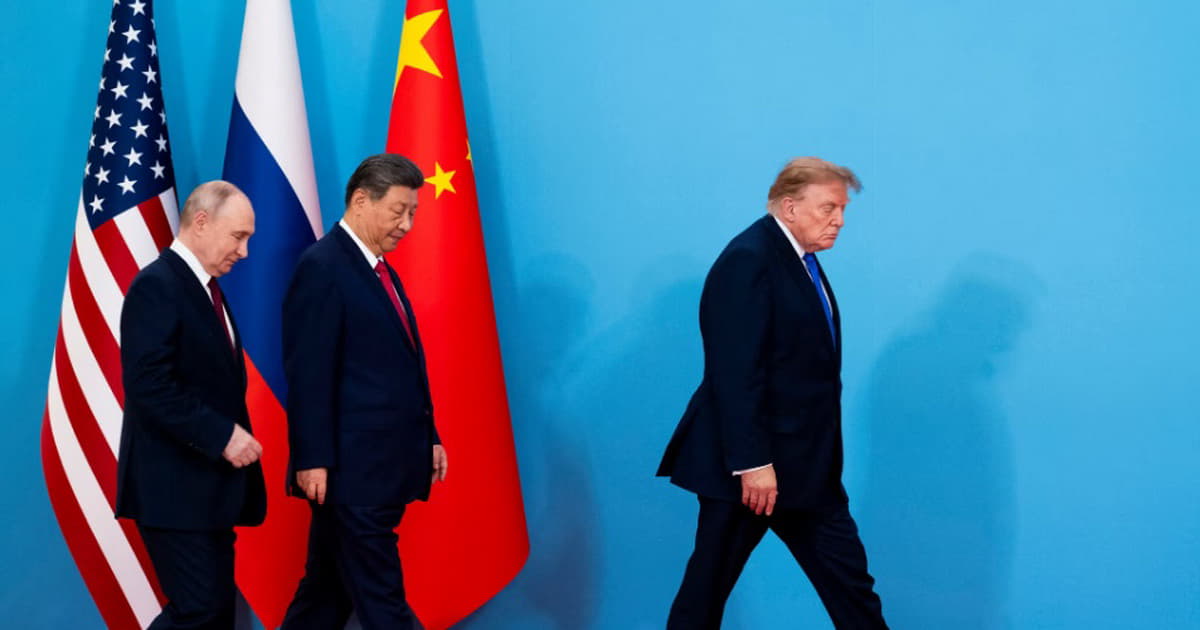
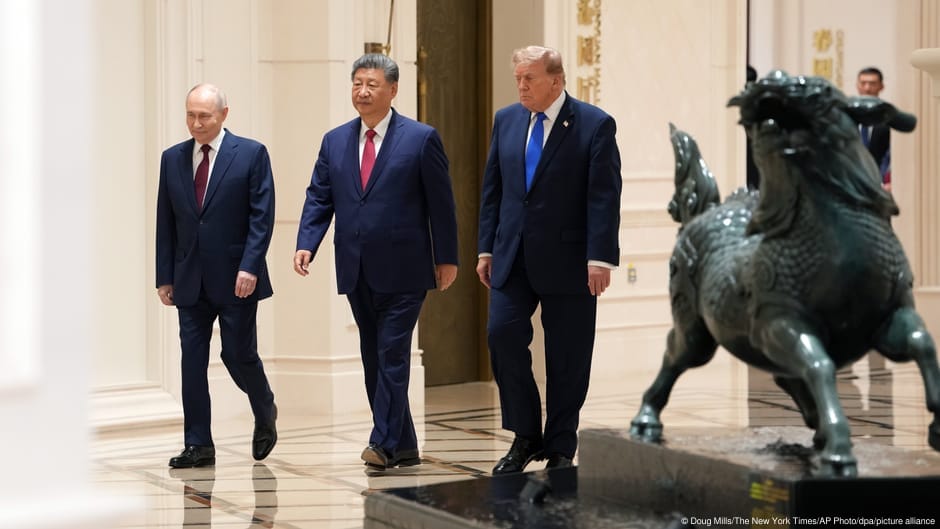
In recent days, the main American story in Ukrainian, Japanese and Turkish debates has not been the domestic struggle in Washington itself, but a new way for the United States to conduct world affairs: negotiating directly with its biggest rivals while leaving allies—and countries affected by those deals—waiting outside the door. The November 19 meeting between Donald Trump, Xi Jinping and Vladimir Putin in Shenzhen became a particularly vivid symbol of this concern. Formally, the leaders of the United States, China and Russia issued a “Declaration on Peace,” but it included no concrete agreement on Ukraine, Iran or nuclear arms control. (apnews.com) Paradoxically, the lack of substantive decisions did not reassure observers. It showed that the great powers’ practice of discussing the fate of third countries without involving them is itself becoming a political fact.
In Ukraine, the summit was viewed through the historically painful lens of a “new Yalta”—a reference to a possible division of spheres of influence. Ukrainian commentators, however, do not believe Shenzhen was really a second Yalta. Rather, it was a demonstration of how China is turning the diplomatic stage into an asset of its own. In an article for European Pravda, editor Serhiy Sydorenko stresses that “the world cannot be divided three ways” [«світ не ділиться на трьох»], and that Beijing has managed to trade its image as Moscow’s unconditional ally for that of a mediator—one the West can hardly do without if it hopes to put pressure on the Kremlin. For Kyiv, the implications are mixed: China’s involvement could, in theory, increase external pressure on Russia to end the war, but China also gains the opportunity to turn the Ukraine issue into a bargaining chip in its own dealings with Washington. (eurointegration.com.ua)
Ukraine’s reaction has therefore been noticeably less emotional than one might have expected from the image of Trump, Xi and Putin sitting at the same table. Foreign Minister Andrii Sybiha put it bluntly: “Shenzhen is not the Yalta Putin dreams of” [«Шеньчжень — це не Ялта, про яку мріє Путін»]. The remark both seeks to dispel fears of an imposed settlement and serves as a reminder that Russia has still not achieved the battlefield gains that would allow it to dictate a new order. Ukraine’s strategy remains unchanged: rather than ask to be invited to someone else’s “concert of powers,” it wants any negotiations tied to concrete security guarantees, sanctions pressure and military support. (amp.dw.com)
Japan reads the same Shenzhen story differently. The concern there is less about a deal on Ukraine than about Washington potentially building relations with Beijing and Moscow while bypassing the interests of its Asian allies. Japanese political scientist Tomonori Kotani, a professor at Meikai University and head of research at the Japan Institute of International Affairs, summed up Japan’s concern in an interview with Senkyō Dot Com almost as a foreign-policy directive: “The main thing Japan must avoid is being left alone with America” [«Самое важное, чего Японии следует избегать, — это оставаться с Америкой один на один»]. This is not a rejection of the US alliance, but an acknowledgment of its new vulnerability: if the US president sees diplomacy as a series of personal deals, even the closest ally can become a target of pressure—over defense spending, tariffs, investment or policy toward Taiwan. (go2senkyo.com)
The Japanese press and experts are especially wary of the possibility that Trump’s domestic political weakness could make his foreign policy more, not less, aggressive. After the Republicans’ defeat in the November 3 midterm elections, Tokyo is discussing the possibility that the White House will try to make up for its shrinking room for maneuver at home with high-profile foreign-policy moves and new demands on its partners. A Japanese Newsweek analysis asks directly whether Trump’s weakness will give US trading partners room to resist American pressure—or prompt the president to harden his stance. Commentators warn that Japan could face new financial and defense demands precisely because the president will need to project strength. (newsweekjapan.jp)
For Turkey, American unpredictability has a more immediate, almost tangible dimension: the war involving Iran, the threat of regional escalation, energy prices, the security of sea lanes and the question of whether Ankara could be drawn into a conflict through NATO infrastructure. Here, the Shenzhen meeting is seen less as an alarming “division of the world” and more as a necessary channel for managing rivalry. In an analysis for Anadolu Ajansı, Professor Nursin Ateşoğlu Güney writes that the three leaders’ declaration matters above all because it recognizes the need for crisis-communication mechanisms: competition among the United States, China and Russia is not going away, but it needs safeguards to keep it from turning into a direct clash. From Turkey’s perspective, that distinction matters: the meeting itself is neither a victory nor a betrayal; what matters more is whether it can reduce the risk of a war whose consequences would hit Turkey immediately. (aa.com.tr)
This explains the clear difference between the Turkish mood and the Ukrainian and Japanese ones. Kyiv fears that “managed competition” will become a euphemism for freezing the war on Russia’s terms. Tokyo worries that managing crises between superpowers will come at the expense of allies on the periphery. Ankara, by contrast, sees direct contact between Washington, Beijing and Moscow as a chance to prevent a chain reaction of conflicts, from Ukraine to Iran. But Turkish debate is not without skepticism: the country understands that hotlines between capitals are not the same as peace on the ground. This is especially true given Trump’s statements that the United States could resume strikes on Iran after the New Year if negotiations fail to produce an acceptable result. (aa.com.tr)
Turkey’s opposition draws a practical conclusion from this. In a statement by the Republican People’s Party’s Foreign Policy Council, it called for preventing Incirlik Air Base from being used for strikes that could turn Iran irrevocably against Turkey. This reflects a distinctly local perspective: for Ankara, US policy toward Iran is not an abstract question of “deterrence,” nor merely an issue of relations with Israel, but a potential source of pressure on its own borders, economy and domestic political stability. (chp.org.tr)
The second common theme—the consequences of the US midterm elections—also prompts three different but overlapping expectations. In Kyiv, the Democrats’ victory in both chambers of Congress is seen above all as the return of an institutional counterweight to the White House. A column for Ukrainska Pravda argues that the elections’ most important consequence could be the restoration of Congress’s active role in policy toward Ukraine. It also stresses that support for Kyiv should be justified not only as a moral obligation, but also in terms of European security and confidence in American deterrence. (pravda.com.ua)
Turkish analysts take a cooler view of the same result. In an article for Anadolu Ajansı, Professor Tarık Oğuzlu warns that personal rapport between Trump and Erdoğan can no longer be considered a sufficient basis for relations: the administration’s decisions will increasingly encounter institutional resistance in Congress. For Ankara, this means the United States may be more predictable as a system, yet less convenient as a partner: personal deals carry less weight, while sanctions, arms, Syria and human rights are once again returning to the political agenda. (aa.com.tr)
An unexpectedly unified picture is taking shape. In Kyiv, Tokyo and Ankara, the question is no longer whether the United States is powerful: American military, financial and diplomatic might still sets the rules of the game. The debate is about something else—how willing Washington is to bind that power to commitments to allies, international norms and long-term strategy. Ukraine is trying not to become a bargaining chip; Japan, not to be left alone with an ally capable of negotiating over its head; Turkey, not to pay for another American turn toward war with Iran with its regional security. That is why the current response to the United States in all three countries looks less like familiar anti-Americanism or pro-Americanism than a demand of Washington: if it wants to remain at the center of the world system, it will have to convince its partners again that they are not expendable in that system.