As of October 27, 2026, Brazil, South Korea and Japan are discussing more than individual White House decisions. A new problem is emerging: U.S. domestic politics is increasingly becoming a source of international uncertainty. In Brazil, the immediate trigger was Donald Trump’s claim that Lula’s reelection on October 25 had “looked rigged”—without offering any evidence. In Tokyo and Seoul, the main focus remains the U.S. midterm elections on November 3: local experts are trying to determine whether a weakening of the Republicans could constrain Trump or, conversely, make American policy even more chaotic. The shared conclusion is strikingly clear-eyed: what matters to other countries is no longer so much which party formally controls Congress, but whether the U.S. system can produce predictable policies on trade, finance, war and commitments to allies.
Brazil’s reaction is the most emotional, because the dispute concerns sovereignty and the legitimacy of elections that have just concluded. Vice President Geraldo Alckmin called Trump’s assessment “equivocada” (“mistaken”) and stressed that the U.S. president should not interfere in Brazilian politics. It is significant that Trump also said he “gets along well” with Lula. In Brazil, this is seen not as a conciliatory gesture but as a double signal: Washington is keeping open the option of questioning the country’s institutions while still intending to do business with its government. As Agência Brasil notes, the U.S. president linked his suspicions to the extension of voting hours, but offered no evidence of fraud. (agenciabrasil.ebc.com.br)
For Brazil, this is part of a broader story in which trade pressure, visa restrictions, sanctions rhetoric and public support for Bolsonaro-aligned forces have come to be seen as elements of a single policy. In its analysis, Folha de S.Paulo describes relations with the United States as the main foreign-policy challenge of Lula’s new term. The agenda centers on U.S. tariffs, critical minerals and the effort to protect sovereignty while maintaining pragmatic dialogue. (www1.folha.uol.com.br) This highlights a characteristic feature of Brazil’s approach: even those who criticize confrontation with Washington are not calling for a break. Adam Goldsmith, a former U.S. Treasury financial attaché for South America, put the paradox this way in a column for Folha: Brazil’s relatively limited interdependence with the United States temporarily shields it from pressure, but also means missed economic opportunities. (www1.folha.uol.com.br) In other words, Brazil’s debate is not reducible to anti-Americanism. It is more about the cost of dependence and how to prevent access to markets, technology or investment from becoming a foreign power’s license to challenge the outcome of a national election.
South Korea views the U.S. midterms less ideologically and far more practically. The discussion there is not about the abstract fate of American democracy, but about tariffs, investment in U.S. energy, visas for Korean specialists, shipbuilding, batteries, semiconductors and the presence of U.S. troops on the peninsula. In a special report, the state-run trade organization KOTRA warns that the push to restrict China’s role in supply chains will continue regardless of the election results, while policies on electric vehicles, batteries, artificial intelligence and shipyard subsidies will depend on the specific balance of power in Congress and the states. (dream.kotra.or.kr) From the Korean perspective, the United States is both a security ally and a market where the rules can change quickly in response to the American electoral cycle.
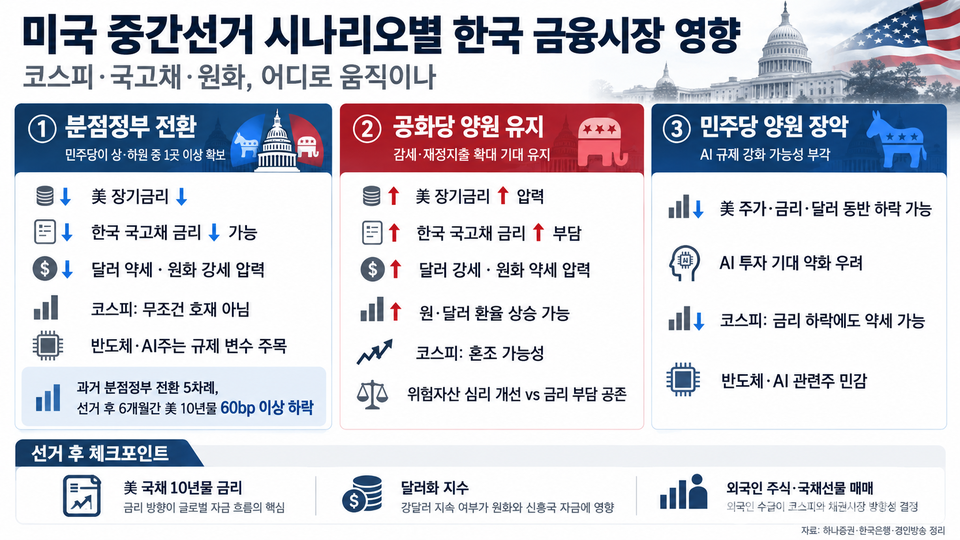
That is why Seoul is particularly cautious about hopes for a “divided government” in Washington. Korean financial analysts allow that a shift to divided government—when the White House and at least one chamber of Congress are controlled by different parties—could lower U.S. Treasury yields and weaken the dollar, easing pressure on the won. But the same scenario could slow U.S. investment in AI and hurt Korean exporters of chips and equipment. As Gyeongin Broadcasting writes, what will matter most for South Korea is not the election winner itself, but the actual response of bond yields, the dollar and AI investment. (news.ifm.kr) This is a distinctly Korean way of looking at America: political crisis in the United States is translated not into support for Democrats or Republicans, but into the cost of capital, exchange rates and industrial orders.
Japan’s debate overlaps with South Korea’s on economics, but goes further on security. Japanese researchers see the November vote as a potential turning point after which Trump may have more freedom to maneuver in foreign policy if he no longer has to fear an immediate electoral price. A study by the Japan Institute of International Affairs notes that the war with Iran has already driven up oil and gasoline prices, weakening the Republicans’ position; at the same time, the direct domestic political costs of escalation may ease after the election. The authors issue a particular warning: if the United States seeks an agreement that addresses only direct threats to U.S. territory, risks associated with Iran’s missile and nuclear capabilities may remain unresolved for Japan. (jiia.or.jp) For a country critically dependent on maritime routes and energy imports, this is not an abstract Middle Eastern issue, but a question of prices, insurance, shipping through the Strait of Hormuz and the resilience of the entire Asian economy.
This points to a deeper Japanese concern: an unstable America may be dangerous not because it will abandon its leadership role, but because it will apply force and honor commitments selectively. Tomohisa Ishikawa, an economist at the Japan Research Institute, writes in an analysis of the election’s implications that U.S. political and social polarization may intensify after the vote. Japan, he argues, will have to ease tensions with its neighbors while also working to ensure continued active U.S. involvement in Asian security. (jri.co.jp) It is a telling formulation: Tokyo does not take the U.S. presence for granted as an unquestionable good, but sees no full-fledged replacement for it yet.
In all three countries, then, the U.S. midterms are seen as a test not only for Trump, but also for America’s ability to govern its international role. Brazil sees the risk of political interference and wants to show that its democracy needs no U.S. certification. South Korea fears that Washington’s swings will make strategic investments hostage to tariffs, visas and partisan deals. Japan worries that domestic infighting in the United States will leave allies choosing between unpredictable U.S. engagement and a dangerous vacuum. The most unexpected common thread is that none of them expects a Democratic or Republican victory, by itself, to solve the problem. The rest of the world increasingly sees America as a country whose domestic conflicts are exported along with its dollar, tariffs, military decisions and doubts about other countries’ elections.