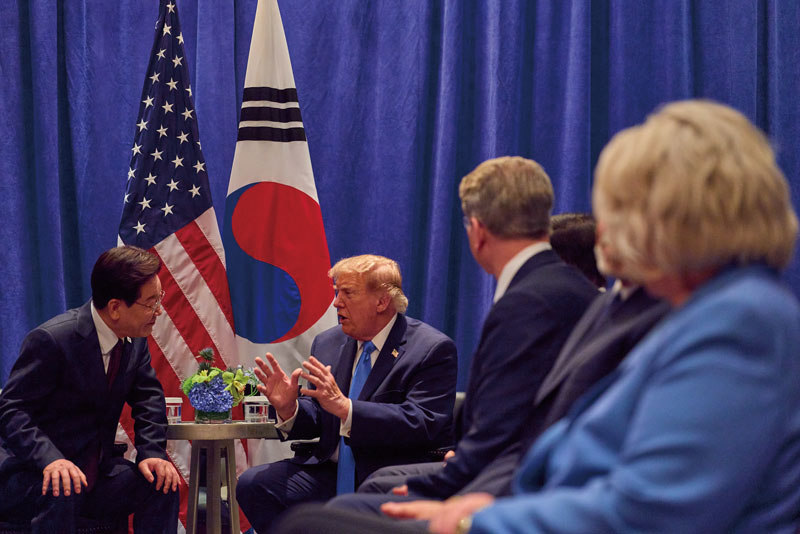
In the final days of October 2026, the United States has become more than a foreign partner for South Korea, South Africa and Ukraine: it is a variable on which investment, exports, security and even the limits of political sovereignty depend. Each country is focused on different U.S. issues: in Seoul, tariffs, promised multibillion-dollar investments and the risk of being sidelined in Washington’s dialogue with Pyongyang; in Pretoria, visa restrictions, threats of sanctions and the future of AGOA trade benefits; in Kyiv, U.S. pressure on Ukraine’s military strategy, intelligence sharing and negotiations with Russia. But the underlying concern is the same: under Donald Trump, U.S. policy is seen as increasingly transactional and shaped by domestic electoral logic.
The main thread connecting these concerns is the U.S. midterm elections on November 3. Abroad, they are seen less as a routine contest between Democrats and Republicans than as a test of whether the White House will continue using foreign policy to produce quick domestic political “wins.” In South Korea, this has sparked concern that alliance commitments may matter less than high-profile deals. Korean media report that, after the first package of South Korean investment in the United States was approved, Trump’s interest in bilateral issues waned noticeably, while military cooperation and the transfer of wartime operational control stalled. A News1 analysis describes the risk of “bypassing Korea”: Washington may return to diplomacy with North Korea, but not necessarily with Seoul fully involved. (news1.kr)
For South Korea, it is particularly telling that the U.S. elections are discussed primarily through the lens of economics. Seoul does not expect a possible Democratic victory to automatically reverse Trump’s tariff policy: confrontation with China, technology restrictions and pressure on partners to localize production are seen as a nearly bipartisan reality. Still, there is hope that a weakened White House would at least be less prone to sudden ultimatums. The Seoul Newspaper captures this ambivalence: a Democratic Congress could step up investigations and oversight of the administration, but a “complete repeal” of the tariffs remains unlikely. (seoul.co.kr)
The local shorthand for this anxiety is “Trump’s bill”—the cumulative demands made of Korean companies and the government: investment in America, participation in infrastructure projects and additional spending on security. A Sisa Journal article describes the pressure as both economic and military; in particular, it discusses Trump’s announced plan to invest $54 billion in Korean funds in a gas pipeline in Alaska. (sisajournal.com) For Korean observers, this is not just a commercial deal. It raises the question of whether the alliance still follows the logic of mutual security or is turning into a system of periodic payments for American political favor.
In South Africa, the same transactional approach by the United States looks much harsher—as an attempt to tie trade, visas and investment to Washington’s ideological objections to domestic policies. Pretoria has come under pressure over U.S. accusations of discrimination against white South Africans, as well as disagreements over land policy, economic empowerment for Black South Africans, relations with Israel and the country’s foreign policy more broadly. Since visa restrictions were imposed, South African commentators have been debating not whether there is a crisis with the United States, but how much further the White House is prepared to go—with financial restrictions, an investment boycott or a review of trade preferences. (apnews.com)
An important local distinction, however, is that South Africa’s debate is not reducible to anti-Americanism. Much of the business community is urging the government not to respond emotionally, but to separate the symbolic conflict from practical economic interests. In a Sunday Times column, commentator Peter Bruce makes the surprising claim that the fate of AGOA—the U.S. law granting trade benefits to Africa—is “the least of our worries”: ending the benefits would hurt exporters, but would not be a catastrophe on the scale of a political and investment rupture. (sundaytimes.timeslive.co.za) It is a sober, almost dispassionate view: the danger lies not in a single tariff, but in South Africa being turned into a cautionary example for America’s conservative audience.
Priyal Singh, an analyst at the Institute for Security Studies in Johannesburg, explains the escalation in terms of the U.S. domestic political climate in a Semafor commentary: false claims of systematic persecution of white South Africans resonate with Trump’s conservative electorate. (semafor.com) For Pretoria, this is doubly painful. The United States is not merely criticizing specific government decisions; it is imposing an external interpretation of the post-apartheid reality, in which measures to remedy historic inequality are portrayed as reverse discrimination. The local response is therefore about defending not only trade interests, but also the country’s right to define the meaning of its own social transformation.
Ukraine views America from a very different position of existential dependence. For South Korea, tariffs and investment are questions of future growth; for South Africa, the issue is political and economic autonomy. For Kyiv, U.S. decisions are directly tied to its ability to hold the line. That is why reports that Trump disapproves of Ukrainian strikes on Russian oil infrastructure and may restrict intelligence sharing triggered not ordinary diplomatic anxiety, but a sense that the country’s military resilience was under threat. In a Ukrainska Pravda analysis, journalist Yuriy Butusov poses a starkly practical question: what is more dangerous for the front—disruptions to Starlink/Starshield or an end to U.S. intelligence support? (pravda.com.ua)
Ukrainian analysts see a risk in the current U.S. approach: Kyiv could become a prop in a pre-election peace-making spectacle. Vadym Denysenko, head of the analytical center Delovaya Stolitsa, said Trump may seek to push Ukraine into capitulation-like concessions so he can present the outcome as his own achievement before the congressional elections. (interfax.com.ua) This does not necessarily mean that everyone in Ukrainian society shares this assessment, but it captures a widespread fear: Washington may define “peace” not by how secure Ukraine is, but by how quickly a political deal can be struck.
Ukraine’s response, however, is not passive. Mykola Bielieskov, a senior analyst at the Come Back Alive Foundation and a researcher at the National Institute for Strategic Studies, stresses in an interview with Radio Free Europe/Radio Liberty that Kyiv’s public warnings about the critical importance of U.S. aid are a signal to both American parties and an attempt to mobilize Ukraine’s supporters within the U.S. political system. (radiosvoboda.org) In other words, Kyiv is relying less and less on the predictability of a single president and increasingly on engagement with Congress, experts, the defense industry and European capitals.
The paradox of the current moment is that South Korea, South Africa and Ukraine view America differently, yet reach similar conclusions. Seoul sees an ally that hands it a bill; Pretoria sees a superpower willing to replace a complex social reality with a convenient ideological narrative; Kyiv sees an indispensable partner whose support is becoming conditional and politically volatile. All three countries must now find ways to retain access to American power while reducing their dependence on America’s mood. That—not tariffs, AGOA or even individual negotiations with Moscow—is becoming the most important international response to the United States today.