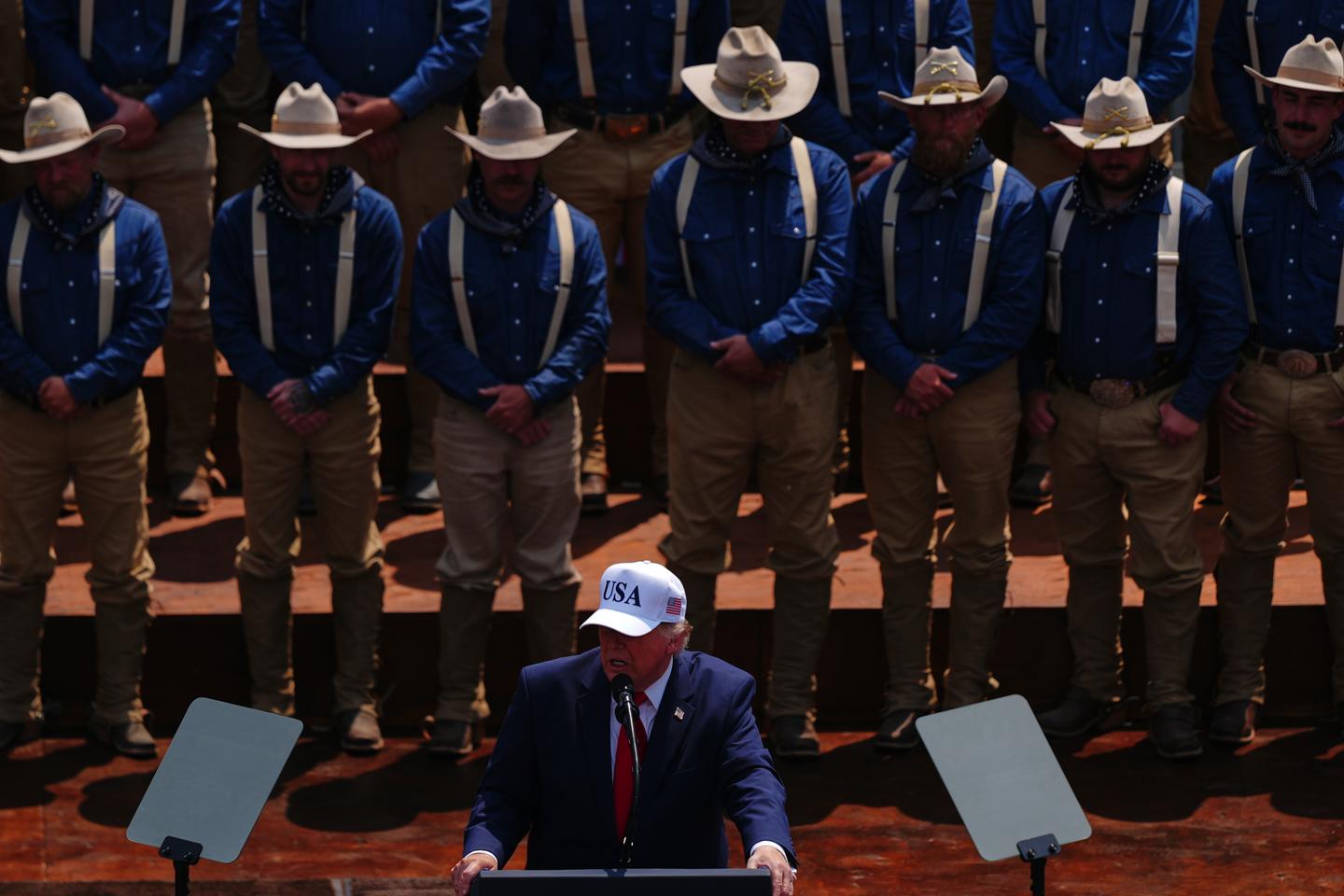
In South African, French and Turkish debates, the United States is now seen not as a distant superpower setting the overall global order, but as a direct producer of instability—military, trade-related, humanitarian and political. The most prominent common theme is the American policy toward Iran and the Strait of Hormuz. But behind it lies a broader conclusion among local commentators: under Donald Trump, Washington is increasingly acting through pressure, threats and bilateral deals, while allies and countries dependent on American decisions have to do less to share the US strategy than to insure themselves against its consequences.
In France, the reaction to the resumption of American bombardment of Iran after the June memorandum is particularly sharp because it combines legal and strategic arguments. Martin Cudey-Matinier, an expert at the Paris-based Institut Montaigne, writes in his analysis, “From Self-Defense to Punitive War”, that the return of US strikes on July 7 raises doubts about Washington’s stated goal of protecting shipping in the Strait of Hormuz. In his assessment, the American campaign increasingly looks like a “punitive operation,” fraught with violations of international law and questionable in terms of its own effectiveness. (institutmontaigne.org) French concern here is not limited to sympathy for Tehran: it reflects fear that the White House is replacing an achievable goal—ensuring the safety of maritime routes—with unlimited coercion against an entire country. For Paris, this substitution also means a loss of European influence: when diplomacy becomes an appendage to an American ultimatum, Europe ends up paying for decisions it did not make.
The Turkish perspective is noticeably more pragmatic, but no less wary. Turkish analyses focus primarily on the risk of a protracted war near the country’s own regional borders, the impact on trade and energy supplies, and whether Ankara can turn the crisis into diplomatic room for maneuver. In a Türkiye Araştırmaları Vakfı article, the June US-Iran memorandum is described not as a full-fledged peace agreement, but as a temporary, 60-day ceasefire following a devastating war. (turkiyearastirmalari.org) And in an analysis by former US ambassador Robert Stephen Ford published by the Turkish Anadolu Agency, it was noted that an intensification of the war in Iran, combined with inflation and high interest rates, could become a serious domestic political problem for Republicans in the United States. This analysis matters to Turkish audiences not only as a perspective on American elections: it reinforces the local view that Trump may change course under pressure from his own electoral and economic agenda. (aa.com.tr) In other words, Ankara is less concerned with the moral character of American power than with its unpredictability.
South African criticism goes further still: the American war around Iran is viewed as part of an order in which powerful states present their own coercion as the defense of rules. In a Mail & Guardian column, the conflict around Hormuz is described as Iran’s confrontation with a “US-centric order” that uses war, sanctions and the seizure of ships while couching these actions in the language of international law. (mg.co.za) This is a framework characteristic of South Africa—a BRICS country with a strong anticolonial political tradition: the question is not how Washington can win the conflict, but why the United States alone continues to retain the right to determine whose trade, security and sovereignty are legitimate.
The second overarching theme is American economic policy as an instrument of political coercion. In France, this is felt through tariff uncertainty. The debate is no longer so much about whether an EU-US agreement is beneficial in itself, but whether an arrangement whose terms Washington can revisit by threatening new tariffs can be considered an agreement at all. The French customs administration reports that the US 10 percent levy under Section 122 expired on July 24, 2026, while the EU was simultaneously adjusting its tariff regime for some American imports. The official clarification demonstrates how technical and fragile this bargaining process has become. (douane.gouv.fr) Behind the bureaucratic language lies a political emotion: France sees American tariffs not as an ordinary dispute over market access, but as a test of Europe’s ability to act as an independent economic center.
In South Africa, American pressure has a far more tangible cost: it affects the HIV treatment system, research and employment in the public health sector. A Physicians for Human Rights report states that by the end of March 2026, programs addressing HIV, tuberculosis, malaria and primary care remained disrupted after American cuts, while funding for South Africa was further suspended based on Trump administration claims about “white genocide.” The report on the impact of the cuts emphasizes that Washington did not conclude a new memorandum with Pretoria to continue medical funding. (phr.org) The local reaction therefore differs from France’s: for Paris, American tariff policy is a challenge to the sovereignty of the European market, whereas for South Africa, the termination of American programs is seen as a threat to patients and a painful reminder of dependence on an external donor. In their editorial, editors at the South African publication Spotlight call the past year a difficult one for researchers and acknowledge that emergency national funding can soften, but not compensate for, the blow caused by the sudden reduction in American support. (spotlightnsp.co.za)
This is where one of the most unexpected local conclusions emerges. The South African debate is not limited to condemning the United States: it turns the American withdrawal into an argument for domestic self-reliance—for funding research and medical services through South African, African and multilateral sources. This is not romanticism about “breaking with the West,” but a lesson in vulnerability: aid that can be canceled by an administrative decision in Washington cannot serve as the foundation of a national healthcare system.
Turkey, by contrast, sees transactionalism under Trump as both a danger and an opportunity. After the July NATO summit in Ankara, the question of the F-35 and the lifting of restrictions became the main symbol of this duality. President Recep Tayyip Erdoğan stressed, “The F-35 is not a new issue for us; we have already discussed it with the American side,” as reported by the Turkish economic publication Uzmanpara. (uzmanpara.milliyet.com.tr) The Turkish reaction contains fewer illusions about the reliability of the United States than hopes that personal diplomacy with Trump can deliver concrete concessions—on aircraft, sanctions or the defense industry. Significantly, in an Anadolu review, international attention to the possibility of lifting sanctions and selling F-35s is presented as evidence of Turkey’s growing regional influence. (aa.com.tr)
The third common thread is the increasingly personalized nature of American power. The French press sees this as institutional degradation. In a July article marking the 250th anniversary of American independence, the Le Monde editorial board writes that the anniversary has turned into a celebration of Trump himself, against a backdrop of polarization and the deterioration of the United States’ international image. (lemonde.fr) South African authors draw a different, almost pedagogical lesson for their own country. In a Mail & Guardian column on the risk of a “Trump-like leader” emerging, the author links the American phenomenon to economic anxiety, cultural alienation and distrust of institutions, warning that even a mature democracy is not immune to erosion. (mg.co.za)
This produces a coherent, though varied, picture. France views the United States as an ally whose military and trade unpredictability is pushing Europe toward strategic autonomy. Turkey sees the same Washington as a power with which it must bargain hard, extracting benefits from its need for regional partners but not relying on its consistency. South Africa perceives America’s turn as both a humanitarian threat and proof that dependence on external goodwill is strategically dangerous. The common denominator is not anti-Americanism as such. It is the belief that Trump’s America has become less of a universal guarantor and more of a variable factor—one against which other countries must protect their markets, their security and even their hospitals.
![Introduction: The memorandum of understanding signed by Iran and the United States in June 2026 is regarded by many as a turning point in the Middle East. However, this agreement is much more than a simple contract between the two countries; it is rewriting the region’s equations, and Turkey and the Turkic civilizational sphere will also be affected. In truth, although this memorandum reduces the risk of an all-out war […]](https://www.turkiyearastirmalari.org/wp-content/uploads/2026/07/ChatGPT-Image-4-Tem-2026-20_21_44-1024x445.png)



![*PRESIDENT ERDOĞAN: THE F-35 IS NOT A NEW ISSUE FOR US; WE HAVE ALREADY DISCUSSED IT WITH THE US SIDE [FNC-NEWS] - Uzmanpara Milliyet](https://uzmanpara.milliyet.com.tr/i/ANALIZ_RAPORLARI.jpg)