Three seemingly unrelated stories converged this week in Ukrainian, German and Brazilian discussions of the United States: Washington’s attempt to restart negotiations on the Russian-Ukrainian war, Donald Trump’s conspicuous sympathy for the success of the Alternative for Germany (AfD), and a new escalation of the trade conflict with Brazil. Yet local reactions share one idea: America remains too important a power to ignore, and at the same time too unpredictable to rely on unconditionally. In Kyiv, this means anxiety over a peace imposed for the sake of a quick result; in Berlin, irritation at an ally’s interference in a domestic political dispute; and in Brasília, the conviction that Washington has turned tariffs into a means of pressuring sovereign policy.
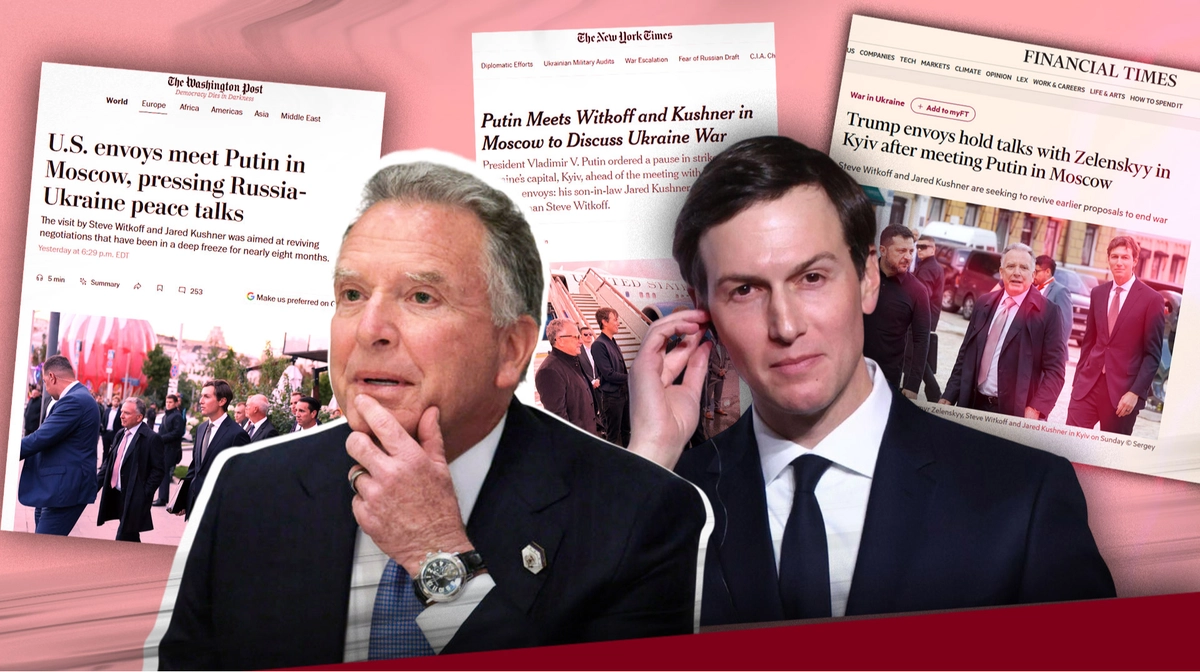
For Ukraine, the main American story was the September 5–6 visits by special envoy Steve Witkoff and Jared Kushner to Moscow and Kyiv. The very fact that both Trump representatives made their first trip to the Ukrainian capital was seen as a necessary signal: Kyiv had long sought to ensure that American mediators heard the Ukrainian side not only after talks in the Kremlin. However, the visit did not spark euphoria. An analysis by Ukrainska Pravda emphasizes that the envoys brought several new ideas but offered no breakthrough on the key issues—territory and security guarantees. Ukrainians interpret their desire to see results before winter in two ways: as an attempt to prevent another campaign of strikes against the energy system, but also as a risk that the U.S. political calendar may prove more important than the conditions for a genuine peace. (pravda.com.ua)
The Ukrainian criticism is particularly directed not at U.S. mediation itself, but at its style. An analysis by Yevropeiska Pravda, examining the Moscow and Kyiv stages of the trip, recalled that Witkoff’s previous contacts with the Kremlin had prompted distrust because of their secrecy and his excessive willingness to accept the Russian framework for negotiations. At the same time, Ukraine’s position is pragmatic: resuming a trilateral format involving the United States, Ukraine and Russia is considered useful as long as it does not replace Ukraine’s own agency. Political scientist Volodymyr Dubovyk put the conclusion even more bluntly in a comment to Hromadske Radio: strategically, Ukraine and Europe should invest in their own military and financial capabilities. This is not a rejection of America, but a conclusion prompted by its volatility. (eurointegration.com.ua)
In Germany, the anxiety stems from a different source but follows a similar logic. After the AfD’s victory in the state elections in Saxony-Anhalt, Trump publicly welcomed the success of the “populist party” on September 9, linked it to migration policy and ended his post with the slogan “MGGA”—an obvious variation on “Make Germany Great Again.” To Germany’s political community, this sounded not merely like an eccentric post by a foreign president, but like an attempt to import America’s culture war into the German electoral process. A T-Online commentary expressed the core of the debate with particular clarity: Germany should defend its democratic self-determination regardless of whether outside influence comes from Russia or the United States. (t-online.de)
This marks a notable shift in Germany’s view of transatlantic relations. Washington is no longer automatically perceived as an external guarantor of the liberal order; some German commentators now see today’s America as a participant in Europe’s polarization. Even Berlin’s official reaction was cautious: the issue of Trump’s remarks was raised directly at a government briefing, but the cabinet did not escalate the matter into a public confrontation. This restraint reflects Germany’s dilemma: it needs cooperation with the United States on security, but at the same time cannot allow a foreign leader to legitimize forces that German institutions regard as a threat to the constitutional order. (bundesregierung.de)
Brazil’s reaction to America is even more sharply framed in the language of sovereignty. The discussion there concerns additional 25 percent tariffs on a significant share of imports from Brazil, imposed after a Section 301 investigation. In Brasília, the conflict is interpreted not as an ordinary dispute over market access, but as political and diplomatic coercion. An article by the Observatório de Política Externa e da Inserção Internacional do Brasil draws a telling conclusion: the tariff functions as a diplomatic sanction disguised in technical trade terminology. The authors link the current dispute to a broader American attempt to use economic leverage to influence Brazil’s domestic institutions and foreign-policy choices. (opeb.org)
The verbal exchange intensified this perception. Marco Rubio said that Lula’s government had negotiated “not in good faith,” while Brazil’s Foreign Minister Mauro Vieira called the tariffs irrational and out of touch with reality, pointing to the longstanding U.S. trade surplus with Brazil. In a Le Monde Diplomatique Brasil column, this exchange is presented as a clash between two models of inter-American relations: Washington views the region through the lens of political loyalty and strategic alignment, while Brasília emphasizes equality, a multilateral approach and the right not to choose sides. Even the more moderate Brazilian editorial line is calling not for a break in negotiations, but for market diversification: Jornal do Comércio describes the tariff crisis as a lesson about the risks of excessive dependence on a single partner. (diplomatique.org.br)
This is where the common thread linking Kyiv, Berlin and Brasília becomes visible. Ukraine wants American power, but not American haste; Germany needs American partnership, but rejects American involvement in its partisan struggles; Brazil is prepared to trade with the United States, but will not accept political conditions as the price of access to its market. Everywhere, the United States is increasingly perceived not merely as a country making decisions at home, but as a power capable of reshaping other countries’ negotiations, elections and economic calculations. The local response is also becoming similar: not a break with America, but a search for greater autonomy—military in Ukraine, democratic in Germany, and trade and geopolitical in Brazil.