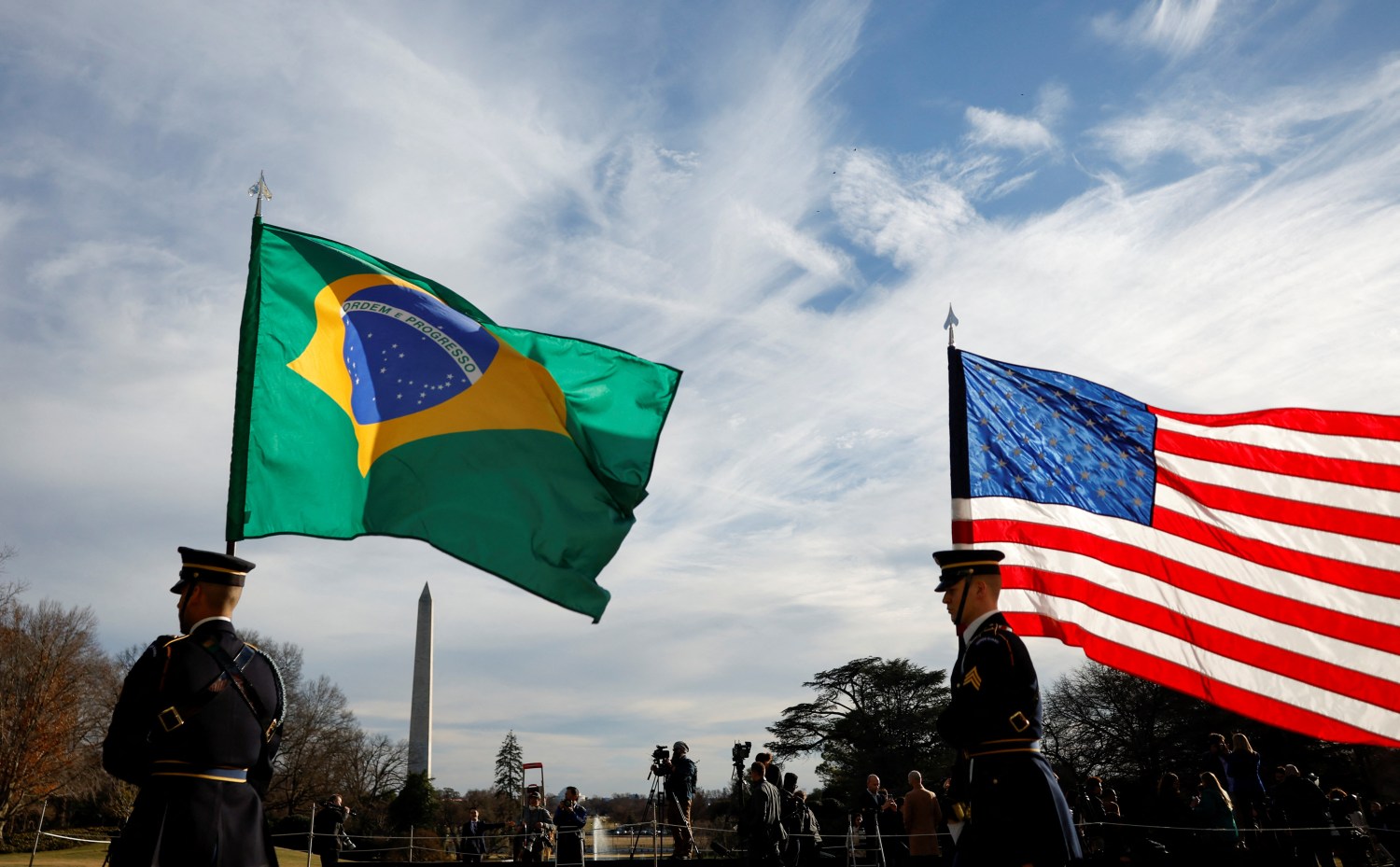
In Brazil, India and Japan, the United States simultaneously appears as an ally, a source of risk, and the main reference point that countries try to keep a little distance from—but for now cannot do without. This has been especially noticeable in recent days: in Indian and Brazilian commentary the US appears as an economic and technological partner; Washington’s decisions affect commodity markets and the fate of local oligarchs; and the Japanese press, through the lenses of nuclear disarmament, East Asian security and future trade wars, discusses how reliable the American umbrella is and how much it will cost. Against this background a common theme emerges across all three countries: the world increasingly lives in the logic of blocs, and the “American question” is in fact a question about one’s own sovereignty and maneuvering space within this new bipolarity.
The first prominent storyline is a new wave of economic and technological rapprochement between India and the US. Indian outlets emphasize that the focus is not on an abstract “strategic partnership” but on very concrete supply chains. Regional media in Indian languages describe in detail the fresh “historic strategic agreement” on critical and rare minerals signed by India and the US on the sidelines of the Quad foreign ministers’ meeting in New Delhi; the agreement concerns the supply and processing of raw materials crucial for electronics and green energy and is viewed as a step toward reducing dependence on China. As one Kannada newspaper notes, this is “a significant event in global diplomacy,” cementing India’s role as a key partner for Washington in the struggle to control resources of the future economy. In Indian commentary the US is presented not as a “senior partner” but as a compelled suitor: India gains the ability to extract concessions and at the same time an argument against Chinese pressure. Some experts, however, remind readers that too close an alignment with the American strategy against Beijing could complicate Delhi’s position in other areas—from Iran to Russia—but the overall tone remains optimistic: the US needs India no less than India needs the US.
At the same time, in the Indian information space the US appears in a far less comfortable role—as regulator and judge on whom the fates of key business figures depend. A symbolic example is reports that the US agreed to drop a criminal fraud case against Indian billionaire Gautam Adani after a settlement was reached. A regional Kannada outlet emphasizes that Adani, who started with the coal business in the 1990s and turned his group into a conglomerate of ports, energy, defense, agriculture and renewables, long ago became part of political debate in India because of his closeness to Narendra Modi’s government. Thus the American decision is perceived not only as a legal resolution but also as a marker of how ready Washington is to take into account the political sensitivity of such cases for key partners. Commentators draw parallels with other instances when American regulators and courts effectively intervened in the internal economic balances of allies and ask whether Delhi will be able to impose more equal rules of the game on the US in the future.
The second major thematic block—Brazilian reactions—portrays the US primarily as a financial-economic power whose decisions on interest rates, sanctions and investments hit Latin America directly. Commentators in leading outlets like Folha de S.Paulo and Globo, discussing fluctuations in the real and new green investment initiatives, regularly return to how Fed policy and Washington’s sanctions strategy reshape global capital flows, forcing Brazil to navigate between access to the American market and a desire to deepen ties with China. One column in Folha emphasizes that “in the new geopolitics of the dollar” any major developing player must think not only about how to enter the American market but also how to escape the risk of future sanctions and secondary restrictions if Washington’s political course suddenly changes again. There is cautious admiration here—the US remains the center of global finance—but also irritation: Brazil, like other countries of the Global South, is effectively a hostage to American domestic political struggles.
At the level of political commentary in Brazil, a growing narrative pits the US and Europe against a new “Global South.” Some left‑ and center‑left commentators welcome Lula’s rhetoric about multipolarity and the need to “talk to Washington on equal terms.” Such pieces recall that dependence on the American market and technologies in the 1990s and 2000s deprived Brazil of freedom of maneuver and propose using the current competition between the US and China to bargain for better terms. On the right, however, voices remain strong that argue no economic breakthrough is possible without a firm alignment with the US, and that a bet on “autonomy” risks losing investor confidence. This internal debate gives the US image in Brazilian optics a split character: at once an example of dynamic capitalism and a source of systemic inequality in the international order.
The Japanese media space, by contrast, focuses on the military and nuclear dimensions of American policy. Reports and analysis about the failure of the recent review conference on the Treaty on the Non‑Proliferation of Nuclear Weapons in New York highlight a sharp confrontation between the US and Iran over wording related to Iran’s nuclear program. Japanese outlets like FNN note that the document ultimately was not adopted, and that during negotiations language concerning Ukraine and especially North Korea was scrubbed or softened, which looks worrying for Japan. Hiroshima and Nagasaki, the “never again” culture and vulnerability to North Korean missiles make the topic of American nuclear strategy nearly existential for a Japanese audience. One FNN guest expert, commenting on the US role in these talks, stresses that Washington remains the guarantor of Japanese security while also being a player whose compromises on Iran or Russia could weaken the non‑proliferation regime overall, thereby harming Japan’s long‑term interests.
Against this backdrop the long‑running Japanese debate about the “fairness” of the US‑Japan alliance continues. Analytical pieces addressing Donald Trump’s statements that the “Japan‑US alliance is unfair” recall old disputes about who pays how much for the stationing of American troops and whether Japan is being turned into a “wallet” to sustain the US military presence in the region. In an FNN piece, political veteran Shigeru Ishiba argues that if the alliance is based on American military protection, Japan must more clearly demonstrate its readiness to participate in joint operations in a crisis over China; otherwise dissatisfaction in Washington will only grow. He specifically caveats, however, that excessive increases in Tokyo’s financial burden—even to the point of directly paying American servicemembers’ salaries—would effectively make them mercenaries, which would be politically unacceptable. This is a nuanced Japanese reply to American demands to “pay more”: the alliance matters, but not at any price and not in the logic of “whoever buys whose army.”
A separate strand of Japanese discussion concerns trade wars and the constitutionality of American tariffs. Business outlets such as Toyo Keizai analyze the consequences of a recent US Supreme Court decision that found certain “Trump‑era” tariffs unconstitutional and ask: if the foundation of the previous protectionist policy is being eroded, what will happen to colossal Japanese investments in American industry estimated in the tens of trillions of yen? In one article the author bluntly asks: “Was it right to enter into investment agreements worth about ¥85 trillion if the legal and political environment in the US is so unstable?” This framing reflects an important shift: Tokyo is beginning to view the American economy not only as a safe haven but also as a source of regulatory risk comparable to China.
There are topics on which the tone across all three countries almost entirely coincides. One is the perception of the US as a power inclined to use military force and sanctions and then leave allies alone to deal with the consequences. In Japanese discussions of a hypothetical military crisis in East Asia, in Brazilian columns on the consequences of American operations in Latin America, and in Indian debates about the reliability of American support amid China’s rising role, the same motif recurs: the US can abruptly change course if its domestic political balance shifts, and then yesterday’s promises lose weight. Japanese forums and commentary periodically cite American analysts warning that Trump or his ideological heirs lean toward a “Don doctrine”—the idea that American involvement in Europe and East Asia can be reduced, shifting responsibility onto local allies. One Japanese comment on a piece about a hypothetical US strike on Venezuela and its implications for Japan reaches a grim conclusion: if Tokyo acts based on guaranteed American support and Washington “removes the ladder” at the last moment, Japan may find itself isolated in the international community. This, essentially, articulates the deep fear shared by all three countries: America is a necessary but potentially unreliable anchor.
Also interesting are nuances that would be less obvious from the American press itself. Japanese assessments of recent US‑Israeli strikes on Iran, for example, emphasize not only legal aspects but simple energy calculations: Japan still depends heavily on oil imports from the Middle East, and openly “taking the US side” risks souring relations with key suppliers. One Japanese commentator recalls that even the Foreign Ministry’s stern statement on Iran’s nuclear program was phrased to avoid a direct appraisal of US and Israeli actions—precisely because, unlike Washington, Japan physically feels the risks to its own oil tankers. In India, discussion of the American line on Iran and Russia is similarly pragmatic: elites are far more concerned about whether new secondary sanctions will be imposed tomorrow than about abstract debates over “leadership of the free world.”
In Brazil the cultural‑symbolic level of attitudes toward the US is particularly pronounced. The press and public figures continue to debate whether Brazil should view America as a model of democracy or as a hypocritical power that lectures others on human rights while ignoring its own problems. On the left, parallels between American policing practices and Brazil’s police, and between racial issues in the US and at home, are common; these comparisons are often used to argue that the “American path” is not universal and is not necessarily suitable for solving Brazil’s social problems. On the right, the mythology of the US as a land of entrepreneurial freedom—where one can learn deregulation, innovation and anti‑corruption—remains strong. In this sense the Brazilian picture of the US is more emotional than the Indian and Japanese ones, where the conversation increasingly shifts to raw geopolitics and economics.
Most important, however, is that in all three countries there is a gradual shift from perceiving the US as the sole center of power to seeing it as one, albeit the strongest, player in a more complex field. Indian discourse increasingly speaks of a “plus‑one” strategy: building partnerships so that any major project can be coupled with an alternative—China, Europe, or regional actors. Japanese analysts write frankly that the era when Japan could “delegate” its foreign policy to the US is over: now it must draw a line between supporting American initiatives and protecting its own interests vis‑à‑vis China, Russia and Iran. Brazilian commentators, for their part, note that Kyiv, Tel Aviv and Taipei have shown that even the closest US partners are not immune to Washington limiting military or political support if domestic considerations demand it.
Thus today’s debates about the US in Brazil, India and Japan are above all conversations about themselves: about how to preserve room for maneuver in a world where “being with America” no longer guarantees automatic protection and prosperity, but “being without America” is still impossible. They contain less idealization and more cold calculation. And it is precisely this shift—from romantic Atlanticism and anti‑imperialism to a dry accounting of benefits and risks—that best shows how global perceptions of the US are changing beyond the English‑speaking world.