The main theme linking recent discussions about America in Japan, Russia and Ukraine is not simply the Republicans’ defeat in the November 3 midterm elections. In all three countries, it is seen as the start of a period in which a president weakened at home could become more active, unpredictable and personally driven in foreign policy. In Japan, this raises fears that Tokyo could be sidelined in Washington’s dealings with Beijing and Moscow; in Russia, it fuels hopes for negotiations with the United States without European mediation; in Ukraine, it prompts concern that the White House’s desire to show quick results could turn peace into a bargain over territory and security.
Japan’s response is especially revealing: the defeat is seen less as a return to American restraint than as a risk that Trump’s domestic agenda will be stymied and his focus shift to the international arena. Japanese broadcaster TV Asahi explicitly voices fears of “legacy diplomacy” — an attempt by a president whose domestic initiatives will be blocked by Congress to make history through major foreign-policy agreements. An unnamed official in the prime minister’s office warns: “When Congress stops functioning, he may channel his energy into other areas — diplomacy and security” “Trump Suffers Major Midterm Defeat: Will This Accelerate His Push for a Diplomatic Legacy?”. For Tokyo, this is no abstract concern: possible contacts between Trump, Vladimir Putin and Xi Jinping are viewed through the lens of Japan’s long-standing “Japan passing” anxiety — decisions about East Asia being made without Japan at the table.
Tetsuo Kotani, a professor at Meikai University, puts it even more bluntly: if the U.S. president moves closer to China and Russia while ignoring an ally’s interests, “the world could be shaped solely through cooperation between two great powers,” seriously damaging Japan’s security and diplomacy. The distinction matters: from Japan’s perspective, the problem is not that America is too weak, but that it might use its strength to strike a deal that disregards its allies’ vulnerabilities. At the same time, Japanese financial analysts see the election results as the start of a “lame-duck presidency.” Nomura expert Hajime Yoshimoto expects the White House to find it harder to pass legislation after January 2027, while the president retains broad room for maneuver in international affairs through executive powers. His analysis links domestic political gridlock in the United States with the risk of new foreign crises, from Iran to relations with China and Russia. (news.tv-asahi.co.jp)
For Russia, the same situation looks almost like a mirror image. The official Russian line does not portray Trump as an ally, but sees the United States as the only mediator capable, unlike Europe, of speaking in terms of a “balance of interests” and a new security architecture. After talks in Abu Dhabi on November 10–11, presidential aide Vladimir Medinsky said the sides had “found common ground on some things, and not on others.” His main point was the need for a “modern, updated security system” in Europe. His more political remark — that much depends on the U.S. position and on whether “Europe comes to its senses” — shows how Moscow distinguishes Washington from European capitals. The Interfax report also carries a promise that Russia’s goals will be achieved regardless. (m.interfax.ru)
This makes the Russian response a two-sided one. On the one hand, U.S. involvement is valuable because it restores direct Moscow–Washington dialogue and reduces Europe’s role; the Kremlin considers Europe a party interested in prolonging the conflict. On the other hand, that involvement does not mean Russia is prepared to abandon its core demands. For Moscow, negotiations are a way to enshrine the principle of “mutual security guarantees” — shifting the discussion from protecting Ukraine against another attack to the broader question of which military and political capabilities should be restricted for all parties in the European system. This is where Russian and Ukrainian interpretations of America diverge most sharply: Moscow sees an opportunity to rebuild the continent’s security order; Kyiv sees the risk of blurring the distinction between a country under attack and an aggressor state.
In Ukrainian media, the United States is currently discussed above all as a mediator whose urgency may be more dangerous than its weakness. Ukrainian political analyst Serhiy Solodky, director of the New Europe Center, said in an interview with Ukrainska Pravda: “I don’t expect a breakthrough. There may be individual agreements, for example on prisoner exchanges, but no more than that.” His reasoning is straightforward: diplomatic meetings alone do not change Russia’s goals, and winter military pressure — including strikes on energy infrastructure — may be part of a calculation to secure more favorable terms at the negotiating table. For Ukrainian readers, Trump’s promise of a “nearby deal” therefore sounds less like a diplomatic success than a warning sign — especially after his remark that Ukraine might have a “somewhat different form” after the war [translated from English]. (pravda.com.ua)
However, Ukraine’s reaction to the U.S. elections is not simply a matter of hoping for a Democratic Congress. Oleksandr Antoniuk, a member of Ukraine’s Defense Forces and a political consultant, argues in an analysis for RBC-Ukraine that a rapid shift in U.S. policy is unlikely: what will be constrained is not the policy itself, but Trump’s ability to pursue his most “fantastical initiatives.” It is a subtle but important distinction. Kyiv does not assume that weakening the president at home will automatically make Washington more pro-Ukrainian. Rather, it could raise the political cost of his decisions, increase scrutiny of negotiators and make it harder to reach agreements that might look like a personal diplomatic deal by the White House. (rbc.ua)
Perhaps most striking is that Japan, Russia and Ukraine are watching not so much the balance of parties in Congress as the American president’s state of mind after his defeat. Tokyo fears he will seek a grand deal with Japan’s powerful neighbors. Moscow hopes that a drive for diplomatic results will make Washington more receptive to Russian arguments about European security. Kyiv fears that the same drive for results will put pressure on Ukraine — above all over territory and postwar security guarantees.
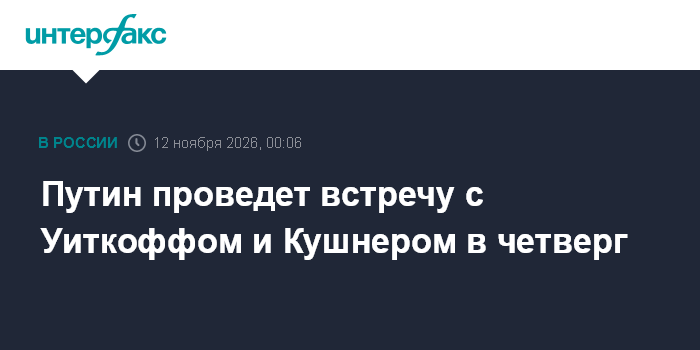
The outcome of the Abu Dhabi talks has yet to resolve these contradictions. The most realistic common result is not a comprehensive peace, but humanitarian and technical agreements, including a major prisoner exchange; the territorial question and the shape of postwar security remain the most difficult issues. On November 12, Vladimir Putin was scheduled to meet in Moscow with U.S. envoys Steve Witkoff and Jared Kushner, while the U.S. side reported some progress on security guarantees. But the sequence of meetings itself shows why America is being watched so closely in all three countries: it is at once an indispensable mediator, a potential architect of a new deal and a source of strategic uncertainty. (m.interfax.ru)