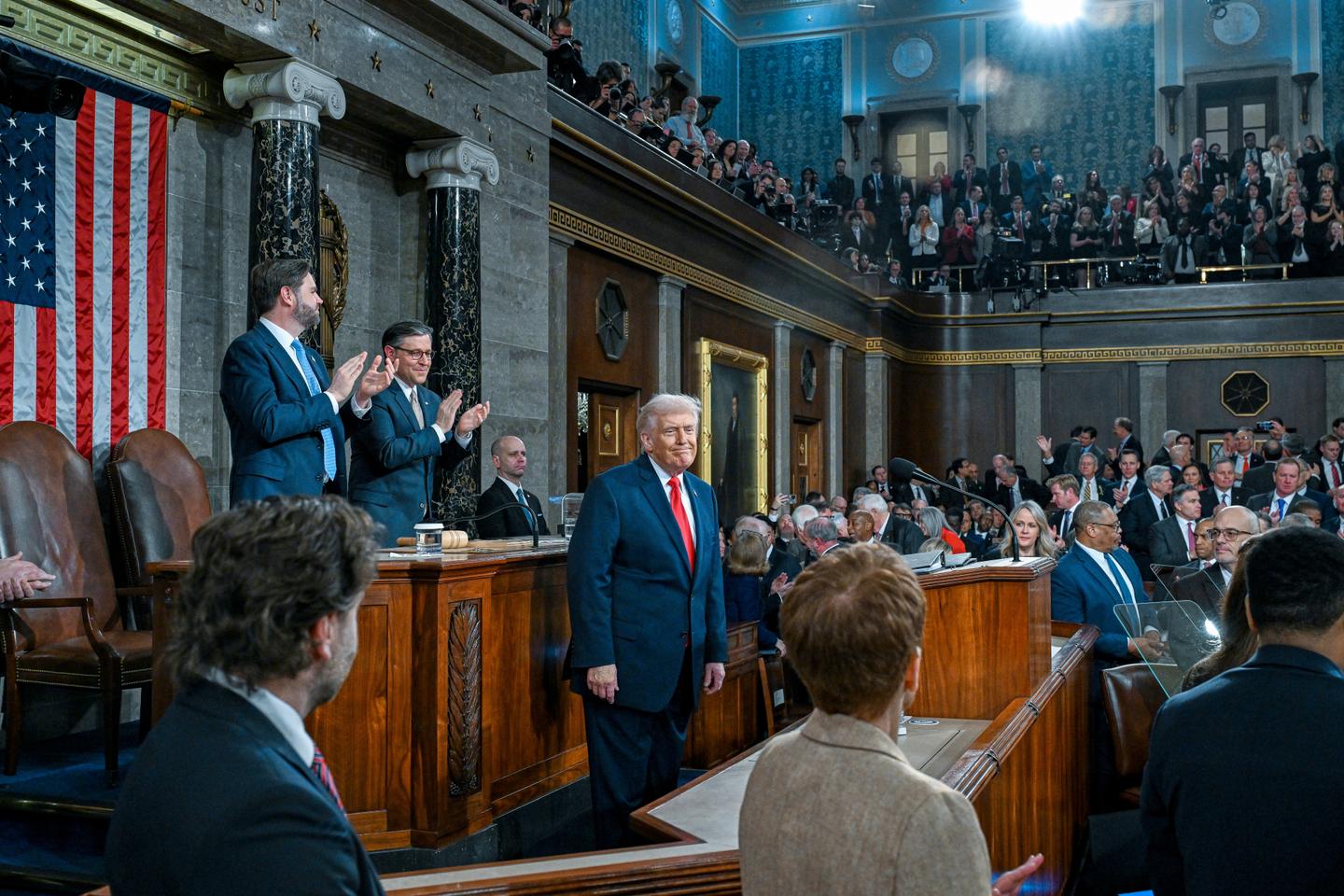
The main American story abroad in recent weeks has been not so much the Democrats’ victory in the November 3 midterm elections as the question of whether it can change the White House’s conduct around the world. In India, France and Saudi Arabia, the question is discussed through different national concerns, but the conclusion is strikingly similar: a Washington weakened at home will not necessarily become less assertive abroad. Its policy is more likely to become even more situational—constrained by Congress, yet leaving the president enormous room to make decisions on war, sanctions, tariffs and technology.
The uncertainty is felt most acutely in connection with the war with Iran. The French press sees the Republicans’ defeat primarily as a vote against an expensive foreign adventure that voters came to associate with the rising cost of living. In an editorial, Le Monde called the Iran campaign a new “unwinnable war” [“guerre ingagnable”] and suggested that its consequences could accelerate America’s disengagement from the Middle East. But the French view is not simply one of expecting a turn toward peacemaking. Analyst Alain Frachon warns in Le Monde that the elections amounted to “a serious brake, but not a halt to unchecked Trumpism” [“un sérieux coup de frein, pas un coup d’arrêt”]. In other words, Congress may make it harder to provide additional funding for an escalation, but that does not change the fact that foreign policy remains primarily in the president’s hands.
In India, the same war is viewed not as a debate about the moral cost of American power, but as an immediate risk to oil supplies, trade and the millions of Indians working in Gulf countries. The Indian Express links a possible diplomatic end to the conflict with the restoration of normal shipping through the Strait of Hormuz and lower oil prices—vital for the world’s third-largest oil importer. But New Delhi is under no illusion that a Democratic victory will automatically rein in the White House. Former Indian ambassador Mohan Kumar remarks in the same publication that a president constrained on domestic policy in the final years of his term may, on the contrary, feel freer to act abroad. The observation neatly captures India’s wariness: Trump’s political defeat could increase, rather than reduce, the temptation to score a foreign-policy “quick win.”
In Saudi Arabia, American policy toward Iran is viewed in even more down-to-earth terms: as a matter of the security of oil infrastructure, maritime routes and the kingdom itself. The Saudi newspaper Al Riyadh saw the election results as strengthening the American “dove camp” [“معسكر الحمائم”], which favors a diplomatic settlement. But the author immediately adds a caveat: unless Iran makes substantial concessions soon, that window will close, and a resumption of the war will become almost inevitable. A columnist for Al Jazirah put the Saudi dilemma even more precisely: Riyadh’s interest lies “neither in expanding the war nor in leaving regional threats unaddressed” [“المصلحة السعودية والخليجية لا تتمثل في اتساع الحرب، كما لا تتمثل في ترك التهديدات الإقليمية دون معالجة”]. This is an important difference from European debates: Saudi Arabia is not simply calling for an American withdrawal. It wants the United States to deter Iran without turning the Persian Gulf into an arena of endless war.
This leads to a second common theme: distrust of personalized American politics. In Paris, Trump’s defeat also became a domestic French event: the far-right National Rally rushed to distance itself from its American ally. Jordan Bardella linked the Republicans’ defeat to “the very serious consequences for the US economy of the American intervention in Iran” [“les conséquences très lourdes pour l’économie américaine de l’intervention américaine en Iran”], while Louis Aliot said that Trump was “immediately paying the price for the Iranian adventure” [“paye cash l’aventure iranienne”], as Le Monde reports. For French politicians, America has become a mirror held up to France ahead of the 2027 presidential election: an example of how nationalist rhetoric can lose when war and energy prices intrude into everyday life.
Indian commentators draw a different conclusion: relations with the United States cannot be built around a single president, even if personal ties with him seem warm. A diplomatic source quoted by The Indian Express says plainly: “It is time for us to reach out to the Democratic congressmen and women who were in the minority, before the next election cycle begins.” This is more than a technical recommendation. It acknowledges that the old bet on personal chemistry between leaders no longer protects India from American demands.
Saudi commentators arrive at the same conclusion from the opposite end of the map. For Riyadh, it is dangerous to confine relations to the White House, since any shift in Washington’s partisan balance affects war funding, security agreements and nuclear cooperation. That is why Saudi debate increasingly emphasizes engaging not with a single administration but with the entire American state apparatus—both chambers of Congress and their defense, foreign affairs and budget committees. American unpredictability is becoming not a temporary deviation, but a structural feature of foreign policy.
A third theme, especially visible in France and India, is the transformation of American technological power into an instrument of strategic pressure. French debates about the United States now revolve not only around NATO and Iran, but also around artificial intelligence, cloud services and military data. In an investigation by Le Monde, a French military source acknowledges the risk of a situation involving “less America, but more control” [“moins d’Amérique, mais plus de contrôle”]: even as political ties with the United States partially loosen, European allies are becoming ever more dependent on American platforms, satellite data and software. France’s concern here is twofold. On the one hand, without America’s technological edge, Europe finds it difficult to maintain military effectiveness; on the other, access to these tools could be restricted by a political decision in Washington.
In India, this dependence appears less ideological, but is no less sensitive. New Delhi wants American investment in semiconductors, AI and defense manufacturing, while resisting attempts to tie access to technology to concessions on market access, Russian oil or migration policy. Deep Pal, director of the Koan Advisory consulting group, notes in The Indian Express that even a Democratic Congress does not guarantee India easier access to advanced chips and defense technology: export licenses, national security reviews and funding decisions are still determined by American interests. India’s formula, then, is not “free ourselves from the US,” as is often heard in France, but “gain access without becoming politically dependent.”
This divergence is especially clear in trade. For Paris, the United States is an ally that increasingly looks like a competitor and a source of extraterritorial pressure; for New Delhi, it is a vital market and technology partner that can at the same time impose tariffs, tighten visa rules and demand changes to energy ties. Indian expert Ajay Srivastava warns that a change in control of Congress will not alter the main direction: both American parties now support economic nationalism, domestic production and strict supply chains. His forecast in The Indian Express sounds almost like an instruction to New Delhi: it should expect not an end to pressure, but “increased pressure on India to secure a trade deal that would demonstrate American influence.”
The most unexpected common feature of the French, Indian and Saudi reactions is that none of them sees Trump’s domestic political weakening as an automatic victory for their own interests. France sees a chance to curb America’s unilateral course, but fears technological dependence. India hopes for more predictable negotiations, but expects new demands on tariffs and energy. Saudi Arabia welcomes a diplomatic opening with Iran, but fears that Washington will either slide back into escalation or reduce its engagement, leaving the region with the same old threats.
Thus, abroad, America is now discussed not as a unified superpower with a clear strategy, but as a country where war, the economy, elections and technological power are ever more tightly intertwined. The Democrats’ victory has given US partners not confidence, but a reason to diversify their ties. Paris speaks of strategic autonomy, New Delhi of strategic flexibility, and Riyadh of regional security and institutional dialogue with Washington. In different words, they are describing the same new reality: the United States remains necessary to rely on, but relying on the United States alone is now dangerous.