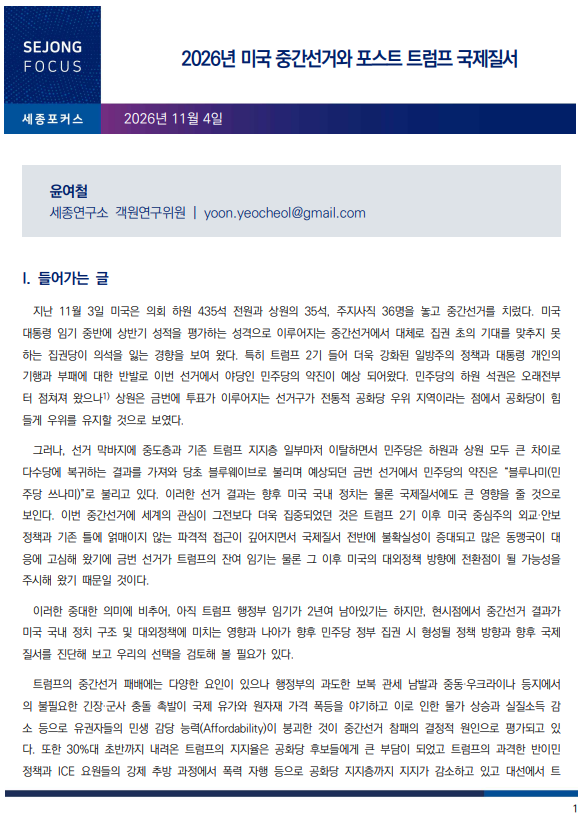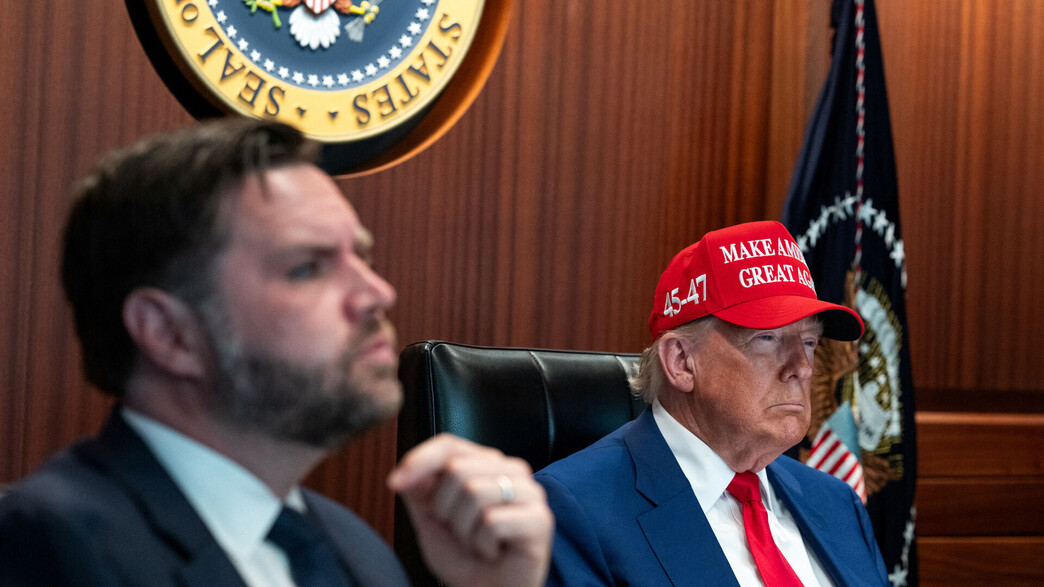
For observers in Israel, South Korea and China, the main American story of the past two weeks has been not so much the November 3 midterm elections themselves as their practical implications: Democrats regained control of both chambers of Congress, and Donald Trump entered the final two years of his term weakened at home, yet still able to set the pace of foreign policy on his own. In all three countries, this is seen not as a promise of a softer America, but as the beginning of a period in which the United States will become even less predictable: Congress will throw up obstacles, the White House will seek quick foreign-policy wins, and allies and rivals alike will have to hedge against sudden decisions from Washington. (sejong.org)
For Israel, this shift has already acquired a very concrete price tag: military aid. The Israeli debate centers on a troubling conclusion: Prime Minister Benjamin Netanyahu’s bet on personal ties with Trump and on the Republicans has not translated into solid American support. Instead, it has accelerated the transformation of Israel into a partisan wedge issue in the United States. Tamir Hayman, former head of Israeli military intelligence and director of INSS, puts it almost as a diagnosis in his column for N12: Israel has been left “without a political home” in America. His point matters precisely because it is directed not only at the Democrats or Trump: in Israel, there is growing recognition that years of estrangement from the Democratic Party, the conflict over the Palestinian issue, and Israel’s association with Trump’s polarizing style have made the country an easy target for both American political camps. (mako.co.il)
Israelis were particularly alarmed by Trump’s announcement that American military aid would end by the close of 2026. In an analysis for Arena Journal, Israeli analyst Eliyahu Gilboa notes that the current package is worth about $4 billion a year, including funds for weapons procurement and missile defense. But, from Israel’s perspective, the issue is not just the sum involved. Aid is seen as a mutual investment: the United States receives intelligence, technology, weapons testing and the military experience of a partner. That is why the local response combines frustration with pragmatism: rather than hope for a return to the old model, Israel is being urged to urgently negotiate a new strategic cooperation agreement before the new Congress makes the terms more stringent. (arenajournal.org.il)
The Iran issue ties Israeli anxiety even more closely to American domestic politics. In Israel, there is a sense that American voters punished the Republicans not only over prices and tariffs, but also over the prolonged confrontation with Iran, which drove up fuel inflation. This has raised fears that Trump, in need of a foreign-policy victory, may seek a deal with Tehran while also limiting Israel’s freedom of action. In other words, Jerusalem is no longer sure that the White House’s tough rhetoric automatically means Washington is prepared to support a new major campaign. (arenajournal.org.il)
In South Korea, American instability looks different: the concern is not that the United States will abandon its ally, but that Korean interests could become bargaining chips in improvised great-power diplomacy. Particular unease was sparked by a November 19 meeting of the leaders of the United States, China and Russia in Shenzhen, on the sidelines of APEC. Korean commentators have drawn a historical parallel with a “second Yalta”—a situation in which outside powers discuss the fate of the peninsula without Korea’s full participation. Ewha Womans University professor Park Won-gon warns in a Yonhap report that if talks focus on a possible Trump–Kim Jong Un meeting, denuclearization could take a back seat. Korea’s concern is not that talks with Pyongyang are inherently bad, but that, after an electoral defeat, Trump may prefer a high-profile personal deal to a durable security framework.
Economic concerns add to that anxiety. In Seoul, the impact of the American elections is measured not only in diplomatic terms, but also in the movement of Samsung Electronics and SK Hynix shares. The Democrats’ victory raised expectations of tighter regulation of American data centers—and thus a possible slowdown in demand for memory chips and AI equipment. After reassessing the risks, South Korea’s KOSPI fell sharply in early November; Korean economists explicitly linked the drop to concerns over American AI infrastructure. (cn.yna.co.kr) President Lee Jae-myung called on the government to prepare for possible new shocks from the United States, while strengthening ties not only with the White House, but also with Congress, corporations and state governments. (cn.yna.co.kr) The formulation is telling: South Korea is not waiting for Washington to become a unified and predictable center of power again, but is trying to work with several Americas at once.
China’s response is markedly calmer—and perhaps for that reason the most revealing. Chinese analysts do not see the midterm elections as a turn toward détente. In a commentary published by People’s Daily Online, researcher Wang Peng describes “managed competition”—competition with risks kept in check—as the basic framework for relations. His argument is simple: anti-China rhetoric was indeed less prominent during the campaign, as American voters were more concerned about the cost of living and the war with Iran. But that does not mean the United States is abandoning technological, trade or geopolitical rivalry. In China’s view, a Democratic Congress may make it harder for Trump to maneuver, but it will not automatically take a more moderate line on chips, investment or restrictions on China. (world.people.com.cn)
This leads to a conclusion shared by all three countries, though each gives it a different emotional coloring. Israel sees an America whose domestic weariness with wars and spending could bring down the familiar architecture of aid. South Korea sees an America where a president’s personal diplomacy could get ahead of allies’ interests, while domestic political decisions instantly ripple through Asian technology supply chains. China sees not a weakened rival, but a noisier, more divided and nonetheless strategically consistent competitor. The paradox of the current moment is that American polarization does not diminish the United States’ influence on the world. It changes the nature of that influence: Washington’s partners now have to fear not only America’s power, but also its domestic swings.