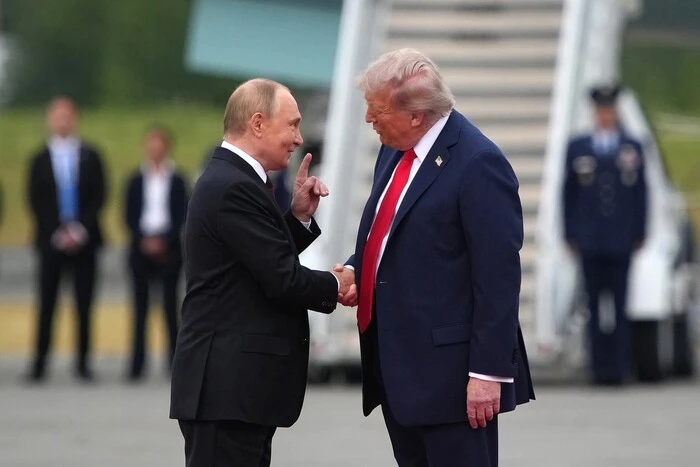
Today’s roundup looks at concerns over Washington’s course under Trump. In France, commentators are discussing divisions within the United States, economic disillusionment, and the risk of conflict with Iran. Ukrainian coverage focuses on the threat of weakening support for Kyiv, possible concessions to Putin, and the impact of U.S. policy on security and trade. The roundup is based on articles from Le Figaro (France) and Glavcom (Ukraine).
Trump’s economy: Growth is there, but Americans don’t feel prosperous
Ahead of the midterm elections, Donald Trump is presenting the state of the United States as a resounding success for his administration. The president gives himself an “A+” for “running the country, the economy, everything.” But the French newspaper Le Figaro offers a far less triumphant reading: behind the outward resilience of the U.S. economy, the paper argues, citizens’ frustration and anxiety over the cost of living are building.
With notable irony, the paper contrasts the president’s self-assessment with households’ day-to-day experience, asking: “The Coué method? Self-persuasion?” This captures the central focus of the French analysis: the issue is not only growth and investment, but also the gap between the White House’s political narrative and how people perceive their own financial circumstances.
As the paper notes, the U.S. economy is “not doing too badly.” Growth is expected to reach 2.3%, with investment in technology and artificial intelligence remaining a key driver of activity. Still, this is below the rate of more than 3% recorded under Joe Biden. The technology boom supports macroeconomic resilience, but does not resolve the politically most sensitive problem: the declining sense of purchasing power and families’ concern over rising expenses.
The cost of living, rather than favorable statistics, may prove more important at the polls. Investors and large companies care about capital inflows, AI development, and technological prospects; voters, by contrast, focus on the prices of basic goods, housing, energy, and everyday services. GDP growth alone does not guarantee public support when people’s household budgets give them no sense that their circumstances are improving.
This conclusion is especially familiar to French readers. In France, assessments of government economic policy rarely come down to a single GDP figure: political sentiment is shaped more by real incomes, inflation, housing affordability, and the cost of electricity and food. The American experience described by Le Figaro illustrates a broader European logic: investment-led and high-tech growth does not automatically translate into a sense of prosperity for the majority.
At the same time, the article highlights the strategic context for Europe. The scale of U.S. investment in artificial intelligence and the strength of its technology sector demonstrate the continuing gap between the United States and European countries. For France, which has declared its ambition to achieve technological sovereignty and develop its own AI sector, this is a reminder of the competitive pressure from the U.S. economy.
Trump’s political vulnerability over the cost of living may have consequences beyond the United States. His dependence on voter sentiment ahead of the midterms could affect Washington’s trade, tariff, and investment policies—and, in turn, European partners and French businesses. In this sense, the French analysis goes beyond assessing U.S. economic indicators: it treats economic statistics as a tool in the election campaign.
In its political and economic “decoding,” Le Figaro focuses above all on the weakness of the president’s strategy. Trump is trying, in the paper’s words, to stop voters from doubting his economic success. But behind the resilience figures, investment growth, and technological optimism may lie frustrations that will count for more at the ballot box than official reports on the state of the economy.
Ukraine sees Trump’s policies strengthening Russia’s position
The policies of Donald Trump’s administration are prompting increasingly alarmed reactions in Kyiv: Ukrainian observers believe that Washington’s decisions may not merely weaken support for Ukraine, but directly help Russia achieve its military objectives. As a Glavcom article citing The New York Times notes, the concern is that the United States could change course in a way that gives Moscow economic, political, and military advantages while the war continues.
In the article “NYT: Trump Is Reversing U.S. Policy and Helping Putin in His War Against Ukraine”, the United States is portrayed no longer as a difficult and unpredictable—but necessary—partner to Kyiv, but as a country whose actions could intensify Russian pressure on Ukraine. This is especially painful given Ukraine’s dependence on U.S. weapons, intelligence, and satellite communications.
One symbol of this shift, the article says, is an agreement to supply Russian diesel fuel to the United States. From Ukraine’s perspective, this is not merely a commercial deal but also a political signal: Washington is effectively engaging with Moscow and, Kyiv fears, partly easing the pressure of sanctions on the Russian economy. Energy export revenues remain an important source of funding for the Kremlin’s war.
Reports of periodic pauses in intelligence-sharing with Ukraine and delays in Ukrainian Defense Forces’ access to the Starshield satellite system have caused similar concern. For Kyiv, these decisions have direct military consequences, not merely diplomatic ones. Intelligence and satellite services are essential for providing early warning of attacks, protecting infrastructure, coordinating units, and conducting military operations.
Ukraine’s interpretation links these developments to Russia’s strategy of applying pressure over the winter. Russia is systematically attacking energy infrastructure in an effort to disrupt electricity, heating, and supplies. In this context, the phrase “force Ukraine to surrender through hunger this winter” captures the fear of a scenario in which cold, fuel shortages, and prolonged outages become tools of pressure not only on the population but also on the country’s political leadership.
President Volodymyr Zelensky sharply criticized Trump’s refusal to impose sanctions on Russia under the “Graham Act.” He called the weakening of restrictions a “sanctions blackout.” In Kyiv’s view, declining to take further action against Moscow amid massive attacks on Ukraine’s energy infrastructure does not bring peace closer; instead, it “only encourages the Kremlin to continue the war.”
In Ukraine’s view, the consequences of this policy are felt on several fronts. Militarily, there is a risk of losing timely access to U.S. intelligence and technological capabilities. The humanitarian and economic risks include the prospect of another severe winter campaign against the energy system. Politically, Ukraine may need to seek stronger guarantees from European partners and accelerate the development of its own defense, satellite, and energy capabilities.
The historical context is also significant. Ukraine is deeply sensitive to any attempt by major powers to reach agreements with the Kremlin without fully taking Ukraine’s position into account. That is why, in Kyiv, Trump’s public expression of gratitude to Vladimir Putin for the fuel deal is seen not as an ordinary commercial episode, but as a signal that could weaken Russia’s international isolation during the war.
The article does not claim to present a neutral account of events: it brings together the fuel agreement, sanctions policy, intelligence cooperation, and Russian attacks on energy infrastructure in a single, alarming scenario. Its central conclusion is that Trump’s unpredictability and a possible shift in U.S. policy could change the balance of the war in Russia’s favor—at the very moment when Ukraine most needs consistent external support.