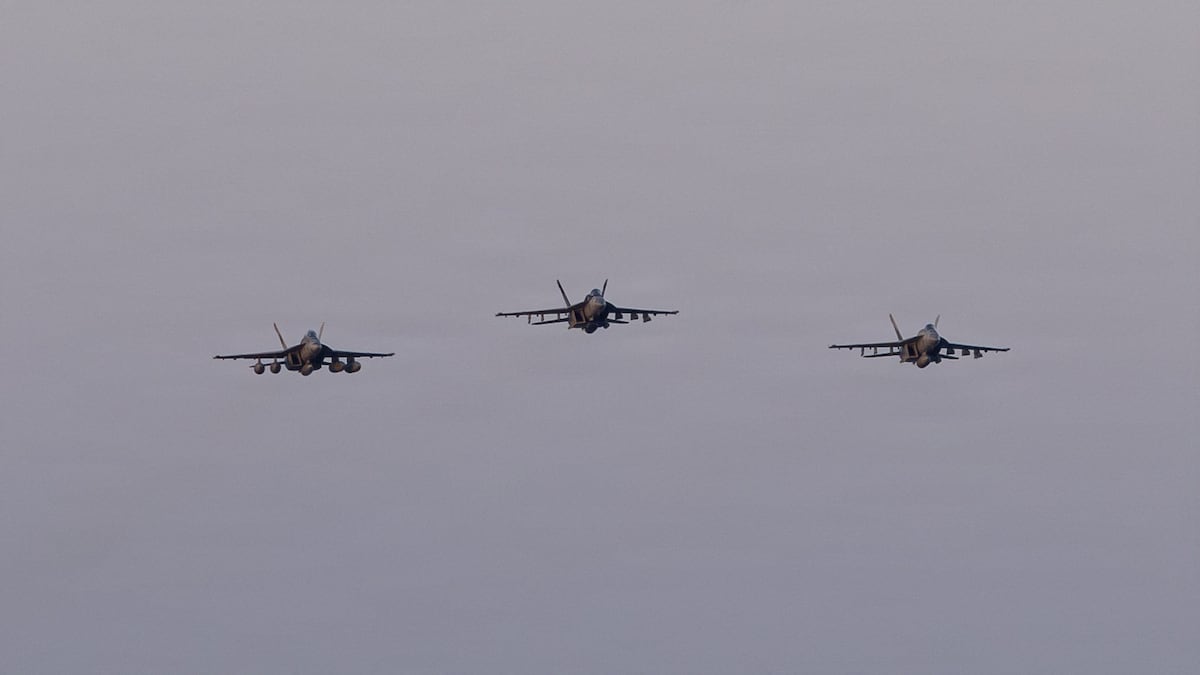
Venezuelan publications view a possible conflict between the US-Israel coalition and Iran as a dangerous and irresponsible escalation that exposes the vulnerability of American dominance. Analytical pieces and columns are especially critical of Trump's rhetoric — from threats and ultimatums to promises of a quick victory — which, authors argue, only increase the risk of military conflict and regional instability. Reports emphasize Iran's readiness to respond, human losses and the strategic consequences of the attacks, including accounts of shot-down aircraft and situations compared to kidnappings — all of which create a picture that shifts the emphasis from neutral reporting toward condemnation of American militarism and the assertion that the US has overestimated its power and finds itself in a vulnerable position. This piece was prepared based on materials from elpais.com (Venezuela) and www.instagram.com (Venezuela).
Venezuela between Hormuz and Caracas: nuclear blackmail, Trump and the silence of the media
To a Venezuelan reading European columns about the war in the Middle East while scrolling through Instagram comments, today's world appears through a double lens. On one hand — an analytical fear of a possible US nuclear strike on Iran, discussed by a columnist in the Spanish press. On the other — anger and distrust toward the "Western press," voiced in Venezuelan social media, where Donald Trump is referred to as "señor naranja," and global media are called "esclavos del sionismo."
This dual optics is clear when comparing the Spanish column about Washington's "nuclear option" regarding Iran, published in El País, and a Venezuelan analysis of an Instagram post that discusses Trump's threats to close the Strait of Hormuz and attack regional infrastructure, referencing a post on Instagram. Together they form a coherent picture of how political violence by the US, the threat of a major war, and the role of information in that game are perceived in Caracas.
The column in El País poses an extremely stark hypothetical question: could Donald Trump, upon returning to power and confronted with a deadlock in a war against Iran, decide to use nuclear weapons to, in the author's words, "provoke hell" on Iranian territory and break the "real balance" on the battlefield? This prospect is described as more psychological than military: it's less about military rationale than about a display of force and blackmail in situations where the aggressor cannot achieve a "neat" victory by conventional means, while the attacked regime does not fall and behaves, in the author's figurative wording, like a "hydra with seven heads."
From Caracas that question sounds familiar. First, because Venezuelans have grown used to the rhetoric "all options are on the table," which Washington has used since 2017 regarding Venezuela, Iran and other "problem" countries. Second, because the experience of recent decades has shown: the US is well versed in the arsenal of sanctions, economic strangulation and covert operations, but extremely cautious when it comes to prolonged, bloody and politically hard-to-justify wars for its own electorate.
The Spanish text is constructed as a debate of "arguments and counterarguments." One inner voice says: Trump and Benjamin Netanyahu, faced with a military deadlock, could resort to "nuclear madness"; another replies: that option is political suicide and would encounter the fiercest resistance within the US itself and among its allies. It is this "dialogue" that particularly resonates in Venezuela.
The first important theme — the limits of American power. The El País author emphasizes that a "real parity" has emerged on the battlefield: the aggressor cannot win without enormous losses and a costly ground operation, while the attacked side — whether Iran or its Middle Eastern allies — is not inclined to capitulate and knows how to regenerate its capabilities. In Venezuelan analytical circles this idea long ago became commonplace: the US retains colossal military potential, but it is constrained by political limits — public fatigue with "endless wars," the risk of new "Iraqs" and "Afghanistans," the fear of images of thousands of coffins. Hence the reliance on sanctions, hybrid actions, economic blockade, rather than direct interventions like the now-unthinkable Iraq-2003 or Libya-2011.
The second theme — the conflict between "madness" and negotiations. The El País column insists that before pressing a nuclear button, there is always a way back to diplomacy, even if it will be presented by propaganda as "our victory" — "they are exhausted, they cannot defeat us." For a Venezuelan reader this sounds especially familiar. Caracas has seen Washington alternate periods of "maximum pressure" — intensified sanctions, threats, support for "regime change" — with tactical softening: issuing oil licenses, partially allowing Venezuelan oil onto the market, launching and freezing dialogues. Meanwhile, the rhetoric "the regime fell," "they can no longer" does not disappear, even when the White House is quietly forced to negotiate with the very government it yesterday called "illegitimate."
The third theme — the use of war as an electoral tool. The Spanish author reminds that both Trump and Netanyahu are heading into elections; polarization, demonstrating toughness and playing to voters' nerves serve their interests. In Venezuela this confirms a long-held suspicion: US policy toward Caracas, Tehran or Gaza is often driven not by rational interests but by electoral logic. Toughness toward "dictators," "terrorists," "rogue regimes" scores points with certain groups — the Israeli lobby, the Cuban-American community in Florida, evangelical voters. For Venezuela this means the country's fate is often hostage to Washington's political calendar.
The fourth line of reasoning concerns domestic political costs of extreme decisions. The El País piece draws a clear line between World War II, where the US's use of nuclear weapons is still justified as a fight against "Nazi-fascism," and a potential war against Iran, which would be seen by the world as an "illegal aggressive war." A nuclear strike in that context would not be a symbol of victory but an admission of political failure, a signal that all other means proved insufficient. And this logic, many Venezuelan analysts believe, restrains Washington not only from "nuclear madness" but also from open occupations like those many in Caracas feared at the peak of the 2017–2019 crises.
The fifth aspect — risks for the region and the global economy. The Iberian text highlights: radioactive contamination, strikes on transport corridors, and likely escalation of retaliatory attacks would affect not only Iran but also "friendly emirate regimes," and even Israel. From Caracas they add oil and logistics: any war around the Strait of Hormuz, especially with threats to attack infrastructure, could push up oil prices and tanker freight, which in the short term benefits producing countries like Venezuela, but in reality threatens greater turbulence, tighter financial restrictions and more difficulty selling "problematic oil."
At this point the European analysis connects with a Venezuelan voice from Instagram, examined in the piece and based on the post. There the focus shifts: not the nuclear bomb, but Trump's alleged threat to attack "all power plants and the bridge" if the "paso de Ormus" is not opened. Not cold calculation, but outrage at how, in the author's view, "Western media" are silent about this.
The phrase "van le@tos con la información ohhh no quieren informar con la verdad" fits precisely into the Venezuelan context, where for many years there has been the belief that the "international press" lies and distorts almost everything concerning the country, its crisis and its alliances. Inside Venezuela it is common to hear that global channels:
- downplay the damage from sanctions, focusing only on repression and corruption;
- show street protests against the government but ignore rallies by its supporters;
- frame any contact between Caracas and Moscow, Beijing or Tehran as a "threat to democracy" rather than an attempt to survive under blockade.
Now the same distrustful optics is transferred to Hormuz. It is asserted that Western TV channels and newspapers either "lag far behind" reality or directly hide Trump's words about possible strikes on energy infrastructure because "medios occidentales o prensa q son esclavo del sionismo." This is not the language of measured geopolitics — it is the language of the street, where the mirror of global politics has long been cracked and split into "us" and "them": "us," who live under sanctions, and "them," who control the financial system, weapons and media.
Symbolically, Donald Trump in this Instagram comment is called "señor naranja" — a nickname that in Venezuela is firmly associated with the period of the harshest sanctions and attempts at "regime change." For Venezuelans the "orange señor" is not just the former US president but the face of the oil embargo against PDVSA, the seizure of state assets abroad, and threats of military intervention. And when he is credited with threats to bomb "plantas eléctricas y puente" somewhere near Hormuz, in popular imagination this echoes memories of the major blackouts of 2019, when the government spoke of "cyber and physical attacks on Guri," and the opposition blamed chronic collapse of the power system.
This view of Hormuz as a pressure point on global energy naturally intersects with the Venezuelan experience: whoever controls oil and tanker routes largely controls the world economy. Thus, for the Venezuelan reader any talk of closing the strait or striking infrastructure is not an abstract "over there war" but a factor that directly affects the price of a Venezuelan barrel, the country's budget, Caracas's negotiating position in OPEC and OPEC+, and its dependence on deals with Iran, Russia and China.
If one juxtaposes the two texts — the European column in El País and the Venezuelan-Instagram commentary discussed with reference to the Instagram post — the same nerve emerges: fear that decisions about war and peace are made in Washington based more on internal political calculations than universal norms, and distrust about how these decisions are explained to the world.
The Spanish author, discussing a possible nuclear attack, stresses the existence of checks: Congress, the judiciary, allies who are "already sick" of endless escalation, and above all — the American voter, who will not understand why a new "optional" war has been started. The Venezuelan Instagram voice doesn't believe this so much: it is more convinced that the media are subordinate to an invisible center of power that will justify any escalation if it benefits "Zionism" and "the empire."
Yet both texts agree on at least one point: that the game is being played on the edge of an abyss. In the El País column this is described by the "chicken game" metaphor, when two cars race toward each other and the winner is the one who turns away later. In the Venezuelan version, based on the Instagram post, this sense of extremity is expressed in the formula "they don't tell the whole truth," implying that real threats — strikes on power plants, bridges, energy infrastructure — are much closer than they seem from evening news broadcasts.
For Venezuela at least three lessons follow.
First: even in extreme scenarios like the theoretical "nuclear option," Washington is constrained by internal and external politics. That does not rule out harsh sanctions and hybrid attacks, but it makes steps that would instantly turn the US into a global pariah less likely. For Caracas this is a signal: there is a ceiling to escalation, albeit a dangerously high one.
Second: the battle for perception is no less important than the war on the ground. That the same Iran crisis becomes a rational "pros and cons" exercise about a nuclear strike in the Spanish text, and a cry about "media slaves of Zionism" in the Venezuelan text, shows how deep the trust gap in information sources is. For Venezuela, long accused of propaganda and disinformation, this is not abstract but everyday reality.
Third: the shared fate of periphery countries. Both Iran and Venezuela appear in these mirrors as states without nuclear weapons, but living under the threat of military, economic and informational power from the nuclear North. Hence the acute sense of asymmetry: those with the bomb set the rules; those without it face sanctions and demonization even for attempts to create their own security systems.
In the end both the Spanish column and the Venezuelan Instagram comment speak to the same thing: the global order is structured so that the security and sovereignty of countries like Venezuela and Iran depend not only on their domestic policies but also on the emotional and electoral cycles in the White House. And while in one hemisphere the debate is whether political calculation will allow Trump or his successors to "provoke hell" with a nuclear strike, in the other hemisphere millions of people discuss on social media why this is "not told truthfully" on television and what else the "slaves of Zionism" in Western newsrooms are hiding.