The story of the United States team’s elimination from the World Cup quickly went beyond an ordinary sports recap: international attention converged on disappointment, unpleasant episodes, and a growing wave of criticism. Not only the results of the matches came under scrutiny, but also questions about the coaching staff’s work—and how the team is perceived at a moment when more is expected of it. Amid controversial decisions and sharp assessments, there are also biting comments from abroad: instead of a “typical” defeat, the American dream is being turned into a story about overreach and excessive pomp—pomp that has now become a reason for mockery. Read in today’s roundup about how confidence disappears, and why successes are suddenly being read as a failure of ambition.
This material was prepared based on publications from www.goal.com (Venezuela), es.euronews.com (Venezuela), and as.com (Venezuela).
Venezuela laughs at the US failure at the 2026 World Cup
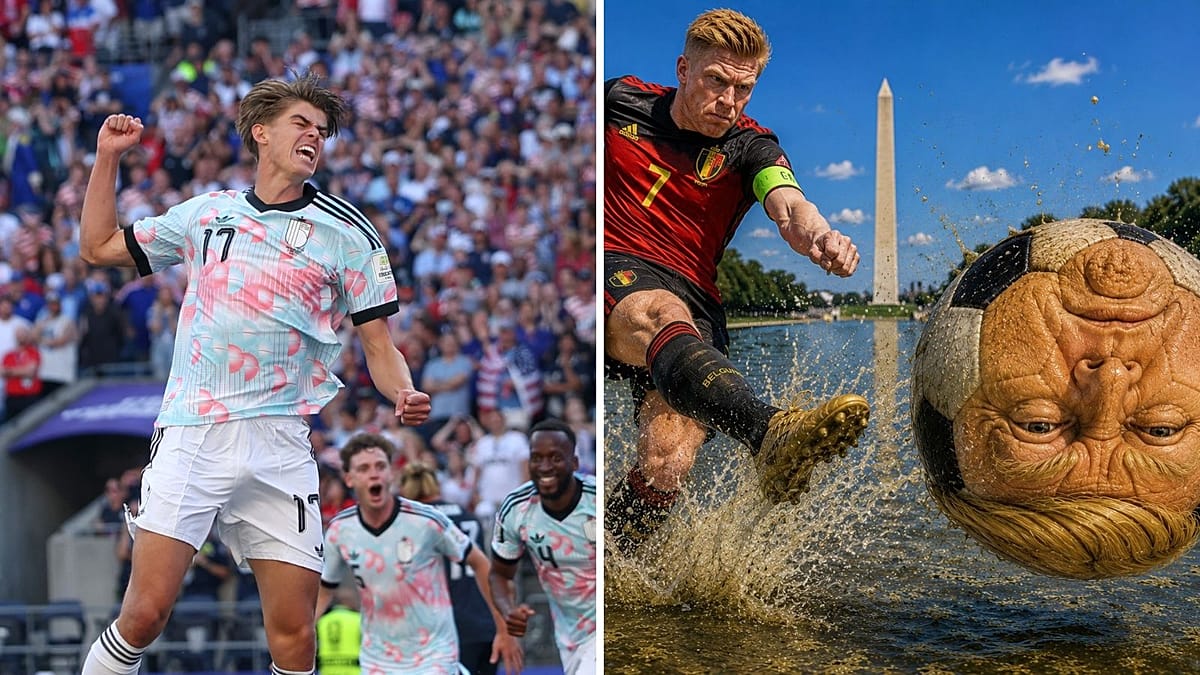
In Venezuela’s interpretation, the US team’s failure at the 2026 World Cup became not just a sporting setback, but a symbolic collapse of the entire idea of the “American dream” on the football pitch. Alongside the 1-4 loss to Belgium and the team’s exit from the tournament, Venezuelan coverage—including a post on Goal—emphasizes that this is an event that in the region is being received with irony, sarcasm, and an obvious enjoyment in watching the image of the US as a country that can automatically turn resources, organization, and ambition into success collapse.
After the defeat, Mauricio Pochettino did not hide his disappointment. He admitted that the team “was not up to the mark,” took responsibility, and left the question of his future open. His words sounded like a direct self-assessment of the failure: “Responsibility lies with me,” “we must analyze what happened,” and “we did not show our style of play.” At the same time, he did not ignore mitigating circumstances: an injury to Christian Pulisic, Seržino Dest’s poor form, and mistakes by goalkeeper Matt Freese. Still, the overall tone was unmistakable—this was a defeat that shattered expectations and noticeably cooled talk about the future of the project.
In Venezuela, this story is read much more broadly than simply as a report on a failed match. Here, the US loss is seen as confirmation of old criticism of the American model of supremacy: big money, loud statements, and powerful infrastructure do not always translate into real victories. That is why the tournament hosts’ collapse is perceived as a painful blow to the image of a country that is accustomed to claiming leadership in everything—including sports.
The same motif also appears in reactions to other pieces about the 2026 World Cup. In a Euronews publication retold in the Venezuelan context and tied to the story of Belgium mocking Trump and FIFA, the US defeat is presented as grounds for satire not only against the football team, but also against politics, corruption, and the influence of strong players on international institutions. The Belgian players’ dance and the slogan “Overturn this” are seen in the regional interpretation not as just a joke, but as a public gesture of contempt for authority—and for attempts to impose convenient rules.
For the Venezuelan audience, it is especially important that sports and politics are intertwined in this story. The image of FIFA, allegedly bending under pressure, fits easily with already existing distrust of international structures, while the figure of Donald Trump reinforces the sense that football has long stopped being a fully autonomous arena. As a result, Belgium’s victory is seen as a moral resolution—a moment when “justice prevailed,” and when the public humiliation of those in power turned out to matter more than the actual score.
Another Venezuelan piece, dedicated to the 2026 World Cup bracket and quarterfinal scenarios, continues the same line: the US exit is treated as a symbolic failure of American football ambition. Even though the tournament was held on US soil and the country was positioning itself as the new football center, reality again reduced it to its familiar place—under the shadow of European and South American leaders. In this context, it is particularly noticeable that the CONCACAF zone lost all its representatives, and the regional hierarchy at the world championship has returned to what it was: Europe dominates, South America holds its brand, and the US failed to capitalize on either its home status or expectations.
For Venezuelan authors and readers, this is also an opportunity for broader cultural and political irony. Here, a football defeat can easily become a metaphor for a more general fall from the pedestal: a country accustomed to talking up its own superiority is again turned into a victim of its own expectations. Against the backdrop of local experience with crises, broken promises, and constant attempts to start over, such a storyline provokes a special reaction—from sarcastic enjoyment to a sense of symbolic justice.
That is why Venezuela’s take on the US failure at the 2026 World Cup is not a dry sports commentary, but a unified reaction to a whole set of themes: the team’s weakness, uncertainty around Pochettino’s future, FIFA’s vulnerability to political influence, mockery of Trump, and the general collapse of the image of American infallibility. In this story, football is only the surface; underneath it is a conflict between power and reality, ambition and results, claims to leadership and a practical inability to deliver.