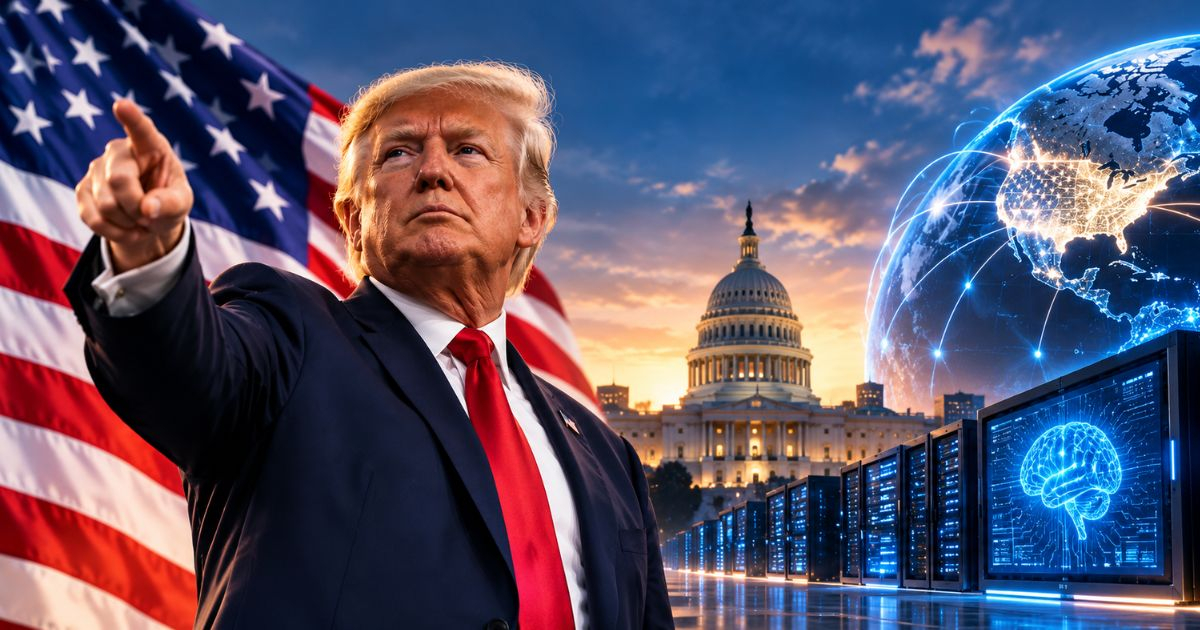
Donald Trump has announced the creation of an American “Superintelligence Force,” presenting the development of advanced artificial intelligence as a matter of national power and the United States’ strategic superiority over China. The reaction has focused on Washington’s efforts to turn AI from a primarily domestic technology issue into a key instrument of geopolitical competition. This material is based on reports by CiberCuba, Instagram, and Infobae (Venezuela).
The US AI Breakthrough Widens the Technology Gap
The creation of the “Superintelligence Force” by Donald Trump’s administration is the latest indication that the United States is shifting the development of advanced artificial intelligence systems toward national security, economic leadership, and geopolitical rivalry. Venezuelan media and outlets targeting Venezuelan audiences have covered the initiative primarily as part of Washington’s struggle to preserve its lead in the technology race, including its competition with China.
As CiberCuba reports, the new structure is supposed to bring together the efforts of federal agencies, major technology companies, and critical infrastructure owners. Trump said that the United States must “continue to lead” the development of this field, while superintelligence itself could become something “more significant than the Industrial Revolution and the internet.”
Venezuela’s Diario Avance uses similar wording, presenting the new initiative as a tool for coordinating government efforts intended to “protect the interests and improve the lives of all Americans.” The publication is primarily factual and contains no comments from Venezuelan specialists or officials. For local audiences, however, such rhetoric is inevitably viewed through the lens of the gap between global technology centers and countries facing financial, sanctions-related, and infrastructure pressures.
Infobae places particular emphasis on the rivalry between the United States and China. The head of the new structure, Jay Clayton, stated the task in stark terms: “The risk of not being first is high.” According to him, losing the lead would intensify both known and not yet fully understood threats, particularly those posed by “adversaries.” In this framework, artificial intelligence becomes not merely a commercial technology but a strategic resource linked to defense, intelligence, cybersecurity, data control, semiconductors, and computing capacity.
The “Superintelligence Force” is expected, within 120 days, to assess the technology’s risks and opportunities and establish cooperation among federal agencies, businesses, civil and religious organizations, and critical infrastructure providers. The issues under consideration include cybersecurity, biological and chemical threats, the protection of critical systems, employment, and consumer rights. The participation of intelligence officials, leaders from the defense technology sector, and the Federal Trade Commission underscores that the White House views AI as an element of state power, not merely as an innovation market.
At the same time, the Trump administration is relying less on mandatory regulation than on voluntary corporate self-regulation. The heads of Google, xAI, Anthropic, Meta, Nvidia, and OpenAI signed an agreement that the president called “morally binding.” It provides for internal control mechanisms, independent review groups, external audits, and oversight by boards of directors. However, the agreement is not legally binding, meaning that the key rules governing the technology’s development will still largely be shaped within the American government and corporate centers of power.
For Venezuela, the news matters not because the country is directly involved in developing advanced models, but because of the possible consequences of a new technological division of the world. Venezuela’s economy faces sanctions, a shortage of investment, problems with energy and digital infrastructure, limited access to international financing, cloud platforms, advanced chips, and equipment. At a time when the United States is concentrating the resources of the White House, the defense sector, intelligence agencies, and the largest technology corporations, countries with limited access to capital and computing capacity risk falling even further behind.
The acceleration of the AI race could provide Venezuela and other countries in the region with new tools for education, medicine, public administration, data processing, and the digitalization of services. At the same time, however, it increases the risks of dependence on foreign platforms, cyberattacks, information control, and external decisions regarding access to technology. For the banking sector, energy, communications, and public services—which are developing amid unstable infrastructure—this issue has very practical implications.
The deepening technological confrontation between the United States and China could also reduce the room for maneuver for countries not integrated into the Western financial and technological system. On the other hand, it increases the importance of alternative partnerships with China, Russia, and other states willing to supply telecommunications solutions, digital infrastructure, and equipment without the conditions imposed by Washington. Dependence on alternative suppliers, however, does not mean technological independence; it merely shifts the center of external influence.
The promotion of the term “superintelligence” instead of the more familiar “artificial intelligence” is also significant. This is not merely a matter of vocabulary. In American political rhetoric, the new concept turns technological advantage into a symbol of national power and global leadership. For Venezuela, where technological sovereignty is often associated with political independence and resistance to external pressure, this US mobilization appears to confirm that digital technologies are becoming a new arena in the struggle for influence.
The publications do not provide a detailed position from Caracas, assessments by Venezuelan experts, or an analysis of the state of the country’s AI infrastructure. Nevertheless, the overall message of their coverage is clear: for countries with limited resources, AI is ceasing to be a neutral innovation. It is becoming a question of sovereignty, access to knowledge and infrastructure, economic dependence, and the ability to participate in shaping international rules that are currently being written by the largest powers and technology corporations.