
The incident involving Ahmed Kabul—a young man with a disability who was wounded and detained by Israeli forces in Jabata al-Khashab north of Quneitra and later released—was just one episode in the тревожная daily reality of southern Syria. He was not near a military facility, but that did not protect him from being shot and detained. Reports at the time also said that farmland west of Abidin in western Daraa had come under fire, while two artillery shells struck Tel al-Ahmar al-Sharqi in southern Quneitra.
Such incidents cannot be reduced to isolated injuries, detentions, or localized shelling. When the road to a field, passage between villages, or approach to a secondary highway is accompanied by the risk of encountering a checkpoint, being searched, or being shot at, the meaning of the place itself changes. Land ceases to be merely a source of income and a means of ordinary travel—it becomes entangled in the calculations of military power.
Arib al-Rantawi, an adviser at the Al-Quds Center for Political Studies, warns that oppression and violations of sovereignty can create an environment of anger and alienation whose consequences are difficult to control. At the same time, he does not say that southern Syria is inevitably heading toward a broad confrontation, or that all local anger will turn into armed conflict. The question is different: what does repeated military friction do to people’s relationship with their land and with the very notion of security?
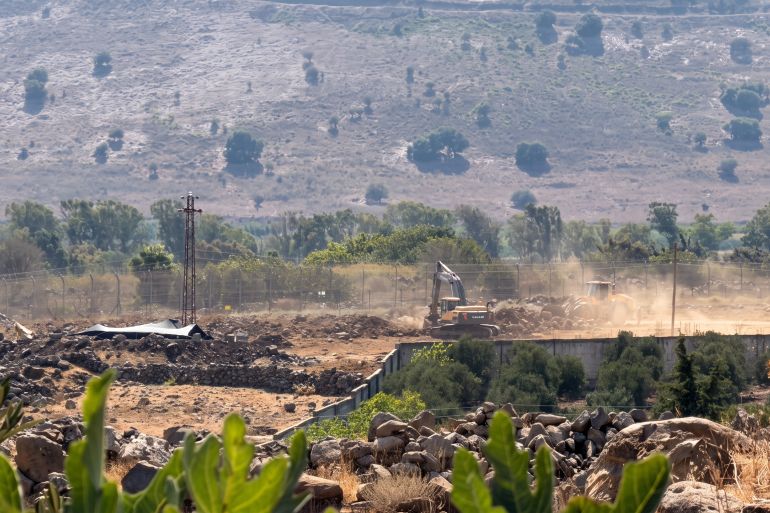
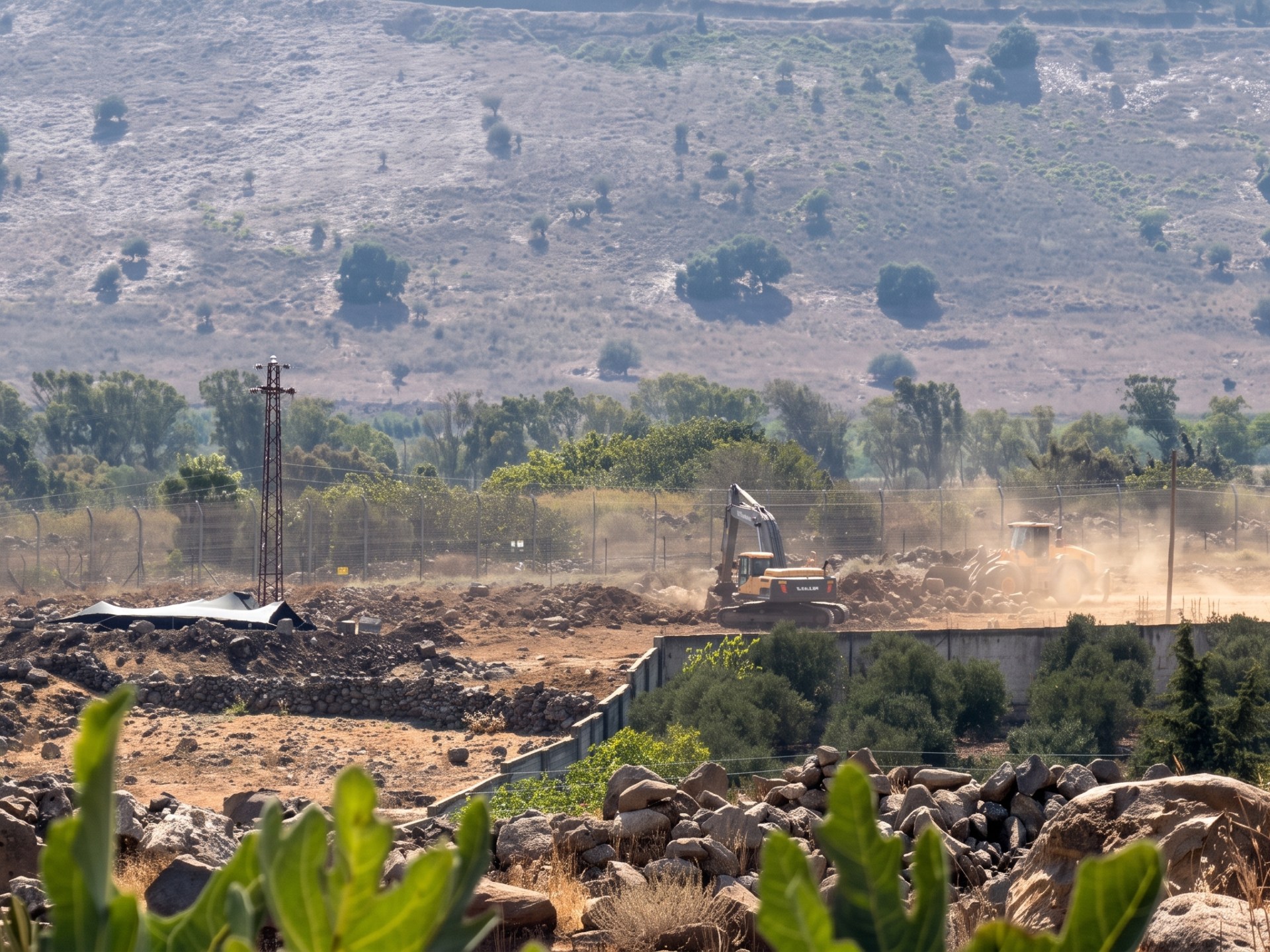
Field reports show that this is not a one-off incident. On October 4, a correspondent for Syria al-An reported that Israeli military vehicles had resumed earthworks and the construction of embankments near the village of al-Asha in southern Quneitra as part of the “Sufa 53” project. In the days that followed, incursions, checkpoints, searches of passersby, and military movements were reported in villages in Quneitra and western Daraa.
Al-Rantawi does not view southern Syria as a copy of Gaza, nor does he present Israeli raids as an inevitable prelude to a major war: each arena has its own history, social structure, local forces, and state calculations. In his view, however, October 7 was an exposing moment that struck at the image of the Israeli army as being based on intelligence superiority, deterrence, and rapid strikes. It once again raised the question of the difference between possessing military power and being able to turn it into a political outcome and lasting security.
A report by the Al Jazeera Center for Studies describes Israel’s strategy as follows: through raids and the establishment of positions inside Syria beyond the disengagement line, it seeks to consolidate military and political superiority and pressure Damascus in negotiations. The holding of border points and high ground, including Mount Hermon and Tel al-Ahmar, is linked to early warning around the Golan Heights and to maintaining southern Syria as a buffer and demilitarized zone. Damascus, meanwhile, prefers a diplomatic approach and is seeking a security agreement that would lead to the withdrawal of Israeli forces from areas occupied after December 2024, while keeping negotiations open because it does not want a military confrontation at this stage.
The historical parallel with the Bar-Lev Line is a reminder that fortifications do not create security by themselves. More than half a century ago, the line was not merely an embankment and a chain of fortified positions along the Suez Canal, but part of a concept that relied on geographic protection to consolidate the reality created after the 1967 war. The October 1973 war demonstrated the limits of the belief that military engineering could provide permanent invulnerability. Moshe Dayan said that breaching the line would require American and Soviet engineering equipment, but Egyptian forces opened breaches in the embankment within the first hours, and elements of the line were turned into isolated positions.
The comparison between the Bar-Lev Line and “Sufa 53” is not an exact military analogy or a prophecy that history will repeat itself. But the two stories converge on a broader question: a fortification does not become security simply because it exists. Embankments, trenches, and posts provide greater opportunities for surveillance, maneuver, and control, but they do not by themselves resolve the political contradiction that produced fear and alienation. Near villages and fields, fortifications can turn from an instrument of deterrence into part of the problem. The “Sufa 53” project began in mid-2022 in the disengagement zone along the occupied Golan Heights; according to Al Jazeera, it includes an eight-meter-wide road, five-meter-high earth embankments, observation posts, and trenches. Syria’s Foreign Ministry considers the completion of this work a violation of the 1974 Agreement on Disengagement.
Israel presents its military activity in southern Syria as a necessary measure to prevent potential threats and protect security. Amnesty International notes that Israeli officials have linked the military presence in Syria to countering threats from Hezbollah or Iran-linked groups, as well as to strikes on weapons depots and air-defense systems. But security is measured not only by what force prevents at a particular moment, but also by what it leaves behind. When fields, roads, and villages become extensions of military space, the question arises: do fortifications and raids provide longer-term security, or do they merely postpone tensions, shifting their cost into the future? In May, Amnesty said that the deliberate destruction of civilian homes in Quneitra province since December 2024 should be investigated as a war crime. The organization used satellite imagery to verify damage to or destruction of 23 civilian structures in three villages, documented testimony about the demolition of homes, gardens, and farmland, and identified nine military bases built by Israeli forces in Quneitra and Daraa since December 2024. In the village of Hamidiyah and its surroundings, according to Amnesty, Israeli soldiers on December 8, 2024, ordered women and girls to leave their homes, while most of the men were detained for questioning until the afternoon; at least 10 families were ordered to leave. Satellite imagery from December 17, 2024, showed tracks left by heavy machinery and new embankments, followed by the construction of a military base less than 300 meters east of the affected area in January 2025. According to an analysis by Amnesty’s Evidence Lab dated August 23, 2025, 14 structures and the walls surrounding them were completely destroyed.
The situation in southern Syria may continue to develop according to a model of managed friction: limited raids, localized shelling, detentions, and the consolidation of positions without sliding into a broad confrontation. But this calm is deceptive, because the cost of such actions is measured not only by their immediate results, but also by the slow accumulation of consequences within local society. A checkpoint can regulate movement, while a trench or military position can strengthen surveillance, but neither answers the political question that remains after the vehicles leave: the memory of those who were stopped or denied access to their land lasts longer. This does not mean that southern Syria is doomed to explode. To avoid that outcome, it must be recognized that people’s everyday lives are not a detail that can be separated from security calculations; clear political and military agreements can reduce tensions if the rules of disengagement are restored, fields, roads, and villages are removed from the logic of military operations, and people are guaranteed access to their land.
In al-Rantawi’s reading, October 7 and the subsequent war in Gaza demonstrated the limits of Israel’s military superiority: an advantage in the ability to strike and the speed of destruction do not by themselves resolve the question of political outcomes, nor do they guarantee that military control can be transformed into lasting security. In southern Syria, the paradox appears differently: the broader military control becomes without a horizon that protects sovereignty, people’s lives, and their right to the land, the more likely it is that what is presented as deterrence will turn into open resentment whose outcome the region does not yet know. So who creates security—the one who establishes control over the land, or the one who guarantees that the land itself will not become a permanent source of fear and alienation?
Comments on the News
What changed in Syria in December 2024, and why does the article link this to the expansion of Israeli operations in the south? — In December 2024, Bashar al-Assad’s regime fell: the armed opposition captured Damascus, Assad left the country, the Syrian army collapsed, and Iran’s presence was sharply weakened. A power and security vacuum emerged. Israel took advantage of this to expand its operations in the south: it deployed troops in the 1974 buffer zone, seized strategic high ground, launched strikes against military facilities, and established new positions in the Quneitra and Daraa areas. The article links the expansion of Israeli operations specifically to the disappearance of Syrian military control and the weakening of deterrence.
What is the international legal status of the Golan Heights and the 1974 disengagement zone, and why does Damascus consider Israel’s work a violation? — The Golan Heights are Syrian territory occupied by Israel since 1967. UN Security Council Resolutions 242 and 497 deem the 1981 annexation illegal; only the United States recognized Israeli sovereignty in 2019, a position not accepted by most of the international community. The 1974 disengagement zone is a buffer zone under Syrian civil administration and the supervision of UN forces (UNDOF); the presence of Israeli troops and construction work there violate the 1974 agreement. Damascus considers any Israeli activity in the zone a violation of Syrian sovereignty and an attempt to change the status quo.
Why is the “Sufa 53” project called that, and how is its name connected to Israel’s practice of creating control zones? — “Sufa” (Hebrew for “storm”) is a code word, while “53” refers to the number of strongpoints or positions planned for the new control zone in southern Syria. The name continues Israel’s practice of assigning code names to military zones and operations, as in southern Lebanon, in order to establish a de facto “security zone” without legally recognizing it.
Who is Arib al-Rantawi, and what does the Al-Quds Center for Political Studies do? — Arib al-Rantawi is a Jordanian political analyst and writer, and director of the Al-Quds Center for Political Studies in Amman. The center conducts research on the Palestinian issue, regional security, and political processes in the Middle East.
Where was the Bar-Lev Line located, and what fortifications did it consist of? — The Bar-Lev Line ran along the eastern bank of the Suez Canal in Sinai, Egypt, after 1967. It consisted of a chain of strongpoints (“maozim”), sand embankments, trenches, bunkers, and artillery and tank positions, and was intended to repel an Egyptian offensive.
What is known about the villages of Jabata al-Khashab, Abidin, and al-Asha, and why have they become points of military friction in southern Syria? — These are Syrian villages in the south of the country, in the Quneitra and Daraa areas, near the Golan Heights and the 1974 disengagement zone. Since December 2024, Israeli forces have expanded their presence there, turning these communities into points of military friction. They lie along the routes used by Israeli troops and near strategic high ground, provoking protests from local residents and Damascus.
Full version: هل يدفع فائض القوة الإسرائيلي الجنوب السوري إلى الانفجار؟