
Scientists at the University of Oxford have made a breakthrough in lithium-ion battery research by developing a method that allows them to examine in detail a critically important but previously invisible component inside electrodes. This finding, published in the journal Nature Communications, could radically improve battery manufacturing, significantly increase charging speed, and extend overall lifespan.
For a long time, the main problem for engineers has been polymer binders — a special "glue" that holds the active materials together in the negative electrode (anode). Although they account for less than 5% of the electrode's mass, the distribution of binders determines mechanical strength, electrical conductivity, and ultimately the battery's durability after thousands of charge cycles. However, because of their microscopic quantities and lack of clear visual cues, scientists could not accurately track how these binders are arranged within the electrode's complex structure.
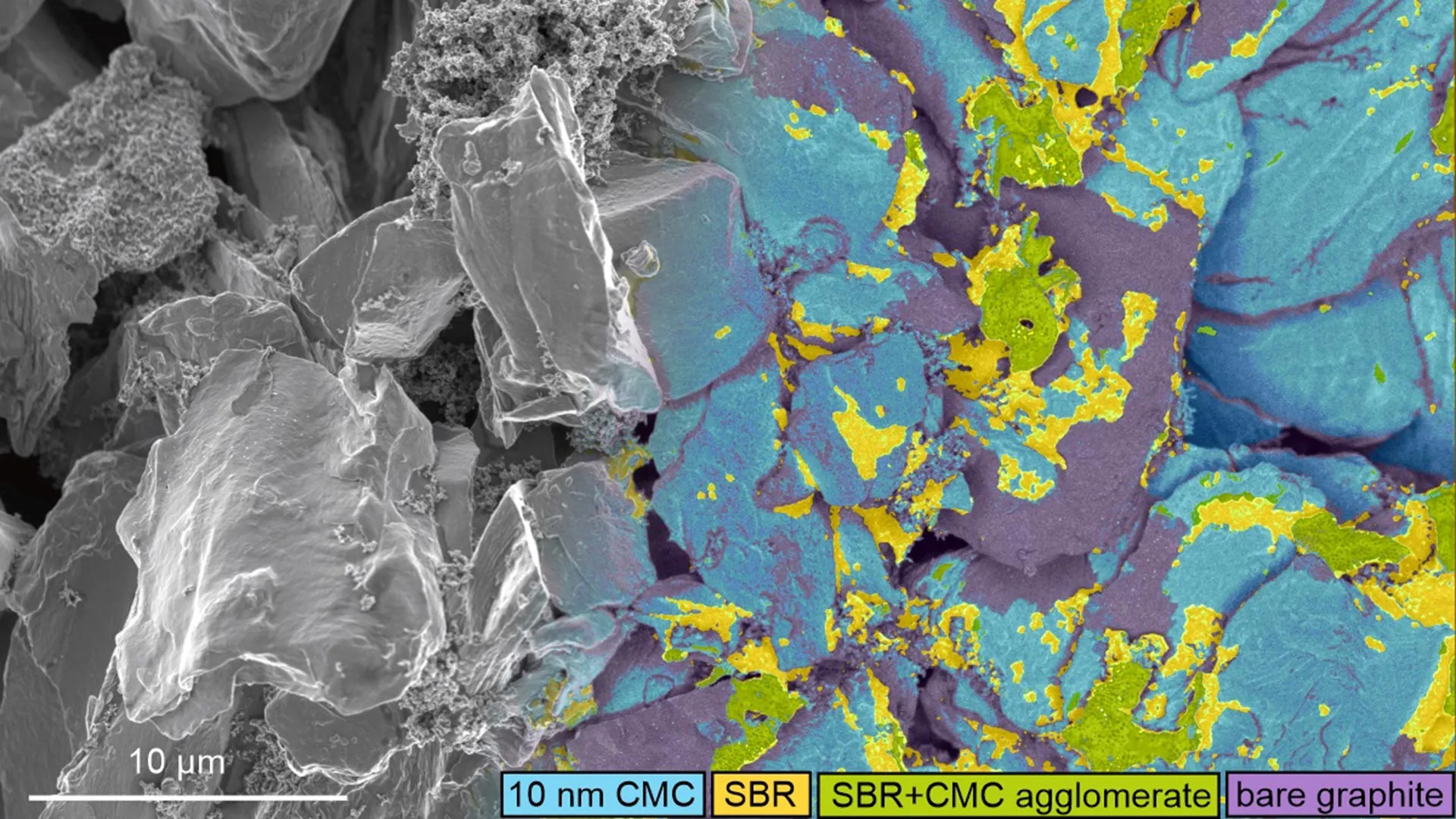
To overcome this obstacle, the researchers developed a patented staining technique. They attached trace markers of silver and bromine to widely used cellulose- and latex-based binders. After such "tagging," the binders can be detected with a special electron microscope that records characteristic X-ray emission or backscattered electrons. This provides a detailed elemental distribution map with nanometer resolution.
Applying the new imaging tool produced impressive results. The team found that even minor changes in binder distribution, achieved by adjusting mixing and drying processes, can reduce the internal ionic resistance of experimental electrodes by as much as 40%. This directly enables faster charging. The researchers also, for the first time, clearly observed and measured ultrathin, only 10-nanometer-thick, layers of binder (carboxymethyl cellulose) coating graphite particles, and tracked how this uniform coating is degraded during manufacturing.
This interdisciplinary work, combining chemistry, electron microscopy, and electrochemical modeling, has already attracted significant interest from industry, including major battery and electric vehicle manufacturers. The technique is applicable to both modern graphite electrodes and next-generation materials, such as silicon-based ones. Silicon is considered an extremely promising anode material because it can theoretically store about ten times more lithium than graphite, promising a substantial increase in capacity. However, its wide adoption is hindered by a serious problem: when absorbing lithium, silicon can expand up to 300%, leading to electrode failure. Current research worldwide is aimed at solving this issue, and the new Oxford imaging technique could become a key tool for those efforts.
The study was supported by the Nextrode Faraday Institution project. The Faraday Institution is a leading independent British institute that coordinates and funds a wide range of projects in battery science and energy storage technologies. In addition to work on improving lithium-ion batteries, the institute supports the development of solid-state batteries, materials recycling research, and projects aimed at reducing cost and increasing battery life for electric vehicles and energy systems. This discovery from Oxford opens new avenues for designing more efficient, durable, and fast-charging power sources for a wide range of devices.
Source: Oxford breakthrough could make lithium-ion batteries charge faster and last much longer