In a number of pieces in Venezuelan media and on social networks a single idea emerges: U.S. policy under Donald Trump is seen as excessive, legally questionable, and increasingly encountering pushback both inside and outside America. Coverage emphasizes judicial and civic challenges to White House executive actions — from ACLU lawsuits to blocks on efforts to defund public media — as well as examples of international disagreement, when Spain and France closed their airspace or otherwise demonstrated dissent with American military moves. Trump is portrayed as acting unilaterally — “one directive, and communism will disappear in Cuba” — while foreign governments, courts and public institutions respond by defending their norms or openly resisting. This picture reflects a broader Latin American critical view of American influence: the U.S. is a hegemon whose decisions provoke legal, diplomatic and political counterreactions. This piece was prepared based on Democracy Now, Instagram and Facebook (Venezuela).
Venezuelan view of the U.S.: from birthright citizenship to oil, war and “double standards”
In the Venezuelan media space, news from the U.S. is almost never read as “foreign” or purely external. It is instantly filtered through local experience — mass migration, oil dependence, sanctions and a protracted conflict with Washington. Thus three seemingly separate storylines — the fight for jus soli (birthright citizenship) in the U.S., deregulation of the oil industry in the Gulf of Mexico, and discussions about a possible U.S. war in the Middle East — coalesce in Venezuela into a single picture of American policy as a source of threats, hypocrisy and, at the same time, necessary opportunities.
At the core of this mosaic are specific news items and commentaries: a Democracy Now! piece on the U.S. Supreme Court case against Donald Trump’s order ending birthright citizenship for children of migrants without legal status (link to the piece), criticism of deregulating environmental rules for oil and gas companies in the Gulf of Mexico in an Instagram post (source), and an emotional political comment on Facebook about the risks of a U.S. (and allied Israeli) war with Iran and rising gasoline prices inside the United States (link).
All these storylines are connected in Venezuelan perception by a single thread: the understanding of the U.S. as a force that externally proclaims high standards of democracy, human rights and environmental protection, while internally gradually eroding its own principles when migration, energy or military agendas demand it.
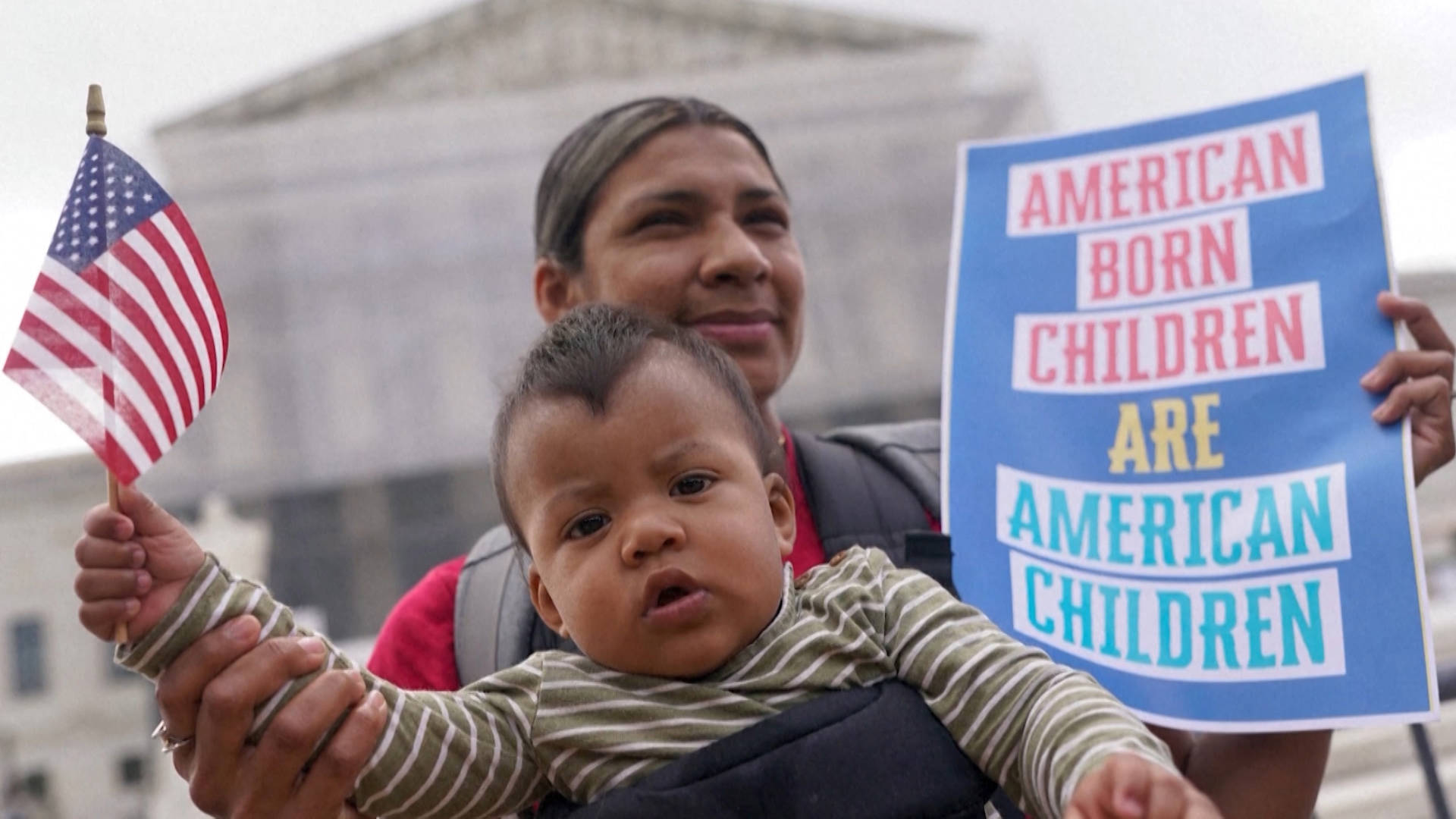
The jus soli story, told in the Democracy Now! piece, looks to an American reader like a dispute over the limits of presidential power and the interpretation of the Fourteenth Amendment. In an interview, ACLU immigration rights project attorney Cody Wofsy explains that Trump’s order abolishing automatic birthright citizenship for children of people without “lawful permanent residence” is, in his words, “extremely illegal, unconstitutional and morally wrong,” and stresses that over 20 years it will affect about five million children born in the U.S. (piece and interview).
In Venezuela these words ring in a painfully familiar register. The language of “gross unconstitutionality” and “rights violations” is a habitual tone for both the government and the opposition. Here people argue daily whether the president violates the Constitution when issuing emergency decrees, postponing elections or changing institutional functions. And the fact that in the U.S. an ACLU lawyer effectively speaks of presidential “abuse” and “constitutional violation” is perceived as confirmation: even there, in the “showcase of democracy,” the executive behaves not so differently from governments in the Global South — only with stronger counterbalances such as the Supreme Court and organizations like the ACLU.
For Venezuelans this is not an abstract doctrine. The country experienced one of the largest migration waves in the world: millions left, hundreds of thousands settled in the U.S. as asylum seekers, TPS holders, temporary visa holders or completely undocumented. Many of them had children born on American soil — these children were regarded by families as “security anchors,” as possible protection from deportation and a chance for long-term improvement. Therefore discussion of abolishing jus soli is perceived in Caracas, Valencia or Maracaibo not as an abstract American reform but as a direct threat: if the Supreme Court upholds Trump’s order, it will affect precisely those families — Venezuelan, Colombian, Central American.
In official discourse this fits easily into rhetoric about Washington’s “racist” and “anti-immigrant” policy. For the Maduro government, Wofsy’s remarks that the order is “morally wrong” could become a handy quote: the U.S., which regularly accuses Caracas of human rights violations, itself, according to its own human-rights lawyer, promotes measures that are “deeply unconstitutional” and “amoral.” The opposition, especially its more liberal and human-rights segments, reads the same piece differently: the emphasis is not on U.S. hypocrisy, but on the fact that even there migrants’ rights hang by a thin thread — activists, NGOs and courts. For them the ACLU is an example of the “strategic human-rights advocacy” Venezuela lacks and which, if institutions functioned, could protect citizens inside the country from government arbitrariness.
Between these two poles there is also a very practical level: remittance economics. The lives of millions of families in Venezuela depend on transfers from those who work in the U.S. Birthright citizenship has long been seen as a long-term insurance — a guarantee that a family will settle, stabilize, increase income and be able to regularly support relatives in Caracas or Maracaibo. An attempt to strip such children of citizenship is associated with a threat to this fragile economic mechanism: the question is not only legal status but the future of the money flows without which in the outskirts of Caracas people don’t pay for food, medicine and electricity.
Finally, Venezuelans notice the contrast: the U.S., advocating the rule of law everywhere, is, according to the Democracy Now! piece, willing to directly collide with its own constitutional text when it comes to curbing migration from the Global South. Adapting this storyline to domestic discourse, Caracas authorities can again speak of “blatant discriminatory practices” and “racism” in the U.S., while local human-rights defenders will remind that migrant vulnerability is global and that even stable democracies do not guarantee unconditional protection.
In a parallel information flow, a critical Instagram post reports the decision of a U.S. federal committee on endangered species, which unanimously voted to free oil and gas companies operating in the Gulf of Mexico from the application of a decades-old law protecting whales, birds and sea turtles (source). The author emphasizes that this is the “latest effort by the Donald Trump administration” to ease rules that supposedly “hamper national energy production.”
In Venezuela such news is automatically connected to the fate of their own oil state, which is under American sanctions. In the perception of a large part of society, the U.S. appears as a country that, when protecting its own oil and gas industry, is ready to relax environmental restrictions, ignore risks to the Gulf of Mexico, but with respect to competitors — such as Venezuela’s PDVSA — imposes the harshest sanctions, justifying them by human-rights arguments and, sometimes, even concern for the climate. This looks like classic “double standards”: the environmental agenda is used to pressure “inconvenient” regimes but is set aside when it interferes with domestic oil and gas lobbying.
Historical memory of oil disasters intensifies this reaction. The region remembers the Deepwater Horizon explosion and sees the consequences of regular oil spills off its coasts. Venezuela’s coastline — from Zulia to Falcón and Sucre — lives with a gap between official environmental norms and the actual lack of control: leaks from old PDVSA pipelines, mangrove pollution, declining fish stocks. Against this backdrop, news that the U.S. is consciously weakening protections for whales, birds and turtles in favor of additional drilling in the Gulf is perceived as confirmation that the logic “oil first, nature later” is universal — only in the U.S. it combines with growing power and profit, while in Venezuela it combines with infrastructure degradation and raw-material dependency.
Domestically this story also easily divides into two narratives. The official line can present the committee’s decision as evidence of U.S. “environmental hypocrisy”: a country that criticizes Latin America for deforestation and pollution itself destroys marine ecosystems for cheap energy. Opposition experts, especially economists and energy specialists, will point to something else: while the U.S. quickly adapts regulations in the interests of its energy strategy, Venezuela, sanctioned and burdened by corruption, loses production capacity and markets. For them this news is an occasion to argue that Venezuela’s problem is not only American sanctions but also domestic mismanagement preventing the country from taking advantage of possible “windows of opportunity” in the world market.
The environmental dimension is complemented by geography: the Gulf of Mexico and the Caribbean Sea form a single ecosystem. Any major spill or accident in the gulf will sooner or later affect the biology of the entire basin — from the U.S. coast to Caribbean islands and the northern shore of South America. For Venezuelan fishers and coastal communities this connectivity is obvious: Gulf of Mexico problems are potentially their problems too, even if the decision was made in distant Washington.
The third storyline is an emotional Facebook post where the author, referring to rising gasoline prices in the U.S. (“for the first time since 2022 a gallon of gasoline exceeded $4”), reflects on a possible war with Iran and states that “everyone will pass away except the U.S. and Israel,” and that American forces in a hypothetical ground operation will be “crushed like ants” (post). This is no longer reporting but pure political speech, stylistically and ideologically consonant with Bolivarian anti-imperialist discourse.
Such phrases are familiar in Venezuela. For more than twenty years the authorities and a significant portion of the public sphere have described the U.S. as an “empire in decline” that compensates for political and moral decay with military force. Predictions of U.S. defeat in any “ground adventures” — whether Iraq, Afghanistan or a hypothetical war with Iran — have long been part of everyday narrative. They serve several functions.
First, they help process the trauma of sanctions and the threat of intervention. For a country that regularly hears from Washington that “all options are on the table,” up to and including the use of force, the claim that American troops will be “crushed like ants” is a symbolic disarmament of fear: if the “empire” can be stopped in the Middle East, then in Latin America it is not as omnipotent as it seems.
Second, the comment links external aggression to domestic economic consequences for the U.S. The rise in gasoline prices to more than $4 per gallon is presented as a “blowback” of their own war and confrontation. For a Venezuelan reader, whose country historically sold cheap oil to the U.S. and then was subject to an embargo, this logic is simple: your people pay for your wars at the pump; ours pay for your sanction regime with hunger and the collapse of the social state.
Third, such rhetoric legitimizes Venezuela’s foreign-policy alliances. Strategic rapprochement with Iran — in refining, military cooperation and sanctions evasion — is portrayed as a deliberate choice in favor of “strong allies” capable of withstanding U.S. pressure. When the post asserts that U.S. forces “will not achieve success” in a land operation and will be routed, then without naming Iran directly the author projects onto that country an image of an impenetrable and strategically successful “militia” against the “empire.” For the loyalist audience in Venezuela this confirms the correctness of alignment with Tehran, Moscow, Beijing and other opponents of Washington.
The language of this commentary — dehumanizing metaphors, prophecies of defeat without grounding in factual evidence — reflects the broader culture of political communication in Venezuela: polarized and emotional, where social networks have become an extension of the street and parliamentary tribunes. Here both the news of gasoline prices in the U.S. and the possible escalation in the Middle East are instantly fitted into a black-and-white scheme of “empire versus peoples,” without nuances of military logistics, diplomacy or real political debate in the U.S. Congress.
Comparing all three storylines — the Supreme Court case on citizenship, deregulation in the Gulf of Mexico, and emotional forecasts about war and gasoline — makes clear how they are stitched together in the consciousness of the Venezuelan audience. These are not three independent facts but three manifestations of the same worldview: the U.S. as a state that
- violates its own Constitution when it is convenient to fight migration from the Global South;
- relaxes environmental restrictions when that increases the competitiveness of its oil and gas, even at the cost of threatening endangered species and marine ecosystems;
- is ready for military adventures whose consequences hit the pockets of its own citizens and the stability of the global energy market.
Through this lens the Venezuelan reader sees not just American disputes over law and policy but a mirror of their own reality. A country whose migrants may now be deprived of the “security anchor” of children’s citizenship; whose oil company under sanctions watches a competitor weaken regulations to boost production; whose propaganda is built on images of an “empire” and “resisting peoples” reads every Washington move as another confirmation of an old formula: rights, the environment and peace matter to the U.S. only until they interfere with its migration, energy and military interests.
At the same time the same information yields more complex lessons. The existence of structures like the ACLU and lawsuits against Trump’s order reminds that in the U.S. there are real mechanisms to challenge presidential power — mechanisms long missing in Venezuela. Environmental battles around the Gulf of Mexico show that even in the “center” there are activists and experts able to question decisions favoring corporations. And Americans’ internal pain over high gasoline prices shows that even for a superpower external policy has a domestic cost.
It is precisely in this multilayeredness — a mix of critique of “double standards,” envy of functioning institutions and the desire to see the “empire” punished — that a specific Venezuelan perspective on any American news item is born, whether it is a Supreme Court dispute over jus soli, new drilling in the Gulf of Mexico, or another escalation in the Middle East.