Venezuelan media and social networks increasingly portray America under Donald Trump as hyper‑militarized yet internally constrained — a country whose moves have direct effects on Latin America and the world. Commentators question Washington’s dependence on NATO, the weakening of financial dominance relative to China, and the real limits of presidential power, while demonstrations of military might are accompanied by fears of regional spillover. Particular attention is paid to the confrontation between the US and Israel with Iran and to expanding ceasefires that reports present more as shaky pauses than genuine peace. At the same time, US migration and deportation policies — including repatriation flights to Cuba — are discussed as concrete examples of US influence on countries in the region. Taken together, the Venezuelan debate mixes distrust of Washington’s motives, concern about possible “collateral” effects on Latin America, and arguments about whether the US is losing global influence or merely restructuring it. This overview was prepared based on materials from YouTube, El País and Factchequeado (Venezuela).
Venezuela between the US, NATO and the Vatican: Caracas’s view of global hegemony
The Venezuelan view of world politics has long been shaped through three key prisms: oil, US military power, and the country’s own experience of sanctions and pressure. Thus what in Europe or the US is presented as analysis of NATO, Trump, or Washington’s conflict with the Vatican is in Caracas perceived as an explanation for why the country ended up under blockade, why it cannot fully sell its oil, and why any escalation in the Middle East or Europe inevitably affects Venezuela’s economy and internal politics.
Against this backdrop, the video “✅ ¿Por qué ESTADOS UNIDOS necesita a la OTAN para sobrevivir?” from the Memorias de Pez channel on YouTube (link to the video), a compilation of El País materials about Trump and US foreign policy (US section of the outlet), and the analysis by the Institute for Digital Democracy of the Americas (DDIA), published via Factchequeado and REDESCover (DDIA piece), fit into a single mosaic. For Venezuela these are not disconnected stories but fragments of one large narrative: how American hegemony — military, economic, symbolic — is organized and sustained, and how it strikes countries like Venezuela.
From Caracas’s perspective, what the Memorias de Pez video says — that the US is not a “selfless defender” of peace and that its geopolitical and economic survival rests on NATO, a network of bases, control of routes, influence over Europe, and deterring rivals — is hardly a revelation. Rather it is seen as a vivid confirmation of how the infrastructure of power works, whose consequences Venezuela feels through sanctions, financial blockade, and diplomatic pressure.
That is why in Venezuela NATO is seen not simply as a “defensive alliance” but as infrastructure of American hegemony, which then translates into sanctions against PDVSA, restrictions on insurance and chartering of vessels carrying Venezuelan oil, closure of access to the dollar system, and a pressuring agenda within the EU and other Atlantic bloc countries. What the video describes as the “undeniable economic hegemony” of the US is decoded in Caracas very concretely: Washington and its partners’ ability to block transactions, cut off financial channels, and dictate terms for trade in energy resources.
Against this background, differences among domestic Venezuelan audiences do not negate the common feeling of dependence on this architecture. The official camp calls NATO “the armed wing of imperialism” and links its expansion to pressure on Russia — a key military and diplomatic ally of Venezuela. For the government, any weakening of Russia due to confrontation with NATO means a narrowing of Caracas’s maneuvering room and a reduction of external support. Thus each flare‑up between NATO and Moscow or Beijing automatically provokes in Venezuela an intensification of rhetoric against the “NATO–US bloc,” demonstrative contacts with Moscow, Beijing, Tehran, and emphasis on joint exercises, defense agreements, and energy cooperation.
Parts of the opposition and liberal circles, by contrast, see NATO and the close US–Europe relationship as a system that provides predictability, rules of the game, and inflows of investment for those integrated into it. In their reading, the video’s thesis that the US “spends too much defending Europe but in return gains strategic advantages” reminds Venezuela of the price of isolation: being outside these circuits — NATO, the EU, Western markets — the country loses access to capital, technologies, and legal standards, and instead faces a sanctions regime and dependence on a limited set of partners.
Venezuelan internationalists and economists add a technical explanation: US dominance of financial architecture and key energy routes — what the video talks about — is precisely what makes secondary sanctions possible, hindering not only direct oil shipments but also insurance, lending, and contract servicing. For them NATO is not an “armed pole by itself” but a contour that helps Washington keep Europe aligned with its strategy, and therefore secure European agreement on sanctions and diplomatic pressure against states labeled problematic.
El País’s compilation on the US and Trump (materials page) complements this picture in the Venezuelan optic, showing how Washington’s foreign policy is intertwined with military force and energy. Pieces about the Persian Gulf, the Strait of Hormuz, and the “long road to restoring energy supply” are read in Caracas as a reminder: any turbulence in Hormuz theoretically raises the strategic value of Venezuelan oil, but the sanctions regime prevents that value from turning into real revenue. What European journalism calls a “global energy crisis” is for Venezuela an example of how Washington can simultaneously worry about “global supply” and at the same time consciously block exports from major producers if that suits its foreign‑policy objectives.
This is why stories in which Trump complains about insufficient loyalty from allies attract special interest, such as El País’s piece on his remarks about the Spanish government: “Trump, sobre el Gobierno de España: ‘No han estado ahí para nosotros’.” For a Venezuelan audience the line that Madrid “was not there” in the war against Iran sounds like confirmation of the impulse they already ascribe to Washington: an ally must provide political support, bases, infrastructure — otherwise it is publicly rebuked for disloyalty. In Latin America this easily maps onto US pressure on Caribbean and Latin American states over recognition of Venezuelan leadership or maintenance of sanctions.
El País pieces about the global economy’s fear of oil shortages and “cracks in global dependence on raw materials” are read in Venezuela with near sarcasm. The world fears shortages and high prices while a country with some of the largest reserves lives in economic collapse, much of it intensified by Trump‑era sanctions. For local analysts this is a stark example of how a state’s place in the world system is determined not by resource volumes but by access to the infrastructure of hegemony and admission to Western financial and technological circuits. Hence discussions about dedollarization, diversification of export destinations, seeking “non‑Western” creditors, and attempts to use oil as leverage in negotiations to ease sanctions.
The migration block from the same El País materials — news about deportations, ICE policy, such as the resignation of acting director Todd Lyons — looks in Spain like an internal American agenda. In Venezuela it is a story about the fate of hundreds of thousands of compatriots trying to reach the US via Central America and facing a hardening policy launched under Trump. This produces a double perception: Washington as a source of economic pressure (sanctions, blockade) and as a coveted migration destination where the same people are vulnerable to the deportation machine.
Regionally, Mexico attracts attention. Articles on Claudia Sheinbaum’s cautious line, who must deal with Trump, such as “Sheinbaum busca un golpe de efecto ante un Trump con mil frentes abiertos,” are read in Caracas as a handbook on balancing next to a hegemon: the need to negotiate on migration and trade while trying to preserve some autonomy and to participate in the club of “progressive” governments. In Venezuela some elites compare this to their own situation, but the difference is fundamental: Caracas lacks that degree of economic linkage with the US, so its stance is not complex bargaining but an almost complete turn to Russia, China and Iran and rhetoric of frontal confrontation.
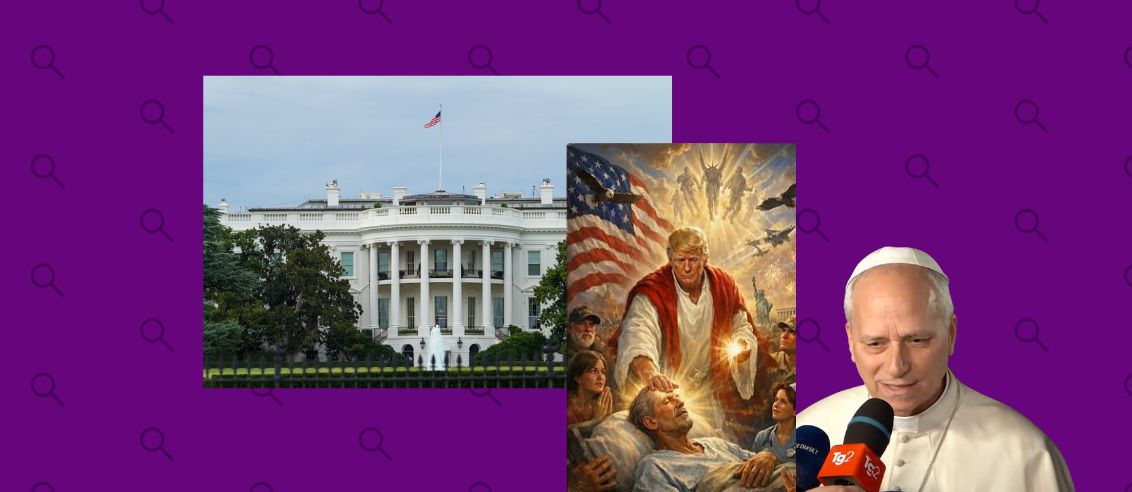
Against this background, the DDIA analysis published by Factchequeado and REDESCover under a headline about narratives around the conflict between the Vatican and the Trump administration (details here) adds an important dimension — the symbolic and informational. Formally it deals with how the Latino audience in the US reacts to the standoff between Pope Leon XIV and the White House, the pope’s criticism of “diplomacy of force” towards Iran, and his refusal to participate in the US’s 250th anniversary celebrations. But for Venezuela this is another stage where moral authority, military hegemony and discourses about war clash.
The image of the pope, who according to DDIA monitoring is unafraid to criticize Trump’s threats to “destroy entire Iranian civilization” and who demonstratively prefers visiting migrants in North Africa to celebrations in Washington, resonates with Venezuela’s anti‑militarist and anti‑interventionist sentiment. In a country where official rhetoric for years has spoken of “hybrid war” and “blockade,” and part of society has experienced real fears of military intervention, any major public actor who publicly counters US militarist discourse is perceived as a potential ally — even if the Vatican is itself critical of the Caracas regime.
Particularly interesting for Venezuelan readers is how DDIA describes the struggle for symbolic leadership in the Christian world. The report shows how right‑wing conservative influencers in Spanish‑language networks try to depict the pope as a “progressive” tied to leftist politicians like David Axelrod while elevating Trump to the status of “true defender of Christianity.” A typical example DDIA cites is influencer Eduardo Menoni’s phrase: “Trump ha hecho más por los cristianos que el papa progre.” For Venezuelan audiences, including migrants familiar with these bloggers’ rhetoric, it is important to see that this line is part of a conscious strategy to reallocate religious loyalty: from the traditional authority of Rome to a charismatic political leader in Washington.
Another episode analyzed by DDIA is the scandal over an AI‑generated image that depicted Trump almost like Christ. In the Spanish‑language sphere this provoked an outcry, including from conservative Catholics such as Mexican actor and activist Eduardo Verástegui. He, remaining politically rightwing, publicly condemned the “blasphemous” image, stressing that there are limits that should not be crossed. For Venezuela, with its deeply rooted popular religiosity, such a reaction is telling: even in circles sympathetic to Trump and to a hard US foreign policy, the sacred remains a red line. This resonates within the Venezuelan spectrum, where both the government and the opposition actively use religious symbolism, but directly equating politicians with the figure of Christ would provoke mass protest.
Through the DDIA lens Venezuelan readers also recognize manipulation methods long used in their own media space. The institute applies Ben Nimmo’s “4D” frame (desprecio, desánimo, distorsionar, distraer — despise, demoralize, distort, distract) to describe how the pope‑Trump conflict is processed: the pope is presented as a weak and illegitimate leader (desprecio), his critique of war is belittled as “politics” (desánimo), the scandalous AI image is retroactively passed off merely as an artistic “portrait” (distorsionar), and discussion of threats to Iran is replaced with talks about the pope’s alleged leftism (distraer). In Venezuela similar schemes are familiar across both pro‑government and opposition propaganda: from accusations of bishops and human‑rights defenders being “agents” to the constant shifting of economic conversation into conspiracy theories.
It is also important that DDIA emphasizes: the battlefield is not only Washington and Rome but Spanish‑language diasporas, including millions of Latin Americans. For Venezuela this is especially sensitive because a significant part of its population now lives abroad and consumes news through the same channels — YouTube, Telegram, WhatsApp, TikTok — where these narratives spread. As a result, world politics — NATO, the war in the Middle East, conflicts between the White House and the Vatican — reaches Venezuelans already highly filtered and polarized, in messages that depict the US alternately as absolute evil and near‑messianic force, and the pope as either the “conscience of the world” or a “leftist agent.”
Bringing together the Memorias de Pez analysis of US dependence on NATO (YouTube video), El País reports on Trump and American policy (materials page) and DDIA’s breakdown of the confrontation between Pope Leon XIV and the Trump administration (DDIA study), the Venezuelan observer gets a coherent picture.
First, NATO functions not only as a military shield but as a framework of US economic and political hegemony that enables projection of force and sanctions far beyond the North Atlantic, all the way to Caracas. Second, presidents like Trump, with their overt demands for allied loyalty and readiness for forceful solutions in the Middle East, confirm for Venezuela a long‑held suspicion: Washington expects submission from the world in exchange for access to markets and security. Third, the battle to interpret these events in Spanish‑language media — from meme images of Trump as “Messiah” to accusations of the pope’s “leftism” — shows that the struggle for the minds of Venezuelans and their diasporas is waged not only in Caracas but also in Miami, Madrid and Washington.
It is in this aggregate that it becomes clear why in Venezuela the US’s dependence on NATO is seen not as a question of “protection” but as a question of hegemony; why sanctions and energy crises in Hormuz are linked in conscience to idle wells in the Orinoco; and why the conflict between the pope and the White House matters not only for Catholics but for understanding what moral and informational barriers might still restrain the use of force in a world where one state still possesses a unique network of bases, alliances and financial levers — and is willing to use them against countries like Venezuela.