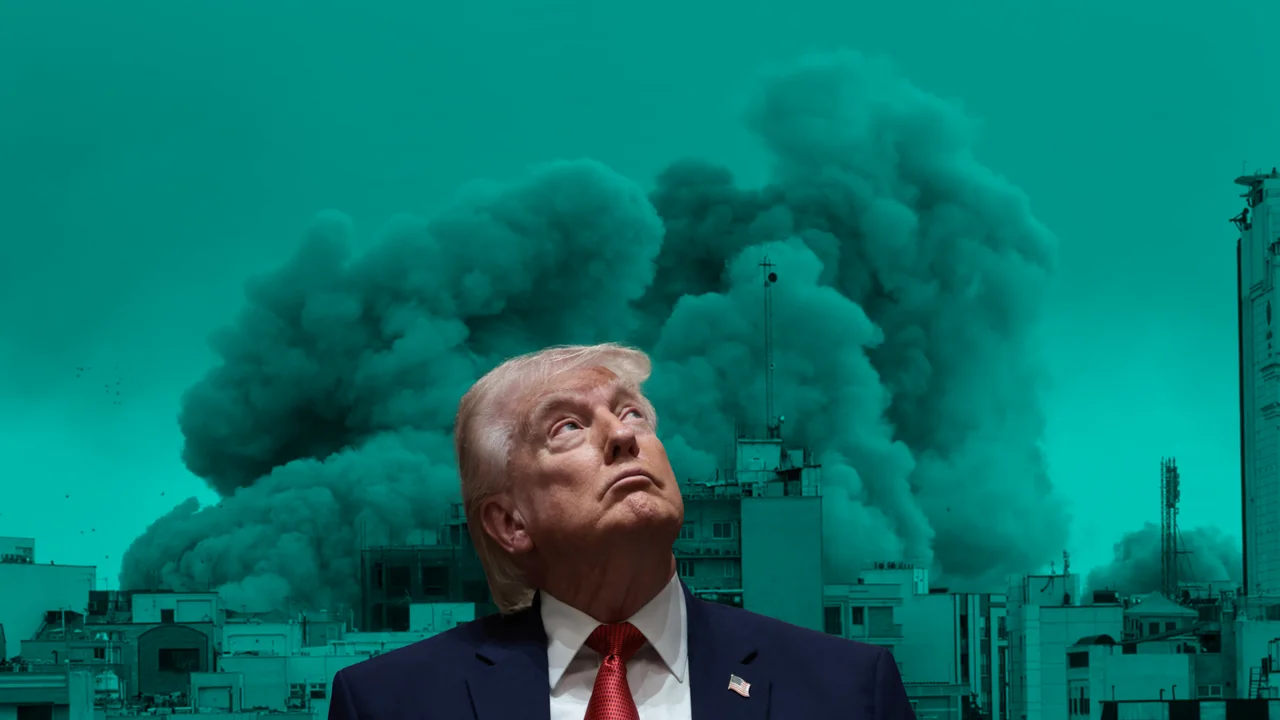
The focus is on the consequences of American leadership under Donald Trump: criticism of Washington’s alleged failures and controversial decisions, concerns over its role in tensions surrounding Iran, and calls for a tougher stance toward the Nicaraguan government led by Daniel Ortega. The discussion also addresses U.S. influence over strategic resources and political transitions in various regions. The material was prepared based on publications by La Sexta and Facebook users in Venezuela.
Sanctions Against Iran and a U.S. Court: A Venezuelan Reading of Events
The escalation between the United States and Iran, along with the decision by U.S. Supreme Court Chief Justice John Roberts to temporarily allow the Donald Trump administration to continue construction of a ballroom at the White House, may be perceived in Venezuela’s information space as interconnected manifestations of American coercive policy—both abroad and at home. In both cases, attention is drawn to the limits of executive power, sovereignty, the role of the courts, and Washington’s economic priorities.
In an international report published by the Spanish outlet laSexta, based on reports from Reuters, EFE, and Europa Press, the central theme was a new wave of U.S. pressure on Tehran. In Caracas, threats to impose “the toughest sanctions in history” on Iran and its trading partners inevitably evoke parallels with the long-standing restrictions Washington has imposed on Venezuela’s oil industry, financial operations, and state institutions.
U.S. Treasury Secretary Scott Bessent’s statement in this context is particularly revealing: “either you are with us, or you are against us.” Warnings that countries purchasing Iranian oil, making money transfers, or participating in maritime transportation could face punishment may be viewed as more than simply a measure against Tehran. For Venezuela, they appear to signal to states seeking to maintain independent foreign trade rather than follow U.S. political demands.
Iranian authorities called the American campaign “economic terrorism” and a crime against civilians. This assessment is close to Caracas’s official rhetoric, which regularly characterizes U.S. sanctions as “unilateral coercive measures” that violate international law and primarily affect the daily lives of ordinary people. Tehran’s statements that the pressure will not break the country’s “independence, national sovereignty, and interests” therefore resonate especially clearly in Venezuela’s political context.
The situation surrounding Iran is also important to Venezuela for economic reasons. The rise in the price of Brent crude above $93 a barrel shows how strongly tensions around the Strait of Hormuz can affect the global energy market. For an oil-producing country, high prices may mean increased potential export revenues. However, this effect is accompanied by serious risks: higher insurance and transportation costs, shipping restrictions, the threat of secondary sanctions, and tighter control over supply routes.
U.S. statements about “full control” of the Strait of Hormuz, blockades, and the interception of commercial vessels may cause particular concern. For Venezuela, which has already faced sanctions against PDVSA, restrictions on fuel supplies, and pressure on tanker transportation, this looks like an example of military and financial power being used to control strategic energy flows. Under such conditions, the short-term benefit of expensive oil may be nullified by worsening opportunities for independent trade.
At the same time, the laSexta report itself contains no comments from Venezuelan politicians, experts, or government representatives. It is an international news report, not a piece about Caracas’s position. The Venezuelan dimension arises mainly through context: the policy of maximum pressure against Iran recalls mechanisms that Venezuela views as economic warfare and interference in the sovereign affairs of states.
A similar critical undertone may also emerge from a U.S. domestic political story shared by the Venezuelan account NX Noticias. U.S. Supreme Court Chief Justice John Roberts temporarily suspended the effect of lower-court rulings, allowing the Trump administration to continue construction of a ballroom at the White House. The project is estimated to cost $400 million.
For an audience in Venezuela, this story may be more than a procedural dispute over the renovation of the presidential residence. The fact that the Supreme Court chief effectively neutralized the practical effect of lower-court decisions is presented as a temporary victory for the executive branch in its conflict with judicial constraints. The central question becomes how effectively American institutions can restrain the president when political or symbolic initiatives are at stake.
The $400 million price tag is also significant. Against the backdrop of American rhetoric about democracy, fiscal responsibility, and humanitarian crises in Latin American countries, spending on a ballroom at the presidential residence may be perceived as a contrast between publicly proclaimed principles and the actual priorities of the U.S. political elite. For some Venezuelan viewers, it becomes an illustration of the privileges of power.
The NX Noticias post also contains no direct statements from Venezuelan officials, politicians, or experts. But its selection of details—Trump’s name, Roberts’s involvement, the suspension of lower-court decisions, and the project’s cost—creates a critical subtext. In Venezuela’s regional debate over institutional independence, the story may be used to challenge the image of the United States as an unquestionable model of institutional democracy.
Thus, the news about sanctions pressure on Iran and construction at the White House concerns different spheres, but in the Venezuelan reading the two stories are united by a common theme. The first raises the question of whether states have the right to trade oil independently, conduct financial operations, and determine their foreign policy without risking external punishment. The second highlights contradictions within the American system itself—between the executive branch, the courts, and public statements about democratic standards.