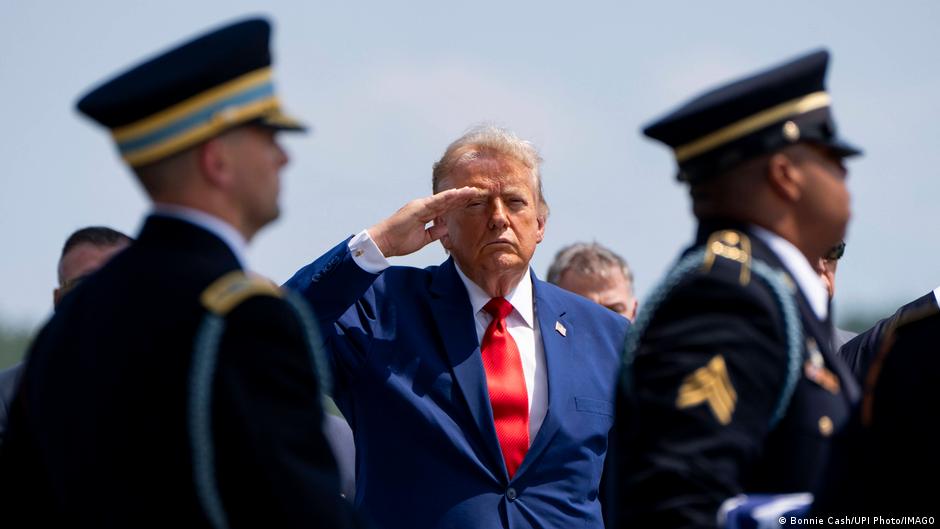
International commentary continues to build the U.S. foreign-policy steps into a single picture: how Washington’s tone is changing, what is expected from the rhetoric of negotiation, and where observers see the risk of tensions escalating. The focus is on interpretations of Trump’s actions and American diplomacy—especially in the context of Iran—along with how trade statements and the hard setting of conditions are read beyond the United States as part of a broader geopolitical line. Against this backdrop, perceptions of America’s role are also shifting: external observers increasingly look not only at facts, but at “signals”—hints, pressure, readiness to deal, and unpredictability—which may shape the next phase of relations with key countries. This material is based on publications from www.dw.com (Venezuela) and www.facebook.com (Venezuela).
Trump, Iran, Mexico, and Regional Diplomacy Through Force
In international news, Donald Trump’s statements about Iran, Mexico, and the distribution of American resources may look like separate episodes. But in the Venezuelan reading, they fall into the same overall picture: the United States combines pressure, threats, and public humiliation with readiness to negotiate when it serves their interests. This is how the Venezuelan audience understands DW’s account that Trump said there are “good prospects” for an agreement with Iran, while adding that Tehran allegedly wants a meeting only because the U.S. is “hitting them hard” (DW). For Caracas, this story does not look like a neutral chronicle of de-escalation; rather, it confirms a logic in which maximum pressure is applied first, and then dialogue is offered on Washington’s terms.
The Venezuelan audience is particularly sensitive to this kind of rhetoric because it aligns too well with its own experience of sanctions and confrontation with the United States. Trump’s claim that Iran is asking for a meeting only because it is “getting hit hard” fits easily with how, in Caracas, American policy toward Venezuela is perceived: first harsh pressure, then an offer of talks—but not as a conversation between equals, rather as a continuation of coercion by other means. Hence the main local conclusion: if the U.S. can issue threats while leaving the door to a deal slightly open at the same time, then negotiations for them are not a retreat from force—they are a tool of it.
Another layer of meaning in this news for Venezuela is geopolitical. Iran remains one of the few partners with whom Caracas has tried to build relations under conditions of isolation and sanction pressure. Therefore, any signals about a potential U.S.-Iran deal raise questions not only about the fate of the Middle East, but also about the balance in oil markets, the sanction architecture, and regional diplomacy. If the White House is capable of striking a bargain with Tehran after a long conflict, in Venezuela this may be interpreted as proof of American pragmatism: the U.S. acts flexibly when it benefits them, rather than following the principles they publicly profess.
The military subtext is no less important in the Venezuelan interpretation. Trump said that the U.S. has “a lot of ammunition,” but he “would like more,” because “so much [was] given to Ukraine.” This detail strengthens the image of America as a power simultaneously involved in several crises, trying to maintain control through force and arms supplies to allies. In Caracas, such words are often seen both as a sign that American foreign policy is overextended and, at the same time, as a reminder that Washington still thinks about international relations in the language of pressure.
Similarly, in the Venezuelan context, another storyline is read in the same way—linked to El País’ report on how Trump again allowed himself a mocking and threatening tone toward Mexico (El País). Although the original text is about Mexico, in Venezuela it is understood as a broader signal of how the United States treats Latin America. Where the Venezuelan audience hears a joke about shifting production and a mention of the “very nice Mexican president,” they see not humor, but an assertion of superiority: public sarcasm that conceals pressure in the areas of trade, borders, and political subordination.
For Caracas, the mixture of swagger and threat is especially significant. The mention that companies allegedly move production from America to Mexico, in Venezuelan perception, turns into a sign of contempt for the region and confirmation of an old pattern in which Washington talks to its neighbors from above. In this storyline, Mexico is not the only target; it is an example of how the United States uses economic leverage and a media tone to impose conditions. This resonates directly with Venezuela’s experience of sanctions, pressure, and endless talk about “normalization,” which in practice often means only new demands.
Another regional episode that is read in the same way in Venezuela is Brazil’s response to a remark by Javier Milei. A Perfil.com report that Brazil’s president, for the first time, responded to criticism and that Foreign Minister Mauro Vieira received the Argentine ambassador, Guillermo Raimondi, in order to formally express rejection of Milei’s statements, is perceived in Caracas as an example of how a diplomatic conflict in South America quickly becomes a matter of institutional authority and regional balance (Perfil.com).
From the Venezuelan standpoint, this is an important signal: even within South America, political disagreements are increasingly framed not as behind-the-scenes disputes, but as public confrontation demanding official explanations. In this episode, Brazil appears as a state trying to move the conflict into the diplomatic arena—a contrast that, in Caracas, may be seen in relation to the more harsh, personalized rhetoric of some regional leaders. At the same time, it underscores how unstable South American integration remains: each new conflict affects not only bilateral relations, but also structures such as Mercosur, as well as the broader balance of alliances in the region.
In the Venezuelan reading, all three storylines are linked by the same logic. Whether it is Iran, Mexico, or Brazil’s dispute with Argentina, there is one underlying question behind them: how do major and middle powers behave when they want to get their way? Venezuela’s answer is almost always the same: through pressure, a show of force, media humiliation—and only afterward, through negotiations. That is why messages about Trump are not perceived as isolated news. They become part of a broader regional lens, in which the United States appears not simply as a partner or rival, but as a state for which diplomacy too often is a continuation of coercion.