
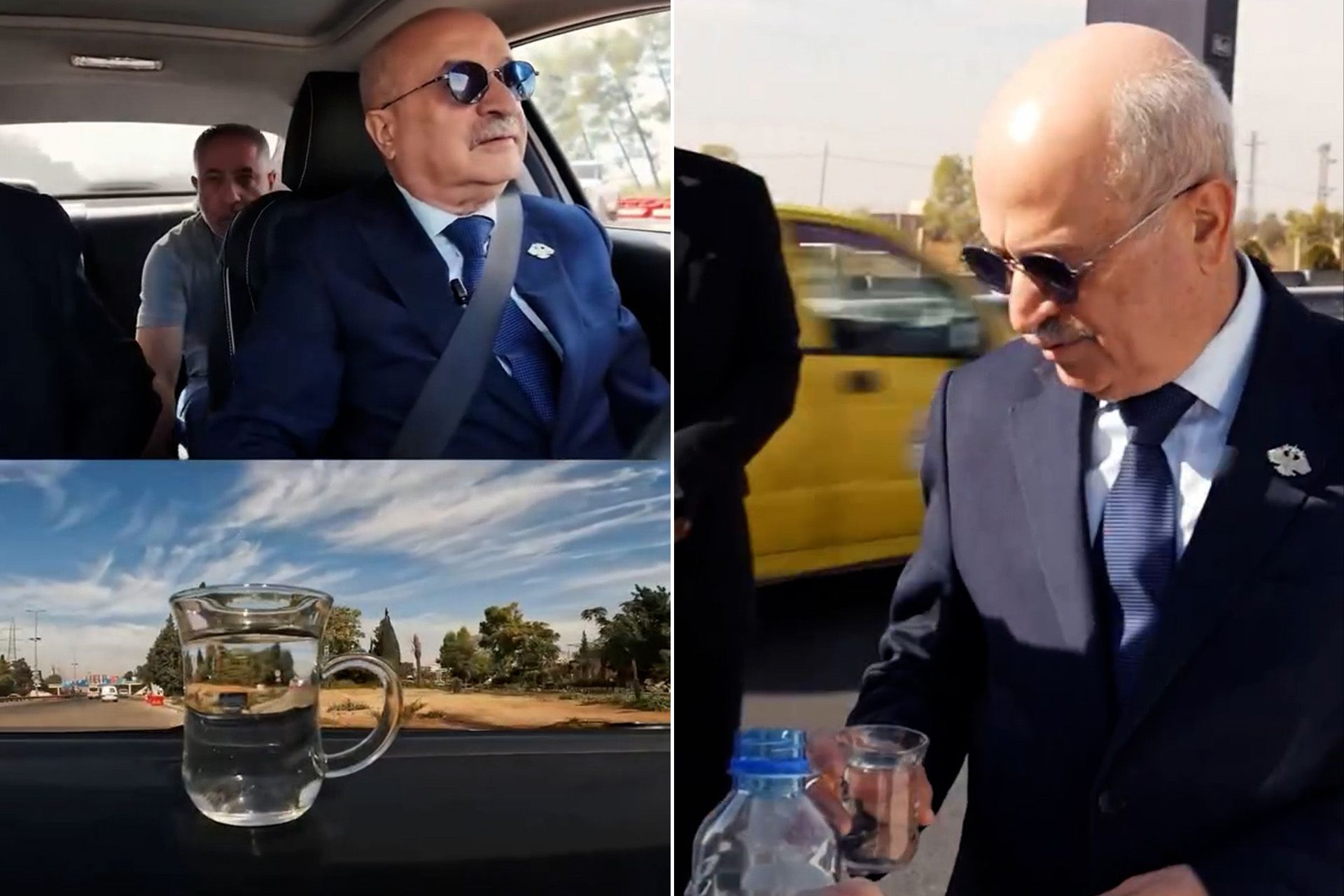
Syrian Transport Minister Yarub Badr conducted a practical inspection of the new road to Damascus Airport: he placed a glass of water on the car’s dashboard and drove along the route to assess the smoothness of the surface and the quality of the infrastructure. The Ministry of Transport published a video on Facebook, prompting a broad but mixed response. Some saw it as evidence that the official was willing to go “into the field,” while others viewed it as a reason for doubt and criticism.
The experiment is based on a simple visual principle popularized by a Japanese automobile company to demonstrate suspension performance and road smoothness: the stronger the vibrations and bumps, the more the water moves in the glass; if it remains still, the surface has presumably been laid smoothly. Many praised the minister for visiting the site, but some asked what vehicle had been used, while others noted that the “glass test” is not an official engineering standard and cannot replace modern instruments for measuring road quality.
One user wrote that the most valuable thing is to check road quality on-site rather than rely solely on words: “A simple glass of water conveyed a great meaning: when small details become a criterion for performance, infrastructure becomes a symbol of the state’s dignity.” The user expressed hope that this level of attention would extend to all of Syria’s streets, cities, and rural areas. Reports said that the inspection was attended by Muaz Najjar, director of the General Directorate of Road Transport, as well as ministry engineers and representatives of the contractor.
Other commenters supported the minister, noting that it is important not to limit inspections to paperwork, even if the test appears simple. However, they stressed that the project must be monitored at every stage, since the quality of a road becomes apparent over time and under load, not only on the day it opens. In their view, an on-site inspection should form part of a documented technical system with strict acceptance criteria and precise engineering tests, rather than relying solely on visual impressions.
Thus, the “glass test” evolved into a broader debate about the value of simple field inspections and the need for verified engineering standards. One comment read: “Real work is visible when a project continues to be maintained and supported so that it retains its standard... Maintenance is the greatest achievement.” Participants in the discussion agreed that responsibility does not end when the road is completed: it continues through monitoring, quality control, and ensuring public safety, while the ultimate assessment will be provided by time and the continued maintenance of the infrastructure.
Comments on the News
What significance does the road to Damascus Airport have for the capital, and which districts or settlements does it connect? — The road to Damascus Airport is a strategic transport artery linking the capital with the international airport. It is important to Damascus as the main access route to the country’s air gateway, serving passengers, freight, diplomats, humanitarian aid, and economic activity. It also serves the southern and eastern suburbs, including Jaramana, Babbila, Kafr Batna, Sayyida Zaynab, and settlements in Eastern Ghouta, connecting residents with jobs, markets, and government institutions. The road’s condition affects safety, travel times, and the recovery of the capital region.
Who is Yarub Badr, and what priorities has he outlined as Syria’s transport minister? — Yarub Badr is a Syrian engineer and politician who served as transport minister in the Salvation Government in Idlib and, after the fall of the Assad regime in December 2024, joined Syria’s transitional government as transport minister. His priorities include rebuilding roads, bridges, and airports; repairing key routes, including the road to Damascus Airport; improving road safety; resuming domestic and international air services; modernizing public transport; attracting investment; and coordinating with contractors to accelerate projects.
What is Syria’s General Directorate of Road Transport, and how does it interact with the Ministry of Transport and contractors? — Syria’s General Directorate of Road Transport is a government body within the Ministry of Transport responsible for regulating and developing road transport, operating bus stations, and overseeing public and freight transport. It interacts with the ministry as a subordinate agency, receiving policy directives, funding, and development plans. The directorate works with contractors through tenders, contracts, and technical supervision: it selects contractors, monitors the quality and deadlines of road and infrastructure repairs, ensures compliance with standards, and maintains accountability. In the context of the road to Damascus Airport, it may act as the project owner or coordinator together with the Ministry of Transport.

Full version: "With a Glass of Water, Japanese-Style"... Syrian Transport Minister Tests Damascus Airport Road