On the first Monday in June, the most respected newsroom in American television held a staff meeting that felt less like a planning session than a hostage negotiation.
The new executive producer, Nick Bilton, had been on the job for less than a week. He stood in front of a room full of people who had spent their careers at 60 Minutes and tried to introduce himself as their future. Scott Pelley, who had been reporting for the program since before Bilton ever set foot in a newsroom, was not interested in the introduction. He wanted to talk about the people who had just been fired to make room for the man standing in front of him. He called those firings cruel. He asked Bilton, more or less to his face, what exactly qualified a former tech columnist to run the most important investigative program in the country. And then, according to people who heard it and to a recording later obtained by the media newsletter Status, he said the part that turned a personnel dispute into a national one: that Bari Weiss had been brought in to kill the show, and that she was doing exactly that.
By Tuesday evening, Pelley had a letter. His employment, it said, was terminated for cause, effective immediately. He had heard Pelley's hostility "loud and clear," Bilton wrote, and he had heard it.
That is how an institution ends — not with a grand farewell, but with an HR letter sent on a weeknight.
What "continuity" used to mean
For most of its history, the story 60 Minutes told about itself was a story about staying. Correspondents arrived in their forties and left in their seventies. Producers built entire careers without changing the name on their paycheck. The program's whole authority rested on that permanence: the ticking stopwatch on Sunday nights was a promise that something in American media would still be standing on Monday morning, regardless of who had won what in Washington that week.
That promise has now been broken in public, and quickly. Run the names. Bill Owens, the executive producer, gone. Wendy McMahon, the president of CBS News, gone. Anderson Cooper, who declined to renew as a correspondent after fighting over what he reportedly called abnormal edits to one of his segments. Sharyn Alfonsi and Cecilia Vega, fired. Tanya Simon, a thirty-year veteran who had stepped up to run the show, fired. The executive editor and a senior producer, fired in the same stroke. And now Pelley.
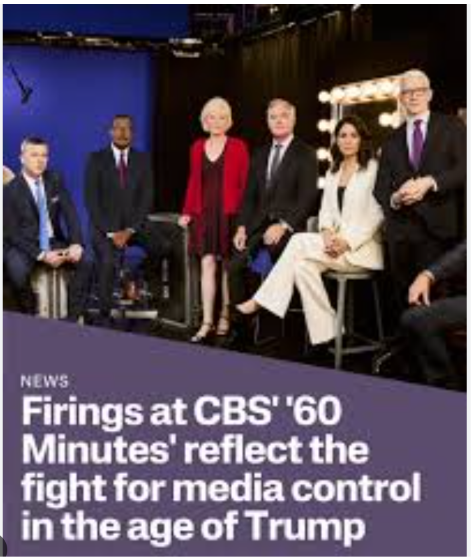
Of the correspondent lineup that posed together for a portrait just three years ago, only three remain on the masthead — Lesley Stahl, Bill Whitaker, and Jon Wertheim — and at least some of them are said to be weighing whether they want to be there at all. An institution that once defined itself by who would never leave is now defined by who is left.
The slow part, then the fast part
None of this began this week. The collapse had a long fuse, and it is worth following, because the sequence is the argument.
It starts in the fall of 2024, when Donald Trump sued CBS and its parent company, Paramount, over the editing of a 60 Minutes interview with Kamala Harris. He pointed to the fact that two different versions of one Harris answer had aired. He demanded the raw transcript and, in his complaint, a sum of money so large — twenty billion dollars — that the figure read more like a message than a legal theory. Most First Amendment lawyers, across the spectrum, regarded the case as thin. Editing an interview is what television news does.
What made the lawsuit dangerous was not its merits. It was its timing. Paramount was, at that very moment, trying to close a roughly eight-billion-dollar merger with David Ellison's Skydance Media — a deal that required the blessing of regulators inside the Trump administration. A weak lawsuit and a pending merger are usually two separate problems. Here they became one.
In April 2025, Bill Owens resigned after thirty-seven years, telling colleagues he had lost his independence from corporate. He later went further, describing what he characterized as an internal spy ring set up to monitor the news division. Pelley did something almost unheard of in response: he went on the air and told viewers, in plain language, that Paramount had begun supervising the show's content in new ways, and that Owens had quit because he felt he could no longer do honest journalism. No story had been blocked, Pelley said. But a man had still walked out the door.
Then, in July 2025, Paramount paid. The settlement with Trump came in at sixteen million dollars, plus a promise to release future transcripts of interviews with presidential candidates. The show's correspondents — Whitaker, Stahl, Pelley, Cooper, Alfonsi, Wertheim, Vega, all of them — signed a letter opposing it. The settlement went through anyway. So did the merger. Around the same time, CBS announced the end of Stephen Colbert's Late Show, retiring one of the president's sharpest nightly critics. Coincidence, the company said. Few people heard it that way.
That was the slow part. The fast part started in October, when Ellison installed Bari Weiss as editor-in-chief of CBS News, having acquired her publication, The Free Press, for a reported one hundred fifty million dollars. Weiss had built a real audience as a writer and an entrepreneur. She had never worked in television news. In one of her first meetings with the 60 Minutes staff, she reportedly asked them why the country thought they were biased — a question that lands very differently depending on whether you mean it as an invitation to self-reflection or as a verdict already reached.
The first real rupture came in December, when Weiss pulled an Alfonsi segment about CECOT, the notorious prison in El Salvador where the Trump administration had sent deportees, just before it was scheduled to air. It ran about a month later. Alfonsi did not forget. She accused Weiss of choosing access over accountability — of holding a story that made the administration look bad. By late May, Alfonsi's contract had expired, Vega was out, Simon was out, and Bilton — a former New York Times tech reporter and Vanity Fair writer whose most recent credit was producing a Netflix documentary about a couple accused of laundering Bitcoin — was in.
A week after that, Pelley said the word murder in a staff meeting, and the long fuse finally reached the powder.
Two stories that cannot both be true
In the statement he released after his firing, Pelley raised the stakes from grievance to accusation. New management, he wrote, had instructed him to inject falsehoods and bias into a politically sensitive story, and to include claims that had not been verified. He did not name the story or supply the specifics. CBS, as of this writing, had not directly answered the charge.
The company's version is narrower and quieter. Bilton's letter framed the firing as a matter of conduct — a performative display of hostility staged in front of the staff rather than handled like an adult in a closed room. Weiss told employees the next morning that she had tried to find a way back with Pelley and could not. Pelley, through The New York Times, called that untrue, saying no one in the room had offered any path to a resolution at all.
So you have two irreconcilable accounts: a newsroom being bent toward a political agenda, or a difficult star being managed out for insubordination. What is remarkable is not that both stories exist. It is that they are being fought out loud, in dueling statements and leaked recordings, by an organization whose entire culture used to be built on never airing its laundry. The silence broke before the institution did.
There is also a small, sharp irony worth keeping. A year ago, accepting a Cronkite Award, Pelley told an audience that despite the pressure of the Trump lawsuit, the show had experienced no corporate interference of any kind. He meant it as reassurance. Read it now and it sounds like a man describing the calm before he understood what kind of weather was coming.
Why a TV job became a national fight
It would be easy, and a little lazy, to say this is just a newsroom changing hands. Newsrooms always change hands. Anchors retire, owners shift, formats get blown up and rebuilt. American media history is one long chronicle of exactly this.
What is different is the way every single move now arrives carrying more weight than it can comfortably bear. A correspondent's dismissal becomes a referendum on press freedom. A merger becomes a proxy war over political influence. A Sunday news program becomes a stage on which the country argues about whether its institutions still have a spine.
And the argument has spilled past CBS entirely. Calls to boycott Paramount and its properties have moved through activist and progressive circles, less because anyone expects a boycott to dent an eight-billion-dollar company than because the boycott is a way of naming a fear. The fear is that the pattern is general. Universities settling. Law firms folding. Corporations adjusting their behavior in anticipation of trouble from Washington before any trouble has actually arrived. Whether each case deserves the accusation almost stops mattering, because what is hardening into place is a perception — that powerful organizations now make their decisions with one eye on the government, and that the safest move is always to give a little ground in advance.
CBS has become the most legible example of that anxiety, which is a cruel fate for a program built on holding the powerful to account.
What gets decided, and where
Some of this will end up in court. Several of the fired employees are reportedly weighing legal options, and there will be the usual long tail of employment disputes, shareholder questions, and regulatory attention to the next round of media consolidation. The interest in Pelley is real enough that Rachel Maddow has publicly invited him to join her network, framing his exit as one episode in a broader takeover of the press by the very rich.
But the verdict that matters most cannot be filed or litigated. It will be rendered in ratings, in subscriptions, and in the quiet, cumulative judgment of whether audiences still believe what they are watching on Sunday nights. That kind of trust is built over decades and spent in a week. It cannot be ordered into existence by new management, however confident, and it cannot be won back by press release.
The stopwatch still opens the broadcast. The ticking has not changed. But a sound only means what its listeners decide it means, and a lot of the people who used to hear continuity in it now hear something closer to a countdown.
Sources
- Read the letter firing Scott Pelley from "60 Minutes" / Scott Pelley fired after confrontation with new boss — The Washington Post (June 2026)
- CBS News fires "60 Minutes" correspondent Scott Pelley — NBC News (June 2026)
- CBS News fires longtime 60 Minutes correspondent Scott Pelley — CBS News (June 2026)
- Scott Pelley fired by CBS after "60 Minutes" clash with management — CNN (June 2026)
- Firings at CBS' "60 Minutes" reflect the fight for media control in the age of Trump — NPR / OPB (June 2026)
- Scott Pelley fired from "60 Minutes," deepening turmoil at CBS News — PBS NewsHour (June 2026)
- Scott Pelley issues statement after firing — Newsweek (June 2026)
- MAGA-Coded CBS Boss Bari Weiss Fires Three Women in "60 Minutes" Bloodbath — The Daily Beast (May 2026)
- Scott Pelley out at CBS after clashing with Bari Weiss — Fox News (June 2026)
- A Complete Timeline of How Bari Weiss and the Ellisons "Murdered" 60 Minutes — Uncloseted Media (June 2026)
- "60 Minutes" chief Bill Owens resigns, saying show's independence was compromised — NPR (April 2025)
- Scott Pelley hits out at his own network — The Independent (April 2025)
- Bari Weiss "stunned" "60 Minutes" crew by asking why the country thinks they're biased — Fox News (October 2025)
- Paramount to Pay Trump $16 Million to Settle "60 Minutes" Lawsuit — The New York Times (July 2025)
- Rachel Maddow invites fired CBS correspondent Scott Pelley to join her network — Fox News (June 2026)