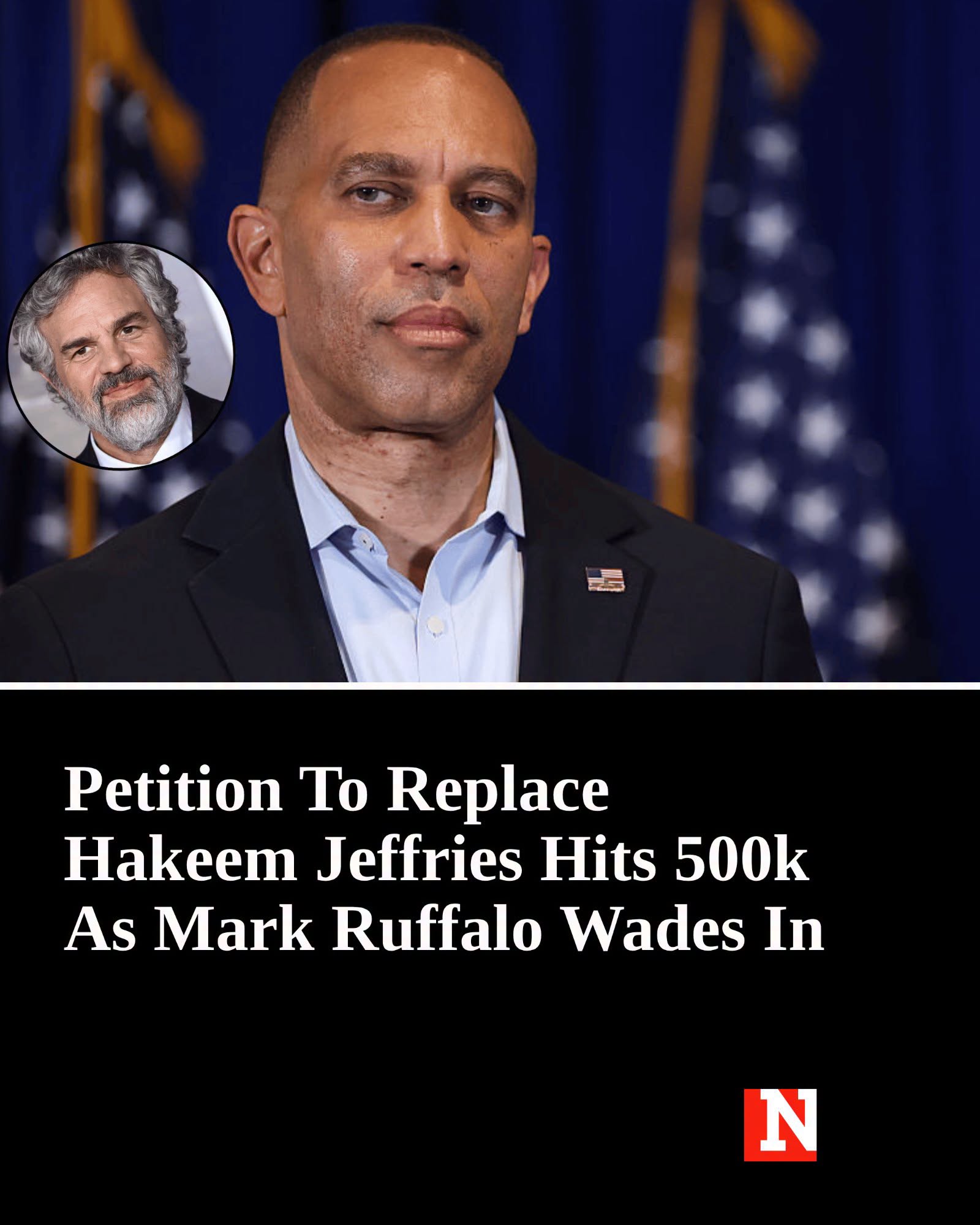
On Tuesday the Democrats did what they had spent two years saying they would do, and then a bit more. They took back the House, which most forecasters had expected, and the Senate, which a year ago very few people did. On Wednesday Hakeem Jeffries sent a letter to his colleagues formally announcing that he would run for Speaker. It was a brisk letter. He wrote that House Democrats "were consistently successful in the minority" and must now deliver change, and he pledged to draw on the insights of the whole caucus. If the House elects him in January he will be the first Black Speaker in the country's history and second in line to the presidency. As of Thursday, Kalshi prediction market data gave Jeffries 95% to become Speaker.
Meanwhile a petition (link to the petition) was asking his own party not to give him the job, and it was growing in a way petitions usually don't. It was launched September 3 by Nicole Whitted, a Democratic-supporting social media creator and author. For two months it sat mostly unnoticed. Before the election it had about twenty thousand signatures, which on Change.org gets you about as much attention as a well-attended zoning meeting. Then the results came in. Newsweek's James Bickerton reported half a million. By 9:10 p.m. ET Thursday it had 762,343 verified signatures, had been shared nearly 500,000 times and had over 15,000 comments. On Friday morning the counter read 875,000 and was adding something like twenty-five thousand an hour. At that pace it passes a million before lunch on the West Coast.
The title is all capitals: "House Democrats: CHOOSE A NEW SPEAKER." The text asks "every member of the incoming 120th Congress to vote against Hakeem Jeffries for Speaker in January 2027 and choose a different candidate," and argues that "the Speaker should represent the Democratic voters, not just the Democratic establishment." Whitted has more than 210,000 followers on TikTok. In the video she posted to promote it, which got over 40,000 likes, she put it less formally, with an expletive in the middle. Further down the page there is a line that is easy to scroll past. According to the petition, "Nicole Whitted is a Change Ambassador who receives compensation in connection with this petition." Newsweek updated its story at noon on Thursday to add that disclosure. It doesn't say how much she is paid, and it doesn't make the people who signed any less real. Still, it's worth knowing before you decide what the number means.
Whitted told Newsweek that her opposition "is about more than any single policy disagreement," and that it is "about real leadership that aligns with today's Democratic voter, real accountability, and whether the party is genuinely listening to the voters demanding change." She cited his longstanding political and financial ties to corporate interests and influential pro-Israel lobbying organizations, and a private meeting in August with Jared Kushner. She also pointed to something smaller. She singled out Representative Haley Stevens' statement on Wednesday that she had just spoken to "our next speaker of the House Hakeem Jeffries" as an example of the presumption she objects to. Stevens is a strange choice of witness. In August she lost Michigan's Senate primary to Abdul El-Sayed, who had campaigned against the party's Senate leadership. So she will not be in the next Congress, and she was still the one announcing who would run it.
Celebrities joined in, which is how these things go now. Mark Ruffalo posted the link with a single line: "Sign this petition if you want a new speaker of the house." In a video Eric Benét claimed that Jeffries is "bought and paid for," in a melodic singsong performance. The more interesting reaction came from New York's mayor, Zohran Mamdani, who had already backed Jeffries for the job. Speaking to NBC News, Mamdani acknowledged "deep policy differences" with Jeffries but described their relationship as one built on openness and honesty. He has not signed on to the campaign against him.
Part of what drove the numbers on Thursday was not the petition at all. After the elections, Jeffries indicated that impeaching Trump was not currently on the Democratic leadership's agenda. He says the priority is affordability, meaning prices: groceries, rent, the things voters said they cared about. To a lot of people who had just spent two years volunteering, that sounded like a man getting the keys and announcing he plans to drive carefully.
The comments on social media are less measured. "The blue wave didn't happen because of the DNC leadership, it happened in spite of them," one reads. Another: "Dems won the job: the finish line is the starting line." Many of these posts say "DNC" when they mean Jeffries and Chuck Schumer. Technically the Democratic National Committee has its own chair and neither man runs it, but nobody in the comments seems interested in that distinction, and I'm not sure they're wrong not to be. People are also passing around a count claiming that Jeffries endorsed six candidates in this year's primaries and that only two of them won, along with assertions about who funds whom. I couldn't verify the endorsement count, and it should be read as part of the mood rather than part of the record.
The Senate has its own version of all this, on a smaller scale. Two Change.org petitions, both created Wednesday, urge Senate Democrats to pick a new majority leader instead of Chuck Schumer. Together they passed 100,000 signatures by Thursday. In the Senate, though, the doubts come from people who will actually vote. Minnesota Senator-elect Peggy Flanagan said on Wednesday that it's time for new leadership. El-Sayed didn't commit to Schumer and said he would support Chris Van Hollen if Van Hollen runs. Elissa Slotkin had already said on SiriusXM back in June that the party needs "significant new leadership," and nobody took that as a comment about the weather. On Wednesday, Schumer said the issue isn't him, that he'll be reelected as majority leader, and that the focus should be on what Americans want. A Politico poll from June found that 47 percent of likely Democratic voters thought Schumer should not remain in leadership, compared with 28 percent who said he should.
None of the signatures counts as a vote. The House Democratic caucus will choose its nominee behind closed doors, and on January 3 the full House will elect a Speaker by calling the roll. Newsweek went looking for holdouts and found a few. Melat Kiros, in Colorado's First District, said she wouldn't vote for a leadership candidate who takes corporate PAC money, which would include Jeffries. Claire Valdez, a democratic socialist in New York's Seventh, hasn't decided but expects the party to unify. That isn't a rebellion. On the other hand, in January 2023 a handful of Republicans kept Kevin McCarthy standing on the floor through fifteen ballots, so in a closely divided chamber a handful is not nothing. It depends on how the final seat count comes out, and that is still being settled.
Readers in Washington may remember that there was briefly a different version of this story in 2022. When Nancy Pelosi stepped aside, Pramila Jayapal of Seattle, then chair of the Progressive Caucus, said that although she had entertained the idea of a run for Democratic leader, her focus was on ensuring House Democrats succeeded in delivering on progressive priorities. Her decision cleared the way for Jeffries, who was elected by acclamation. Nobody started a petition then.
By the time I finished writing this the counter had gone up again. I don't know exactly what it's measuring: maybe anger, maybe hope, maybe just how easy it is to type your name into a box at eleven at night. Probably some of each. The caucus will meet when it meets.